The Jakarta Post
Please Update your browser
Your browser is out of date, and may not be compatible with our website. A list of the most popular web browsers can be found below.
Just click on the icons to get to the download page.


Popular Reads
Top Results
No results found. Please check your search term and try again
Can't find what you're looking for?
View all search results
Popular Reads
Top Results
No results found. Please check your search term and try again
Can't find what you're looking for?
View all search resultsFrom potential to takeoff: How ASEAN can seize global SAF market
As global mandates tighten, ASEAN has a prime opportunity to leverage its massive agricultural wealth and become the definitive global hub for the future of sustainable aviation.
Change text size
Gift Premium Articles
to Anyone
Share the best of The Jakarta Post with friends, family, or colleagues. As a subscriber, you can gift 3 to 5 articles each month that anyone can read—no subscription needed!
 Set as preferred source
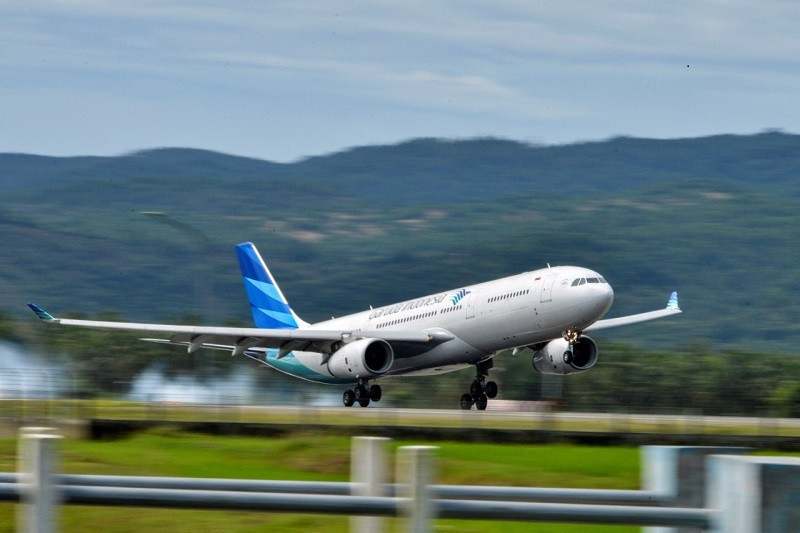 Touching down: A Garuda Indonesia Airbus A330 lands at Sultan Iskandar Muda International Airport on July 13, 2021, in Blang Bintang, Aceh. (AFP/Chaideer Mahyuddin)
A
s global aviation faces mounting pressure to cut emissions, ASEAN has a critical window of opportunity to position itself at the forefront of a cleaner aviation future.
Aviation remains one of the most challenging sectors to decarbonize, accounting for 2.5 percent of global energy-related carbon dioxide emissions in 2023, with that figure projected to grow rapidly. Unlike power generation and most other transport sectors, aviation remains heavily dependent on liquid fuels because of current battery limitations.
With air traffic in Southeast Asia continuing to surge and emission policies tightening globally, sustainable aviation fuel (SAF) offers the most scalable near-term tool to reduce emissions while improving regional energy security.
Backed by abundant regional resources, ASEAN is uniquely positioned to become an international SAF hub - delivering significant economic and climate benefits. However, capturing this market will depend on how quickly member states can turn regional potential into a credible, scalable and internationally recognized supply chain.
The growing urgency around SAF is closely tied to global mandates aimed at mitigating aviation’s climate impact. Under the International Civil Aviation Organization’s (ICAO) Carbon Offsetting and Reduction Scheme for International Aviation (CORSIA), countries have agreed to systematically reduce emissions from international flights. Starting in 2027, these rules will apply more broadly across international routes, making compliance a necessity for regional carriers.
In response, several ASEAN countries are accelerating national measures to integrate SAF into commercial fuel blends. Regional demand for SAF is projected to skyrocket from 15,000 barrels per day in 2030 to over 700,000 barrels per day by 2050, with Indonesia, Malaysia and Singapore driving the bulk of this consumption.

This shifting demand is reflected in aggressive new national policies. As the region’s primary air hub, Singapore will require departing flights to use a 1 percent SAF blend starting this year, scaling up to 3-5 percent by 2030. Indonesia is targeting an initial 1 percent blend in 2027, with a long-term goal of achieving a 50 percent blend by 2060.