The Jakarta Post
Please Update your browser
Your browser is out of date, and may not be compatible with our website. A list of the most popular web browsers can be found below.
Just click on the icons to get to the download page.


Popular Reads
Top Results
No results found. Please check your search term and try again
Can't find what you're looking for?
View all search results
Popular Reads
Top Results
No results found. Please check your search term and try again
Can't find what you're looking for?
View all search resultsOut-of-school children need pathways, not just seats
The government needs to approach flexible education with a view to accommodating the unique circumstances of each child through varying options, so that learning is made both relevant and meaningful for children whose real-life needs cannot be met by traditional schooling.
Change text size
Gift Premium Articles
to Anyone
Share the best of The Jakarta Post with friends, family, or colleagues. As a subscriber, you can gift 3 to 5 articles each month that anyone can read—no subscription needed!
 Set as preferred source
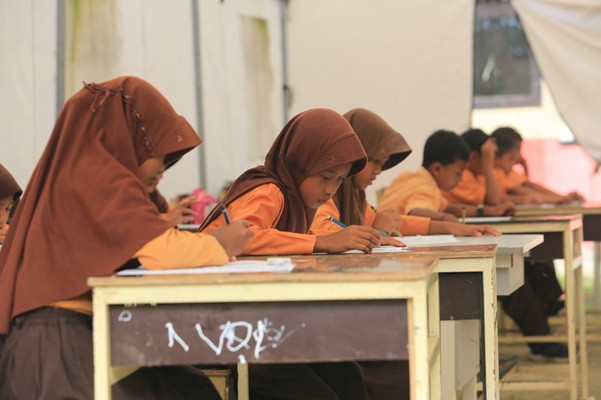 Students take an exam inside a portable structure on June 5, 2026, due to a shortage of classrooms at SDN Alue Lhok elementary school in Jambak village, Pante Ceureumen district, West Aceh. (Antara/Syifa Yulinnas)
I
n Pangkep, a coastal regency in South Sulawesi, some children spend many days at sea with their fisherfolk parents. The school registry has little room for complexity, so they are simply marked absent. After a period of sufficient absences, a child may be considered at risk and be counted among children who are out of school.
The issue of Indonesia’s out-of-school children is not only about school buildings, fees or distance. For many children, formal schooling is simply too rigid in terms of how their families survive.
Now the country has a policy framework in Presidential Regulation (Perpres) No. 3/2026 on the prevention and handling of out-of-school children. It establishes an initial target of getting 645,000 children back into schools and further aims toward zero children out of school by 2045.
Open schooling, distance learning, equivalency programs and community-based inclusive education are among the solutions that the Elementary and Secondary Education Ministry is pushing for.
This is a positive step, but if the aim is to increase enrollment, it misses the point. More than seats, children need pathways that make learning possible again.
Not all out-of-school children fit into one category. Some have never attended classes before, some left school midway and others finished only one level without advancing further.

As UNICEF illustrated, it is clear that the Indonesian issue is very much confined to junior and senior high school-age adolescents. This is when schooling becomes extremely expensive for low-income families: financially, temporally and labor-wise. A teenager may be expected to support themself, look after their younger siblings, relocate with their parents or do whatever else it takes to support the family.