




Enjoy This Gifted Article!
You're reading this thanks to a The Jakarta Post subscriber.
Access is available for 30 days. For unlimited access, consider subscribing.
Please Update your browser
Your browser is out of date, and may not be compatible with our website. A list of the most popular web browsers can be found below.
Just click on the icons to get to the download page.

Can't find what you're looking for?
View all search resultsCan't find what you're looking for?
View all search resultsThe linguistic and social evolution of bahasa binan, particularly its entry into Indonesian popular culture, ironically highlights the continuing stigmatization and discrimination of the queer community from where it originated.
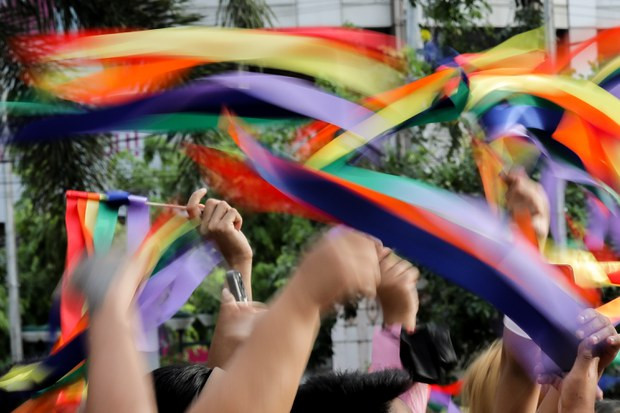 Equal rights supporters wave rainbow flags at a rally on June 2, 2023, as they mark Pride Month in Quezon City, the Philippines. (BenarNews/Basilio Sepe)
f you understand Indonesian and read these two short sentences, you’d recognize some of the words: Sitrim ya. Tapi akika tinta bisikan di jam itu.
Tapi means “but” and di jam itu means “at that hour”, but the rest? Is it some sort of hybrid language?
Yes and no. It’s bahasa binan, or queer language, a slang developed in the LGBTIQ+ community that is used by gay men and transgender women, or waria, a portmanteau of wanita (woman) and pria (man).
The above sentences mean, “Thank you, but I can’t make it at that time”. This was the response from Dédé Oetomo, the doyen of LGBTIQ+ activism and studies, to Dina when she asked him when they could meet up. In bahasa binan, the word tinta (ink) means “not” and bisikan (whisper) means “can”, so tinta bisikan means “cannot”.
Bahasa binan comes in various linguistic registers, that is, it is adapted for a particular situation, purpose or social setting, varying in vocabulary, grammar, tone and categorized into a spectrum from formal to informal. If a dialect reflects who you are based on geography or social group, a language register reflects what you are doing.
Sounds complicated, but actually, we all do this without realizing it. Most languages have five registers: formal, consultative, casual, intimate and frozen, the latter related to historical material.

Like all slang, bahasa binan serves to create a sense of belonging, builds in-group identity, fosters intimacy, allows for creative self-expression, provides an outlet for humor and even serves to challenge established linguistic norms.
Bahasa binan has another function: self-protection. It allows gay men and waria to communicate without being readily understood by outsiders while signaling membership within a shared community.
Those who share the same identity can recognize and interpret the language with ease, creating a sense of safety, trust and solidarity among speakers. At the same time, its use reflects an ongoing awareness of potential threats, reminding speakers that discretion remains necessary in environments where they may face stigma or discrimination.
For example, in a crowded night market someone might suddenly shout, “adinda polesong” (“there are police officers”), alerting those who understand. The term polesong is particularly significant within the waria community, as they have historically been frequent targets of police raids and public order operations.
Bahasa binan was not created by any single individual; instead, it emerged organically. Usage of the language began between the 1960s and the 1980s and continues to evolve to this day. It is formed through a process of hybridization, wordplay and the insertion of affixes into Indonesian, regional or foreign languages.
In 1989 in issue No. 9, GAYa Nusantara magazine began compiling a glossary of gay language, documenting not only the meanings of individual words but also the different word formation patterns found across regions. The lingo varies from community to community, with local versions based on ethnic languages such as Banjarese, Riau Malay, Makassarese and Javanese.
In other cities, particularly Jakarta and Bandung, West Java, the GAYa Nusantara glossary describes a morphological process in which the infix “-in-” is inserted into a word, producing a longer form that may subsequently be shortened in everyday use. Some examples are: bule (white foreigner, especially of European descent), which becomes binuline and is then shortened to binul, and lesbi (lesbian), which becomes linesbini and then lines.
Across much of Java and several regions outside Java, another productive pattern involves altering the final syllable so that the word ends in “-ong”. Some examples are: banci becomes bencong, homo (homosexual) becomes hemong, laki-laki (man, male) becomes lekong, polisi (police) becomes polesong, sama-sama (you're welcome) becomes semong-semong.
At one point, bahasa binan became highly visible after entering mainstream popular culture. Its popularity was propelled largely through film, beginning with the character Emon in Catatan Si Boy 2 (Boy’s diary 2, 1988), who popularized many expressions associated with bahasa binan.
Similarly, in Lenong Rumpi (RCTI, 1991), bahasa binan was used not only by overtly feminine male artists such as Ade “Juwita” and Tata Dado, who played Marlena, but also by other cast members including Debby Sahertian, Harry de Fretes, alias Bo’im, and Robby Tumewu.
The speaking styles popularized by Emon and the actors of Lenong Rumpi were subsequently replicated across Indonesian television and cinema. They also appear to have inspired Debby’s publication of Kamus Bahasa Gaul (Slang dictionary) in 1991. Much of this dictionary documented and normalized expressions that had originated in bahasa binan, particularly those made popular through Catatan Si Boy 2 and Lenong Rumpi.
Meanwhile, the Catatan Si Boy franchise continued well beyond its second installment to eventually reach a fifth, and Lenong Rumpi also enjoyed a long TV run. By the early 1990s, Indonesia’s urban youth had largely embraced what came to be known as bahasa gaul (slang language) as an emblem of modern urban identity.
Two important observations emerge from this phenomenon.
First, by the late 1980s, Indonesian popular culture had begun introducing representations of gay men and waria through bahasa binan, which Debby’s dictionary effectively rebranded as bahasa gaul.
In his essay “Gay Language and Indonesia: Registering Belonging” (Journal of Linguistic Anthropology, Vol. 14, No. 2, 2004), Tom Boellstorff argues that Indonesian gay language simultaneously indexes two seemingly contradictory social worlds: the largely hidden lives of gay men and waria and the highly visible domain of mainstream popular culture.
Second, the incorporation of bahasa binan into popular culture marked a significant shift in its social meaning. What had once functioned primarily as a “secret language” within marginalized communities was appropriated by the entertainment industry and repackaged as fashionable urban slang.
Gradually, bahasa binan ceased to function exclusively as a marker of community identity and instead became a commodity in Indonesia’s popular culture industry. In this way, the language no longer signified resistance but increasingly became a symbol of modernity, sociability and middle-class urban identity.
Pride Month, celebrated yearly in June, commemorates the struggle for recognition, dignity and equal rights for queer communities.
In the Indonesian context, however, it also serves as a reminder that the acceptance of queer cultural expressions does not necessarily translate into the acceptance of queer people. While bahasa binan has entered popular culture, queer individuals who speak it continue to face stigma, discrimination and hostility.
As long as bahasa binan is embraced while the people who created and continue to speak it remain marginalized, acceptance remains partial and conditional. Pride Month reminds us that celebrating a community's culture must go hand in hand with recognizing their dignity, equality and humanity.
Happy Pride Month!
***
Dina Listiorini is a communications lecturer at Atma Jaya University Yogyakarta. Julia Suryakusuma is the author of Sex, Power and Nation (2004).
Share your experiences, suggestions, and any issues you've encountered on The Jakarta Post. We're here to listen.
Thank you for sharing your thoughts. We appreciate your feedback.
Quickly share this news with your network—keep everyone informed with just a single click!
Share the best of The Jakarta Post with friends, family, or colleagues. As a subscriber, you can gift 3 to 5 articles each month that anyone can read—no subscription needed!
Get the best experience—faster access, exclusive features, and a seamless way to stay updated.


