TheJakartaPost
Please Update your browser
Your browser is out of date, and may not be compatible with our website. A list of the most popular web browsers can be found below.
Just click on the icons to get to the download page.


Popular Reads
Top Results
No results found. Please check your search term and try again
Can't find what you're looking for?
View all search results
Popular Reads
Top Results
No results found. Please check your search term and try again
Can't find what you're looking for?
View all search resultsASEAN's energy security and Russia's risky infrastructure
As ASEAN deepens its energy ties with Moscow, the bloc faces a volatile new reality defined by long-range drone strikes deep inside Russian territory. To safeguard its economic future, Southeast Asia must balance the allure of vast Siberian reserves against the growing vulnerability of the infrastructure that delivers them.
Change text size
Gift Premium Articles
to Anyone
Share the best of The Jakarta Post with friends, family, or colleagues. As a subscriber, you can gift 3 to 5 articles each month that anyone can read—no subscription needed!
 Set as preferred source
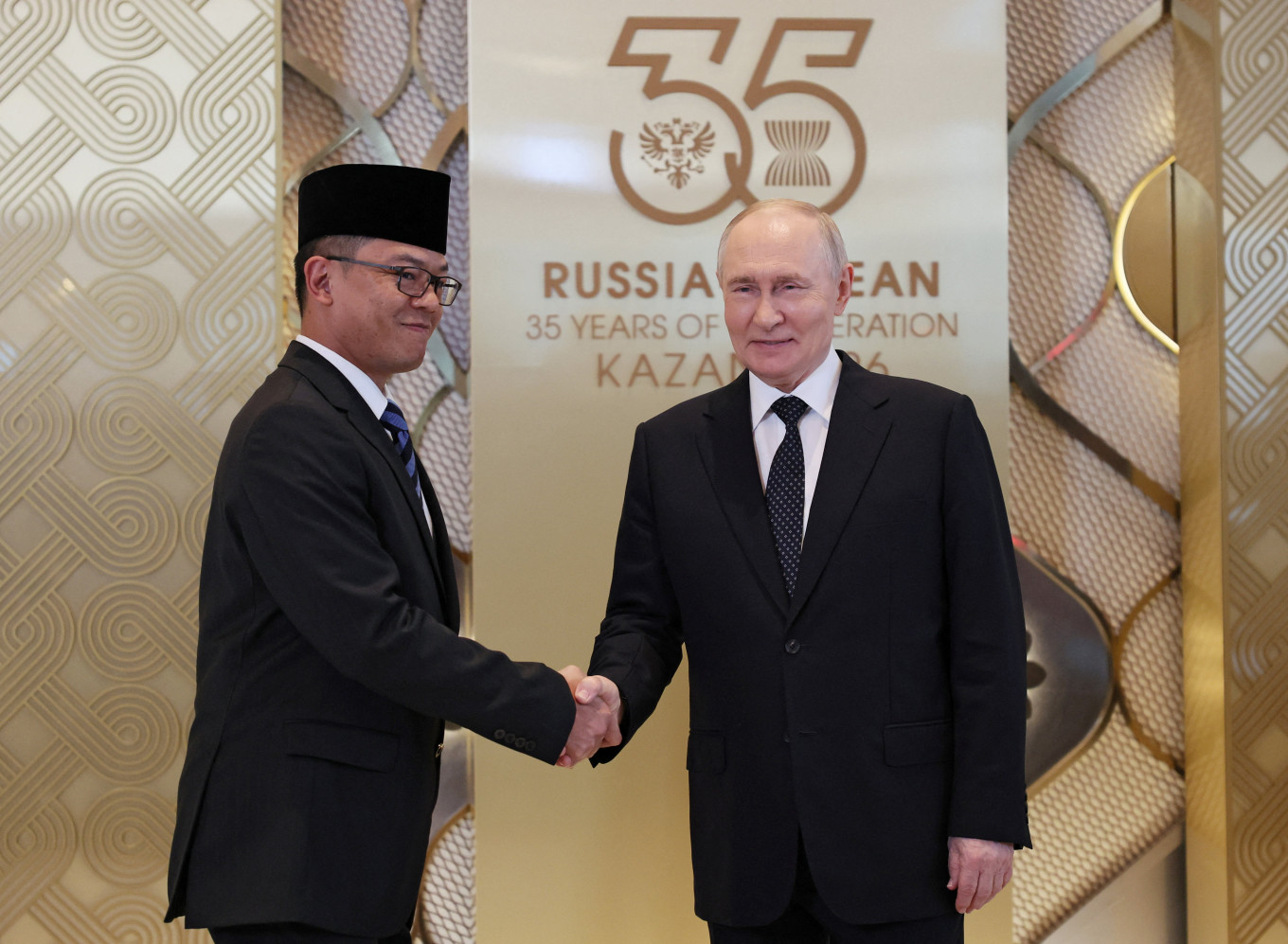 Russian President Vladimir Putin (right) shakes hands with Indonesian Foreign Minister Sugiono during an official welcoming ceremony for the heads of delegations participating in the Russia-ASEAN Summit in Kazan, Russia, on June 17, 2026. (Reuters/Anastasia Barashkova)
T
he recent ASEAN-Russia Commemorative Summit in Kazan marked a milestone in regional diplomacy, celebrating 35 years of relations between the two dialogue partners. While the summit covered a wide spectrum of issues, from digital cooperation to food security, the Joint Statement on Energy Cooperation emerged as its most strategically consequential outcome.
The timing could hardly have been more critical. The ongoing United States-Israeli conflict with Iran, particularly the threat of broader war and its repercussions for maritime security around the Strait of Hormuz, has once again reminded governments throughout Southeast Asia that energy security cannot be taken for granted. Every disruption to global oil and gas markets reverberates rapidly across ASEAN economies, stoking inflationary pressures, raising transportation costs and threatening industrial competitiveness.
Against this backdrop, Russia’s vast reserves of oil, natural gas and petroleum products naturally appear attractive. As one of the world’s largest energy producers, Russia possesses abundant hydrocarbon resources, advanced extraction technologies and decades of experience supplying markets stretching from Europe to East Asia. For ASEAN nations seeking to diversify away from excessive dependence on any single supplier, cooperation with Russia represents a logical strategic choice.
Yet sound energy policy demands looking beyond contracts and diplomatic declarations. The central question is not whether Russia possesses sufficient energy resources, but Moscow’s ability to consistently deliver those resources in an increasingly volatile geopolitical landscape.
The war in Ukraine has fundamentally altered that calculation. Contrary to early expectations that the conflict might quickly conclude, it has evolved into a prolonged war of attrition characterized by technological innovation, economic endurance and long-range precision strikes. Ukraine has demonstrated a growing capability to conduct sophisticated drone attacks against military facilities, logistics centers, fuel depots, refineries and transportation infrastructure located deep inside Russian territory.
These operations have become an integral component of Kyiv's broader military strategy. Rather than attempting to match Russia’s larger conventional forces directly, Ukraine has sought to raise the economic costs of sustaining Russia’s war effort. Energy facilities are primary targets because they generate substantial revenue for the Russian state while supporting both civilian and military logistics.

As technological improvements continue, both Moscow and Kyiv are likely to invest even more heavily in long-range unmanned systems, ensuring that Russian energy infrastructure remains under periodic pressure for the foreseeable future.