The Jakarta Post
Please Update your browser
Your browser is out of date, and may not be compatible with our website. A list of the most popular web browsers can be found below.
Just click on the icons to get to the download page.


Popular Reads
Top Results
No results found. Please check your search term and try again
Can't find what you're looking for?
View all search results
Popular Reads
Top Results
No results found. Please check your search term and try again
Can't find what you're looking for?
View all search resultsWhy the Gulf needs economic ties with Iran
Whatever order emerges from the current crisis, its durability will depend not only on deterrence but also on economic incentives that make conflict costly.
Change text size
Gift Premium Articles
to Anyone
Share the best of The Jakarta Post with friends, family, or colleagues. As a subscriber, you can gift 3 to 5 articles each month that anyone can read—no subscription needed!
 Set as preferred source
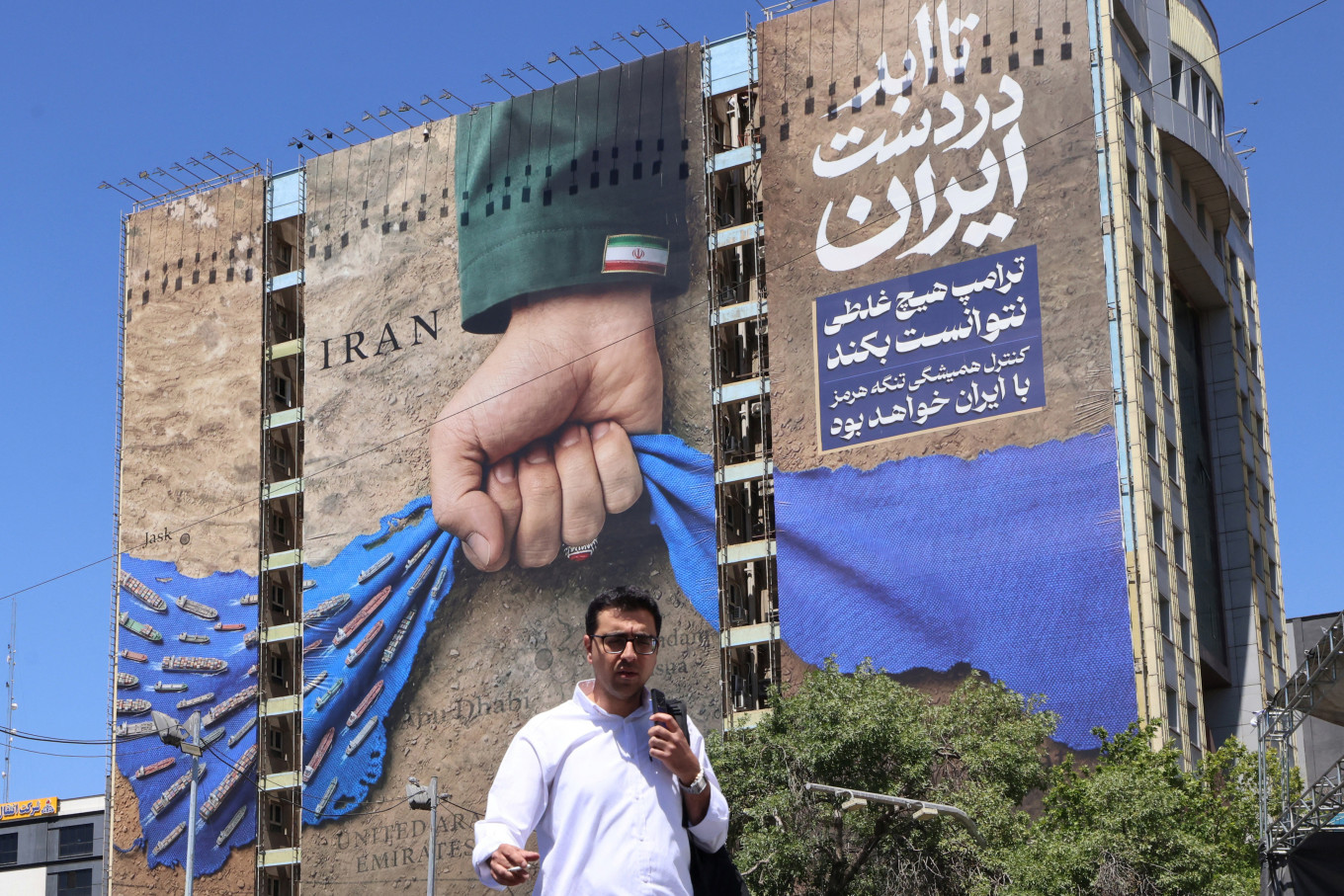 A man crosses a street past a billboard on the facade of a building depicting the Strait of Hormuz with a caption in Persian reading “Forever in Iran’s Hand”, on May 25, 2026, at Vanak Square in Tehran. (AFP/Atta Kenare)
T
he United States-Israeli war against Iran has shattered the Gulf’s old security order. As governments search for alternatives, debate has focused largely on military strategy, diplomatic realignments and the role of outside powers. Missing are the economic foundations of a lasting peace.
Recent moves to expand Omani-Iranian trade and revive the Hejaz Railway linking Turkey to Saudi Arabia suggest that economic integration, once dismissed as politically impossible, is becoming conceivable. Whatever order emerges from the current crisis, its durability will depend not only on deterrence but also on economic incentives that make conflict costly.
In an influential 2015 essay, the Nobel laureate economist Douglass North and the Stanford social scientists Gary Cox and Barry Weingast described what they called the “violence trap.” As trade, investment, infrastructure and production become interconnected, economic complexity raises the cost of violence. Restraint becomes economically rational, because states, firms and citizens have more to lose.
The Gulf remains trapped in the opposite equilibrium. Violence persists not because regional actors are irrational, but because the incentive structure keeps the expected returns of conflict relatively high. In many respects, the Gulf is a single economic space with a common stake in energy infrastructure, shipping routes, financial markets and shared environmental challenges. But political fragmentation into competing blocs allows proxy warfare, infrastructure sabotage and asymmetric attacks to impose enormous regional costs while imposing only limited costs on those who initiate them.
A more economically integrated Gulf would overturn this calculus. Dense commercial ties act as a commitment device, making disruption prohibitively expensive and embedding stability within the region’s economic architecture. Security is generated from within, through organic economic linkages.
This perspective helps explain the paradox that one of the world’s wealthiest regions has failed to achieve durable peace. The rivalry between Iran and Gulf Cooperation Council (GCC) members divides what is naturally a shared regional system connected by geography, energy resources and complementary markets.

For decades, external security guarantees, primarily by the US, managed this rivalry without removing its underlying incentives. Security effectively became a traded commodity, with hydrocarbons and capital exchanged for military protection. States overinvested in deterrence and underinvested in regional economic integration.