TheJakartaPost
Please Update your browser
Your browser is out of date, and may not be compatible with our website. A list of the most popular web browsers can be found below.
Just click on the icons to get to the download page.


Popular Reads
Top Results
No results found. Please check your search term and try again
Can't find what you're looking for?
View all search results
Popular Reads
Top Results
No results found. Please check your search term and try again
Can't find what you're looking for?
View all search resultsJustice on trial
The conviction of a prominent tech reformer exposes a deeper, more systemic crisis: it casts a doubt over whether Indonesia can truly court global investors and elite talent.
Change text size
Gift Premium Articles
to Anyone
Share the best of The Jakarta Post with friends, family, or colleagues. As a subscriber, you can gift 3 to 5 articles each month that anyone can read—no subscription needed!
 Set as preferred source
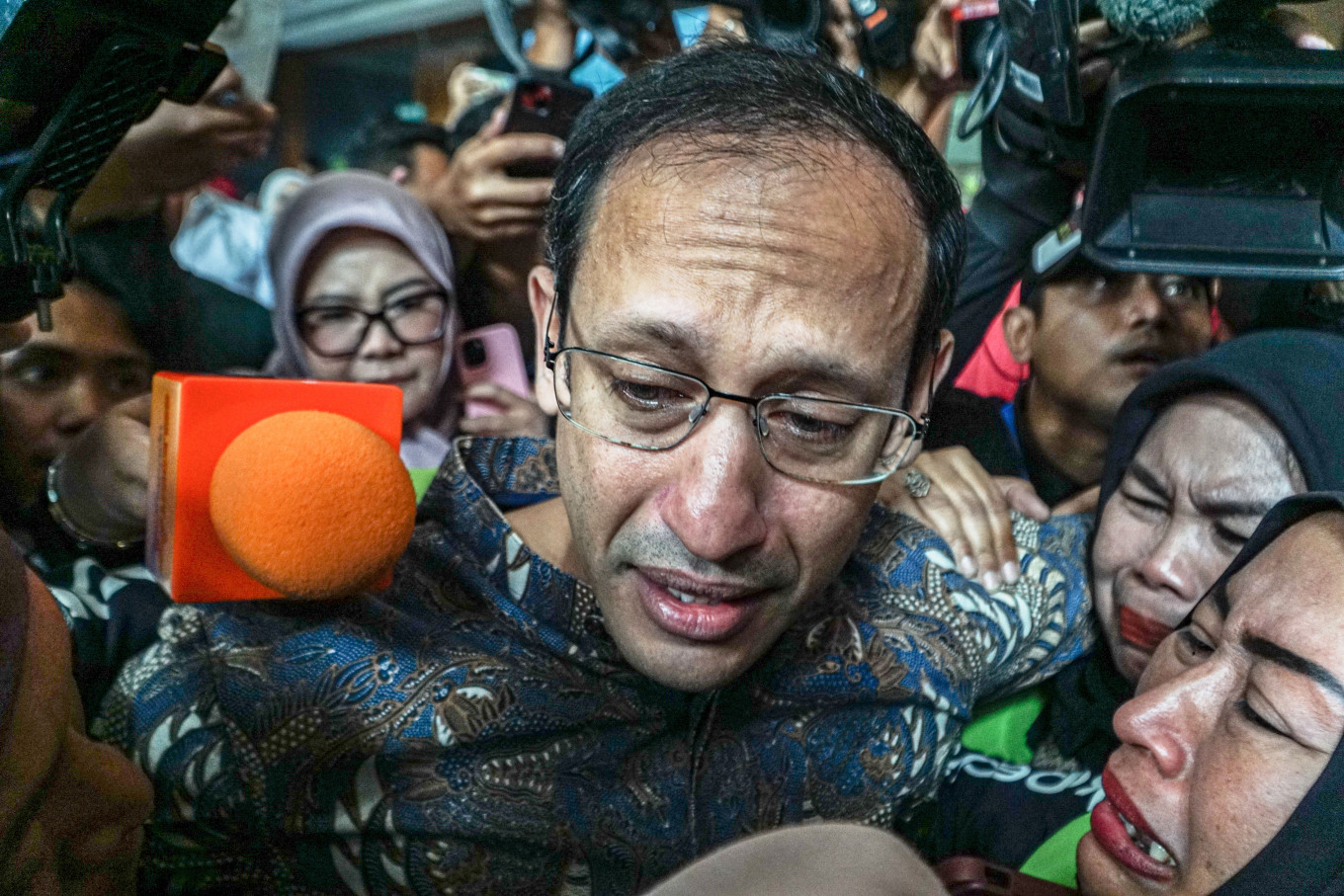 Nadiem Anwar Makarim (center), accused of corruption in the procurement of Chromebook laptops when he was education minister, arrives with supporters at the Corruption Court in Central Jakarta, on June 30, 2026. The court was scheduled to deliver its verdict in the case. (Antara/Salma Talita)
T
he conviction of former education minister Nadiem Anwar Makarim on Tuesday has quickly evolved beyond a high-profile corruption case. It has become a critical test of Indonesia's judicial credibility, its investment climate and its institutional commitment to the rule of law. If public trust is to be restored, President Prabowo Subianto’s administration must confront the systemic implications of this ruling.
Unsurprisingly, the Jakarta Corruption Court’s decision to sentence Nadiem, the poster child of Indonesia’s young and bright entrepreneurs, to 10 years in prison and order him to pay Rp 809 billion (US$45.4 million) in restitution over the procurement of Chromebook laptops during his tenure has ignited national debate. While the sentence was lighter than the prosecution's demand of 18 years, the reduction has done little to ease public skepticism, if not distrust, in a judicial system frequently marred by scandal.
Nadiem plans to appeal the troubling verdict to the High Court and, if necessary, the Supreme Court. The appellate judges must treat this moment as an opportunity to demonstrate that justice in the country is delivered strictly on the basis of evidence and due process, insulated from political motives or populist pressures.
The executive branch’s response to these anxieties has been predictable: Officials reiterated that the judiciary is independent and that the government cannot interfere in active proceedings. While respect for judicial independence is the cornerstone of a democratic legal system, independence alone is insufficient.
Courts must also command public confidence. To earn that trust and respect, the judiciary must consistently demonstrate transparency, certainty and impartiality in its decisions.
For many, the fallout extends far beyond the specifics of a laptop procurement project; it reflects a broader crisis in governance and legal enforcement. A volatile legal environment risks discouraging talented Indonesians living abroad from returning home to contribute to national development. Whether these anxieties are fully justified or not, they warrant serious attention, particularly as international perceptions of Indonesia's legal certainty have deteriorated in recent years, largely because of numerous controversial government policies.

Two structural issues demand the immediate attention of the Prabowo administration. First, Indonesia’s legal system continues to struggle to keep pace with rapid technological advancement. Governments worldwide face the challenge of regulating digital innovation, artificial intelligence and complex procurement systems that evolve faster than statutes. However, Indonesia has tried to police modern technological initiatives using only outdated regulations, an issue compounded by vulnerabilities within the judicial apparatus.