The Jakarta Post
Please Update your browser
Your browser is out of date, and may not be compatible with our website. A list of the most popular web browsers can be found below.
Just click on the icons to get to the download page.


Popular Reads
Top Results
No results found. Please check your search term and try again
Can't find what you're looking for?
View all search results
Popular Reads
Top Results
No results found. Please check your search term and try again
Can't find what you're looking for?
View all search resultsWe have the culture. We lack the architecture
Indonesia's soft power gap is an institutional and capital problem, and the business community cannot afford to wait.
Change text size
Gift Premium Articles
to Anyone
Share the best of The Jakarta Post with friends, family, or colleagues. As a subscriber, you can gift 3 to 5 articles each month that anyone can read—no subscription needed!
 Set as preferred source
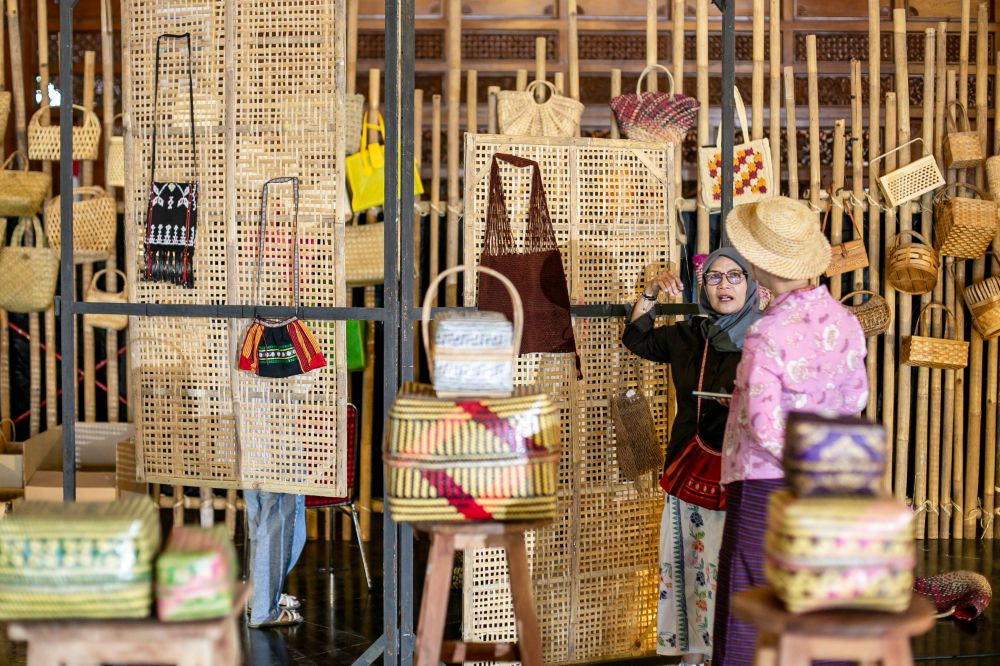 In the bag: Visitors examine handcrafted products on display during the third Nusantara Bag Festival (Festara) at City Hall in Surakarta, Central Java, on June 19, 2026. The event gathered creative entrepreneurs and the public to promote appreciation for Indonesian-made bags, strengthen the creative economy and expand market opportunities for small and medium enterprises. (Antara/Mohammad Ayudha)
B
rand Finance's 2026 Global Soft Power Index places Indonesia at 46th globally. China ranks second, Japan third and South Korea eleventh. Indonesia holds the world's second-richest cultural heritage: over 1,300 ethnic groups, 700 living languages and millennia of civilizational depth. The gap between that endowment and that ranking is not a creative failure. It is an institutional one.
South Korea's transformation is the relevant precedent. In 1994, Seoul made a political decision: culture would be treated as an industry, not heritage. They began directing roughly US$440 million per year investing in film, game and music. The institution that would carry this mandate, KOCCA, was not established until 2009. The structure was built around the strategy, not the other way around. By 2021, KOCCA's own figures showed Korea's content sector generating $107 billion in annual sales.
According to Korea's Export-Import Bank, every $100 million in content exports generates $510 million in total production value, with an additional $180 million in induced consumer-goods exports riding the coattails of a single K-drama release. China read that model and followed.
Indonesia's state budget records show that Rp 1.7 quadrillion ($$94.7 billion) was directed to the creative sector, primarily fashion, food and crafts, between 2014 and 2024. Over that same period, Statistics Indonesia data shows GDP growth falling from 5.78 to 5.03 percent, and by 2025, an estimated 9 million middle-income Indonesians had fallen into the low-income category. Why? Policy calibrated at the wrong tier of enterprise does not generate velocity. It generates the illusion of support.
Indonesia has steadily accumulated creative economy roadmaps and presidential decrees. What has been missing is the implementation architecture beneath them. Five gaps remain consistently unaddressed.

First is the capital gap. Cultural enterprises are trapped in a financing dead zone, too large for micro and small enterprise schemes and too intangible-asset-heavy for conventional bank financing or venture capital. The Rp 10 to 100 billion range, precisely where a local game studio or film franchise becomes globally competitive, has no dedicated financial instrument. Newzoo's Indonesia gaming data shows a market worth Rp 31 trillion annually, with 99.6 percent captured by imported titles. The consumer appetite exists and is paying, simply not for Indonesian products.