The Jakarta Post
Please Update your browser
Your browser is out of date, and may not be compatible with our website. A list of the most popular web browsers can be found below.
Just click on the icons to get to the download page.


Popular Reads
Top Results
No results found. Please check your search term and try again
Can't find what you're looking for?
View all search results
Popular Reads
Top Results
No results found. Please check your search term and try again
Can't find what you're looking for?
View all search resultsWhat a disallowed goal can teach us about counting a nation
Technology can locate a house, but only human intuition can map the invisible millions driving today’s digital economy.
Change text size
Gift Premium Articles
to Anyone
Share the best of The Jakarta Post with friends, family, or colleagues. As a subscriber, you can gift 3 to 5 articles each month that anyone can read—no subscription needed!
 Set as preferred source
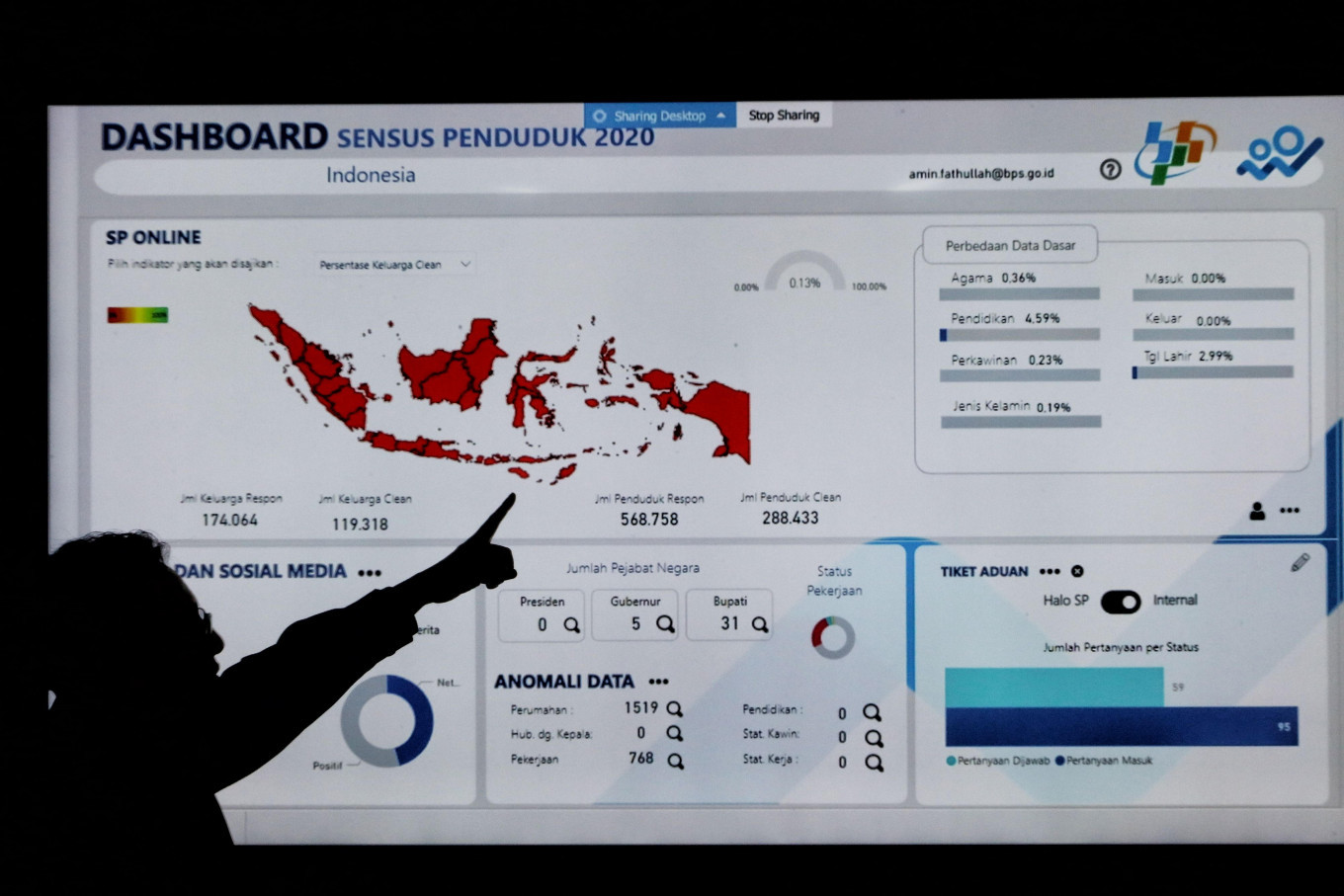 Statistics Indonesia (BPS) staff work at the 2020 population census call center room in Jakarta, on Feb. 17, 2020 .The population census, which occurs every 10 years, aims to update data on the country’s demographics, which are crucial to supporting certain policy interventions and combine door-to-door interviews and data gathering and online submission. (JP/Seto Wardhana)
T
here is nothing crueler in soccer than a goal wiped out by a margin of centimeters. Every World Cup stadium now deploys 16 optical tracking cameras reading more than 150 million data points across a single match, enough to place a player’s body in space with a precision no human eye could ever match.
Yet, FIFA’s own innovation team insists this technology was never about a distrust of referees. The cameras answer exactly one objective question: where is the body when the ball is played? Whether that player is actually interfering with play, blocking a goalkeeper’s sightline or drawing a defender out of position, is left, by design, to a human referee standing closer to the moment than any camera can get. A machine that can locate a person to the nearest centimeter still cannot determine intent.
This gap between data and human judgment extends far beyond the pitch; it is a fundamental question confronting the modern global economy. If a single soccer match requires that level of technological precision and still leaves its hardest judgments to a human being, what does an entire nation need to measure its economic reality?
Consider a household in Indonesia, the Setiabudi family. From the street, their home appears to be a standard, unremarkable residential building with no signage or storefront. Yet, inside, it is a hive of invisible commercial establishments. On any given afternoon, three distinct income streams run simultaneously: one family member packages dropshipped orders, another edits video for the creator economy and a third responds to customer queries as an online affiliate.
A neighbor might believe the family is unemployed because their car rarely leaves the driveway. The truth only surfaces by accident when someone glimpses parcels stacked to the ceiling. No satellite could have captured that data, and no traditional registry built around physical business addresses would have flagged it. The economic activity exists precisely where traditional metrics are not designed to look.
This dynamic gets to the heart of why a national census exists, and why it cannot simply be replaced by a sample survey. A survey tastes a spoonful from the pot and trusts the rest of the soup to taste roughly the same. A census, by contrast, is a comprehensive medical check-up, it insists on examining the entire body.

In statistics, a wrong number leaves a trace that can be followed and corrected. A missing number leaves nothing; every economic plan built afterward proceeds as if that reality never existed.