The Jakarta Post
Please Update your browser
Your browser is out of date, and may not be compatible with our website. A list of the most popular web browsers can be found below.
Just click on the icons to get to the download page.


Popular Reads
Top Results
No results found. Please check your search term and try again
Can't find what you're looking for?
View all search results
Popular Reads
Top Results
No results found. Please check your search term and try again
Can't find what you're looking for?
View all search resultsAs Modi visits Jakarta, what should Indonesia do with Sabang?
As Prime Minister Modi visits Jakarta, Indonesia must seize India’s $9 billion Great Nicobar Project not as a geopolitical threat, but as the ultimate catalyst to finally unlock Sabang’s untapped economic potential.
Change text size
Gift Premium Articles
to Anyone
Share the best of The Jakarta Post with friends, family, or colleagues. As a subscriber, you can gift 3 to 5 articles each month that anyone can read—no subscription needed!
 Set as preferred source
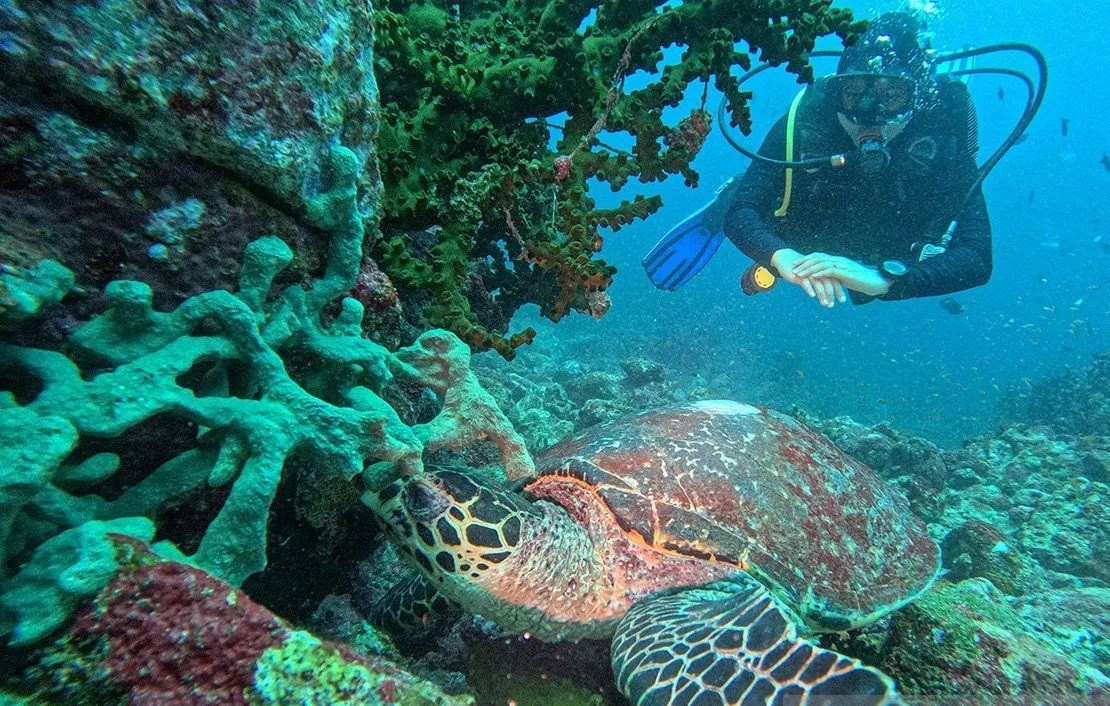 A tourist watches a wild green turtle (Chelonia mydas) from close range on May 15, 2025, at the Batee Tokong dive site in Iboih waters off Sabang, Aceh.
(Antara/Khalis Surry)
A tourist watches a wild green turtle (Chelonia mydas) from close range on May 15, 2025, at the Batee Tokong dive site in Iboih waters off Sabang, Aceh.
(Antara/Khalis Surry)
I
ndian Prime Minister Narendra Modi’s official visit to Indonesia comes at a defining moment for the future of the eastern Indian Ocean. As the leaders of the world’s third- and fourth-most populous democracies convene to discuss trade, investment, defense cooperation and regional security, their talks reflect a rapidly maturing strategic partnership.
Yet one highly consequential issue deserves far greater attention than it has so far received: How should Indonesia position Sabang as India moves forward with its US$9 billion Great Nicobar Project?
Just across the Andaman Sea from Sabang, New Delhi is undertaking one of its most ambitious infrastructure projects in decades. The mega-development on Great Nicobar Island centers on the Galathea Bay International Transshipment Port, alongside a new international airport, modern power infrastructure and a greenfield township. Together, these initiatives aim to establish Great Nicobar as a major maritime and logistics hub at the western entrance to the Strait of Malacca.
For Jakarta, the emergence of Great Nicobar should not be viewed through the narrow prism of strategic competition. Instead, it offers a rare opportunity to unlock the long-underutilized economic potential of Sabang.
Geography has always favored Sabang. Situated on Weh Island at Indonesia’s northernmost tip, it lies less than 100 nautical miles from Great Nicobar and sits at the crossroads of one of the world’s busiest maritime corridors. Every year, tens of thousands of vessels carrying energy, manufactured goods and raw materials pass through the nearby Strait of Malacca, connecting Asia with Europe, the Middle East and Africa. Few places in Southeast Asia occupy such a vital chokepoint.
Yet geography alone does not guarantee prosperity. Despite its designation as a free trade zone and free port, Sabang has struggled to become the maritime gateway policymakers envisioned. Infrastructure development has lagged, shipping activity remains thin and foreign investment has fallen short of expectations. While neighboring nations have rapidly expanded their logistics capabilities, Sabang has remained largely on the periphery of regional trade.

India’s massive investment in Great Nicobar alters this equation. Rather than viewing the project as a threat, Indonesian planners should explore how the two locations can complement one another. Successful maritime economies are rarely built around a single isolated port; instead, they function as interconnected networks where nodes specialize according to their comparative advantages.