The Jakarta Post
Please Update your browser
Your browser is out of date, and may not be compatible with our website. A list of the most popular web browsers can be found below.
Just click on the icons to get to the download page.


Popular Reads
Top Results
No results found. Please check your search term and try again
Can't find what you're looking for?
View all search results
Popular Reads
Top Results
No results found. Please check your search term and try again
Can't find what you're looking for?
View all search resultsWhen landfills become time bombs: A lesson from Jatiwaringin
While the Jatiwaringin landfill fire has exposed the volatile reality of Indonesia’s mismanaged waste, a much larger environmental time bomb is ticking in Bantar Gebang at the gates of Greater Jakarta.
Change text size
Gift Premium Articles
to Anyone
Share the best of The Jakarta Post with friends, family, or colleagues. As a subscriber, you can gift 3 to 5 articles each month that anyone can read—no subscription needed!
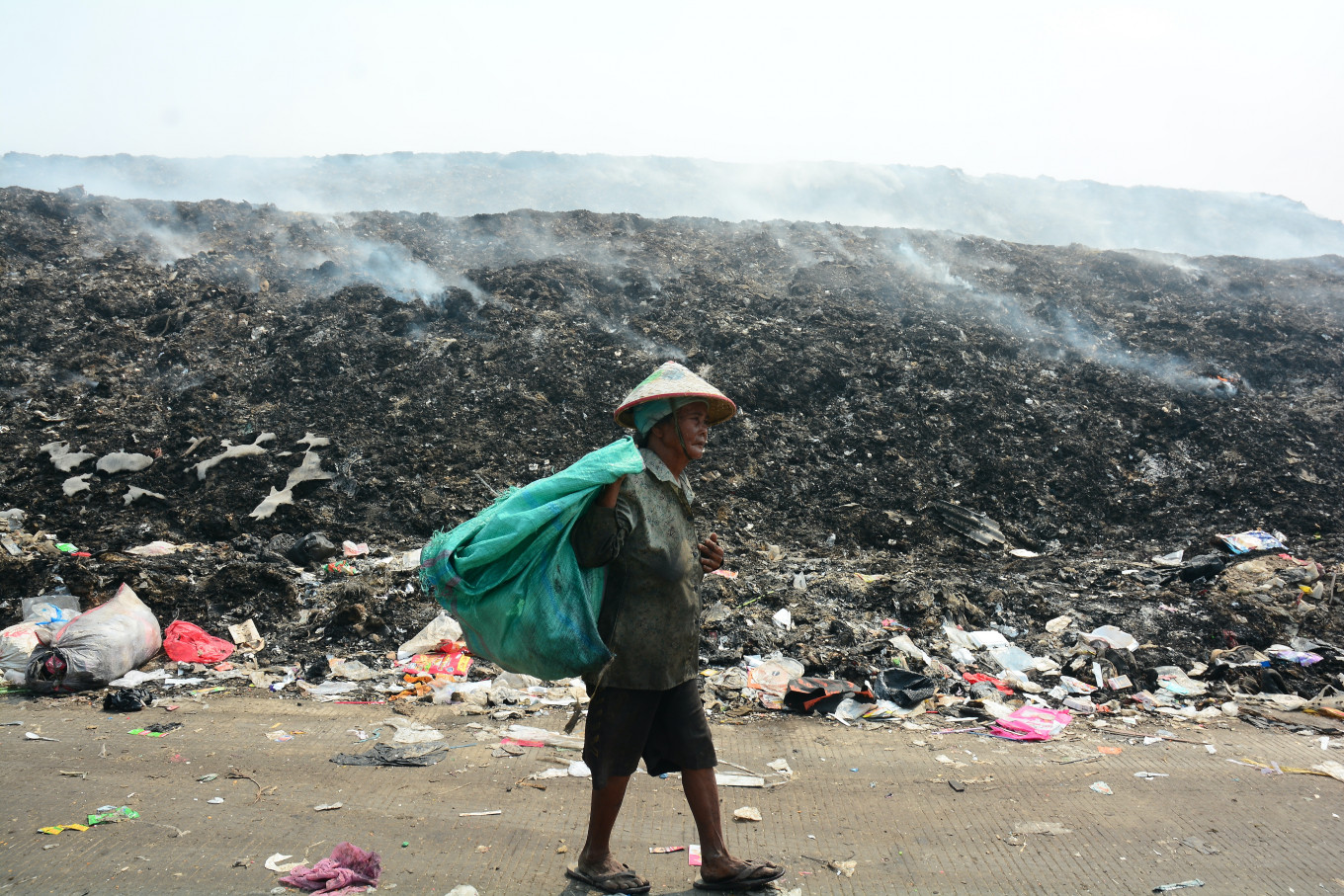 A trash picker walks past a large mound of burning garbage on July 4, 2026, at the Jatiwaringin landfill in Tangerang regency, Banten. (JP/Iqro Rinaldi)
A
s extreme temperatures gripped parts of the Northern Hemisphere in late June, a severe fire erupted at the Jatiwaringin landfill in Mauk district, Tangerang regency, Banten. Within eight days of the initial outbreak on June 30, the flames had expanded from 3 to 15 hectares, devouring nearly half of the 33 ha facility.
The disaster forced hundreds of residents to evacuate to a nearby village hall, leaving dozens displaced and suffering from acute respiratory infections due to the dense, billowing smoke produced. Despite the deployment of four firefighting helicopters and hundreds of emergency personnel, the deep-seated embers beneath the mountain of refuse remained notoriously difficult to extinguish.
The underlying mechanics of the fire are scientifically clear. The accumulation of methane gas (CH4), a by-product of the anaerobic decomposition of organic waste, creates a highly volatile environment. When exposed to soaring ambient temperatures, the risk of spontaneous ignition skyrockets.
In Jatiwaringin, high winds and dry weather severely hindered containment efforts. Furthermore, the landfill’s daily cover system, designed to bury refuse under layers of soil in accordance with sanitary landfill principles, had been implemented only across a fraction of the site. The resulting conflagration was the direct consequence of systemic management oversight.
However, the crisis in Tangerang is merely a warning shot. A far larger threat looms over Jakarta at the Bantar Gebang integrated waste disposal site (TPST) and other major landfills nationwide.
While Jatiwaringin holds waste across 33 ha, Bantar Gebang spans roughly 108 ha and holds an estimated 56 million tonnes of Jakartans’ waste, nearly three times the spatial footprint and an exponentially higher volume. According to a report by the Emmett Institute at the University of California, Los Angeles, the waste piles at Bantar Gebang emit an estimated 6.2 tonnes of methane per hour.

Methane is a potent greenhouse gas with a global warming potential 23 to 28 times greater than carbon dioxide (CO2) over a short-term horizon. In dry, hot conditions, it becomes highly flammable. The structural components for a catastrophic fire are already in place; all that is required is an ignition trigger, whether from extreme weather, a discarded cigarette or friction generated by heavy machinery.