The Jakarta Post
Please Update your browser
Your browser is out of date, and may not be compatible with our website. A list of the most popular web browsers can be found below.
Just click on the icons to get to the download page.


Popular Reads
Top Results
No results found. Please check your search term and try again
Can't find what you're looking for?
View all search results
Popular Reads
Top Results
No results found. Please check your search term and try again
Can't find what you're looking for?
View all search resultsIndonesia must avoid the disorder trap
Genuine freedom requires order under law and that order must begin with the powerful
Change text size
Gift Premium Articles
to Anyone
Share the best of The Jakarta Post with friends, family, or colleagues. As a subscriber, you can gift 3 to 5 articles each month that anyone can read—no subscription needed!
 Set as preferred source
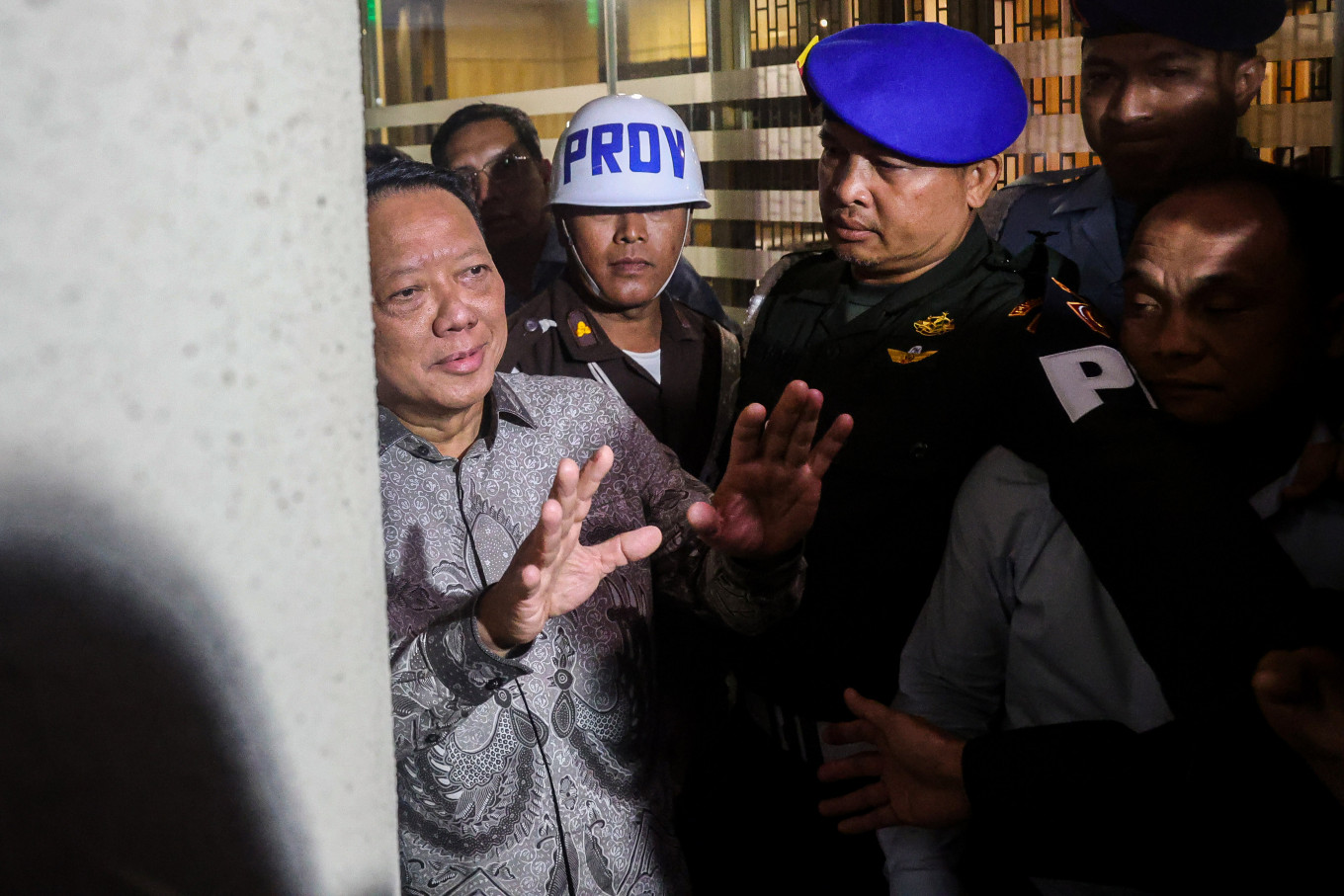 Former deputy attorney general for special crimes Febrie Adriansyah (left) speaks to reporters after questioning at the Attorney General's Office in Jakarta on July 24, 2026. (Antara/Darryl Ramadhan)
I
n West Java, Governor Dedi Mulyadi has won a large following by attacking the everyday machinery of coercion, the illegal levies, protection rackets and premanisme (low-level gangsterism) that shadow markets, transport routes and construction sites. He has ordered anti-premanisme task forces across the province and framed the drive, rightly, as a way to protect investment and ordinary livelihoods.
Yet the same governor is also known for viral, personalized enforcement, such as student curfews, boot-camp discipline and demolitions staged for the camera that have drawn warnings from rights groups. His rise captures both the promise and the peril of the moment: the state reasserting order, but in a personalized and spectacular form that is not always order under law.
At the other end of the hierarchy lies a different warning. This month, Febrie Adriansyah, until recently the deputy attorney general for special crimes, was named a money-laundering suspect and detained. The presumption of innocence applies, and the legal process must run its course. But whatever the outcome, the case revives the oldest question in governance: quis custodiet ipsos custodies, who guards the guardians?
The real subject of Indonesia's development debate is dominated by infrastructure, industrial policy, human capital, technology and investment. Yet all of them rest on a public good that is easy to take for granted: a functioning system of law and order.
“Law” is more than legislation, and “order” is more than tidiness or the absence of protest. Law without order produces rules that exist only on paper. Order without law produces repression, or the domination of society by whoever is greatest. Development requires order under law: a state capable enough to protect people, property and public space, yet legally constrained and accountable.
Mexico shows why this matters. Few developing countries appear better placed to benefit from globalization, a long border with the United States, abundant labor, a substantial manufacturing base, deep integration into North American supply chains. Yet productivity convergence has stalled. Part of the explanation is the state's uneven capacity to maintain order under law.

The Inter-American Development Bank estimates the direct cost of crime and violence in Latin America and the Caribbean at about 3.4 percent of GDP. The greatest cost of disorder is not the money spent after a crime, but the investment never made, the branch never opened, the job declined because the journey is unsafe.