The Jakarta Post
Please Update your browser
Your browser is out of date, and may not be compatible with our website. A list of the most popular web browsers can be found below.
Just click on the icons to get to the download page.


Popular Reads
Top Results
No results found. Please check your search term and try again
Can't find what you're looking for?
View all search results
Popular Reads
Top Results
No results found. Please check your search term and try again
Can't find what you're looking for?
View all search resultsBeyond kitchens: Building a homegrown school meals program
By transforming the free nutritious meal program from a centralized distribution chain into a community-rooted model, the nation can feed its children while also empowering its farmers and regional economies.
Change text size
Gift Premium Articles
to Anyone
Share the best of The Jakarta Post with friends, family, or colleagues. As a subscriber, you can gift 3 to 5 articles each month that anyone can read—no subscription needed!
 Set as preferred source
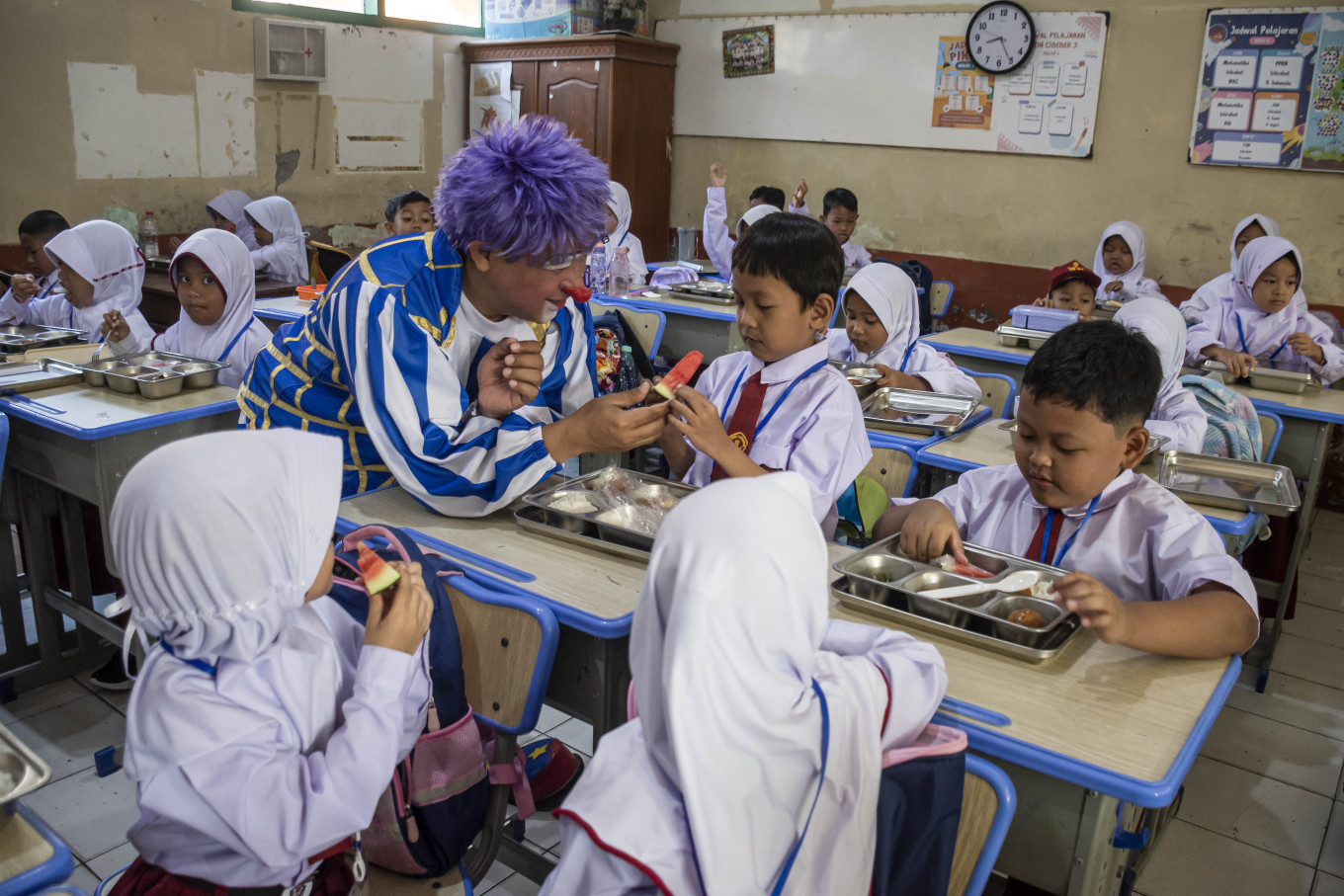 A member of the Cimahi Clown Community presents a slice of watermelon to a student on July 14, 2026, during an orientation program it organized for new students at SDN Cibeber elementary school in Cimahi, West Java, combining entertainment, motivational activities and education while promoting the government's free nutritious meal program. (Antara/Abdan Syakura)
E
very school meal tells a much larger story, one that begins long before food reaches a child's plate: with farmers deciding what to plant, local markets supplying ingredients, kitchens preparing meals and communities working together to ensure children are healthy enough to learn. That is why Indonesia's free nutritious meal (MBG) program should never be judged simply by the volume of food it distributes.
From the outset, the program's ambition has been far greater: to improve child nutrition, strengthen human capital and invest in the long-term future of the country. As the initiative matures, the primary imperative is no longer how quickly it can expand but how effectively it can adapt to the diverse communities it serves.
Recent leadership transitions within the National Nutrition Agency (BGN) as well as ongoing reviews of operational procedures and the temporary suspension of numerous nutrition fulfillment service units (SPPG) that failed hygiene standards reflect this strategic shift.
Scaling a national initiative of this magnitude is inherently complex; building one that continuously learns, adapts and earns public trust is harder still. The above developments should therefore be viewed not as setbacks but as crucial opportunities to strengthen institutional accountability and operational rigor.
One promising pathway forward is to gradually evolve the MBG program toward the homegrown school meals model. Around the world, effective school feeding programs increasingly recognize that every meal can achieve multiple policy objectives simultaneously.
Beyond boosting child nutrition, school meals can secure stable markets for smallholder farmers, stimulate local food systems, support microenterprises and foster healthier dietary habits. Investments in school feeding thus yield dividends for both human capital and regional economic development.

Indonesia is not starting from scratch. Earlier initiatives, including the school-aged child nutrition program (PROGAS), demonstrated the benefits of pairing nutritious meals with nutrition education, local food procurement and community participation.