The Jakarta Post
Please Update your browser
Your browser is out of date, and may not be compatible with our website. A list of the most popular web browsers can be found below.
Just click on the icons to get to the download page.


Popular Reads
Top Results
No results found. Please check your search term and try again
Can't find what you're looking for?
View all search results
Popular Reads
Top Results
No results found. Please check your search term and try again
Can't find what you're looking for?
View all search resultsHidden inequality in Indonesia’s new university accreditation system
Do we measure the quality of education or the institution’s ability to prove quality?
Change text size
Gift Premium Articles
to Anyone
Share the best of The Jakarta Post with friends, family, or colleagues. As a subscriber, you can gift 3 to 5 articles each month that anyone can read—no subscription needed!
 Set as preferred source
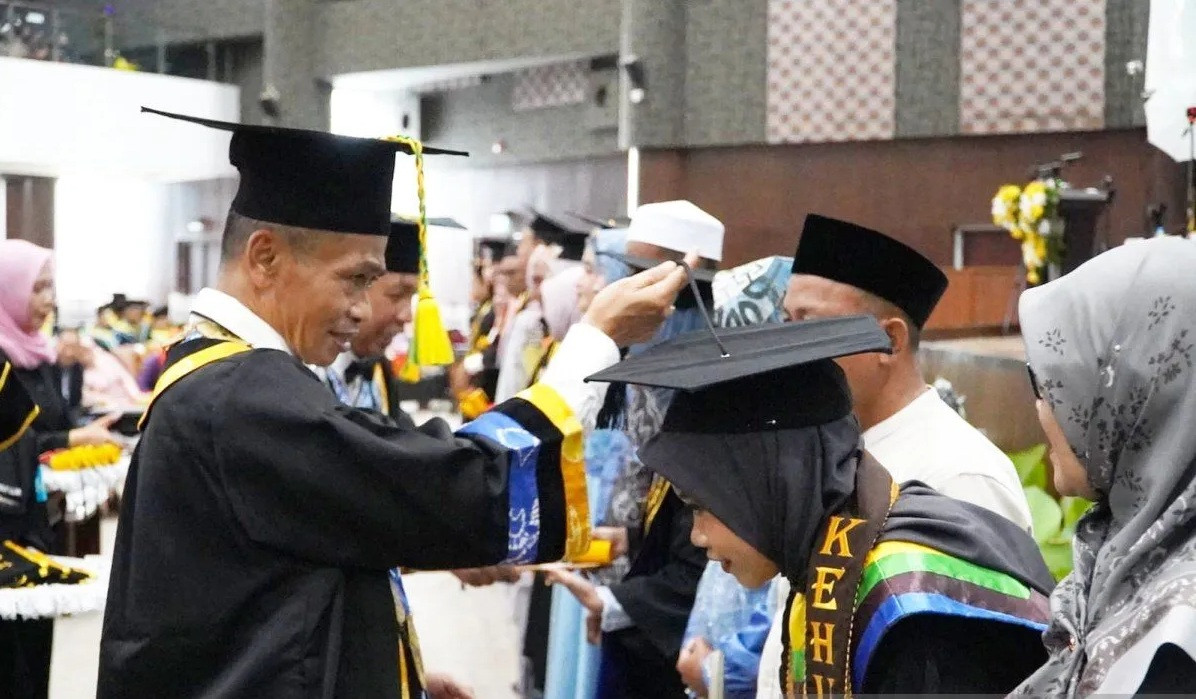 Rector of Lambung Mangkurat University, Prof. Ahmad Alim Bachri, turns the tassel for the top graduates on July 3, 2024, at the faculty level at the ULM Auditorium, Banjarbaru, Banjarmasin, South Kalimantan.
(Antara/Firman)
Rector of Lambung Mangkurat University, Prof. Ahmad Alim Bachri, turns the tassel for the top graduates on July 3, 2024, at the faculty level at the ULM Auditorium, Banjarbaru, Banjarmasin, South Kalimantan.
(Antara/Firman)
W
hen a university serving first-generation students in a remote province receives a lower accreditation score than a fully-resourced institution in Jakarta, despite producing more socially impactful graduates, we must ask: what exactly are we measuring?
A university can be excellent in terms of classroom performance but appears underdeveloped on the dashboard. Another university can have all the best-looking indicators, charts and well-arranged evidence, yet its students receive mediocre education. These considerations should define the core of the new university accreditation reform in Indonesia.
I reflected more deeply on this issue after attending a Religious Affairs Ministry forum on quality assurance for Islamic religious higher education institutions. The new Higher Education Accreditation Instrument 4.1 (IAPT 4.1) places greater emphasis on quality culture, relevance, accountability and mission differentiation, moving accreditation beyond a merely seasonal exercise.
These are the right steps to be made. Higher Education, Science and Technology Minister Regulation No. 39/2025 makes the internal quality assurance system and the external accreditation part of a single quality cycle and also calls for a reasonable use of national higher education data in the accreditation process.
Speakers at the forum elaborated on how SAPTO 2.0, the new Online Higher Education Accreditation System, is a web-based system and has been synchronized with quantitative information from national portals.
But a hard question lingers. Do we measure the quality of education or the institution’s ability to prove quality?

The new system called for universities to keep their data up-to-date regarding lecturers, students, programs, research, publications, community service and institutional achievements. It helps to develop discipline. The data should guide every day's decision.