The Jakarta Post
Please Update your browser
Your browser is out of date, and may not be compatible with our website. A list of the most popular web browsers can be found below.
Just click on the icons to get to the download page.


Popular Reads
Top Results
No results found. Please check your search term and try again
Can't find what you're looking for?
View all search results
Popular Reads
Top Results
No results found. Please check your search term and try again
Can't find what you're looking for?
View all search resultsMining sector: From growth engine to growth constraint
As many industry insiders feared, the mining sector's performance has weakened further, locking it into negative territory for the first half of the year.
Change text size
Gift Premium Articles
to Anyone
Share the best of The Jakarta Post with friends, family, or colleagues. As a subscriber, you can gift 3 to 5 articles each month that anyone can read—no subscription needed!
 Set as preferred source
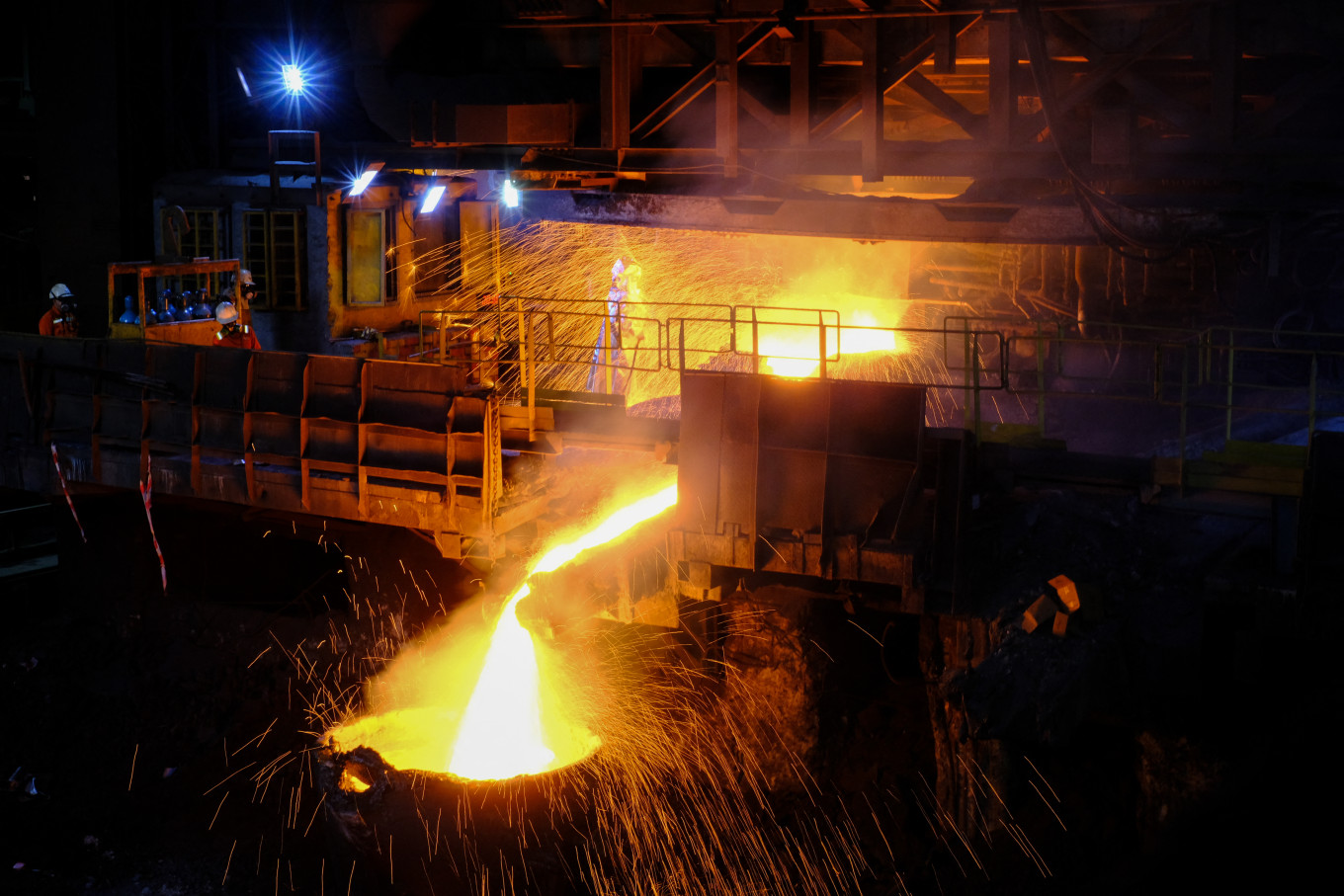 A general view at the nickel smelter of PT Vale Indonesia in Sorowako, South Sulawesi, on August 2, 2024. (AFP/Muchtamir Zaide)
I
ndonesia Statistics (BPS) recently released its national economic growth report for the second quarter of 2026. As many industry insiders feared, the mining sector's performance has weakened further, locking it into negative territory for the first half of the year.
The sector contracted by 1.64 percent in Q2 2026, even as the overall economy expanded by 5.29 percent. This makes mining the sole outlier among the economy's five largest gross domestic product contributors to land in the red.
This outcome aligns with my prior analysis published before the BPS release, in which I projected a contraction between 1 percent and 2 percent. While my estimate proved accurate, I had quietly hoped to be proven wrong.
Admittedly, the Q2 contraction shows a slight improvement over Q1 2026, when the sector shrank by 2.14 percent. While this modest narrowing reflects progress, it raises a critical question: Is the sector entering a genuine recovery, or is this merely a temporary lull before the next wave of pressure?
In my previous analysis, I attributed the first-quarter contraction to three primary structural pressures: a global nickel oversupply that depressed prices, high-pressure acid leach (HPAL) production costs driven up by soaring sulfur and sulfuric acid prices, and persistent regulatory uncertainty surrounding royalty revisions and mineral benchmark prices. These headwinds persisted into Q2 2026, shifting in intensity rather than severity.
The BPS report highlights two main subsectors driving this decline: metal ore mining and coal/lignite mining. Industry observers tracking nickel, bauxite and tin know that output across these commodities has dropped steadily through the second quarter. Meanwhile, gold production suffered following a major landslide at Central Papua’s Grasberg Block Cave underground mine last September. Nearly a year later, operations have yet to fully recover, illustrating how a single operational disruption at a major site can weigh heavily on macroeconomic statistics.

On the other hand, coal and lignite contracted by 1.41 percent. This decline stems less from producer inefficiency or falling market demand than from artificial volume limits imposed by the government's Work Plan and Expenditure Budget (RKAB) production quotas. While policymakers may have valid reasons for these restrictions, businesses find themselves constrained in executing their established production plans.