The Jakarta Post
Please Update your browser
Your browser is out of date, and may not be compatible with our website. A list of the most popular web browsers can be found below.
Just click on the icons to get to the download page.


Popular Reads
Top Results
No results found. Please check your search term and try again
Can't find what you're looking for?
View all search results
Popular Reads
Top Results
No results found. Please check your search term and try again
Can't find what you're looking for?
View all search resultsThe shareholder state is making a comeback
The question confronting policymakers is no longer whether governments should own corporations, but how they should govern them.
Change text size
Gift Premium Articles
to Anyone
Share the best of The Jakarta Post with friends, family, or colleagues. As a subscriber, you can gift 3 to 5 articles each month that anyone can read—no subscription needed!
 Set as preferred source
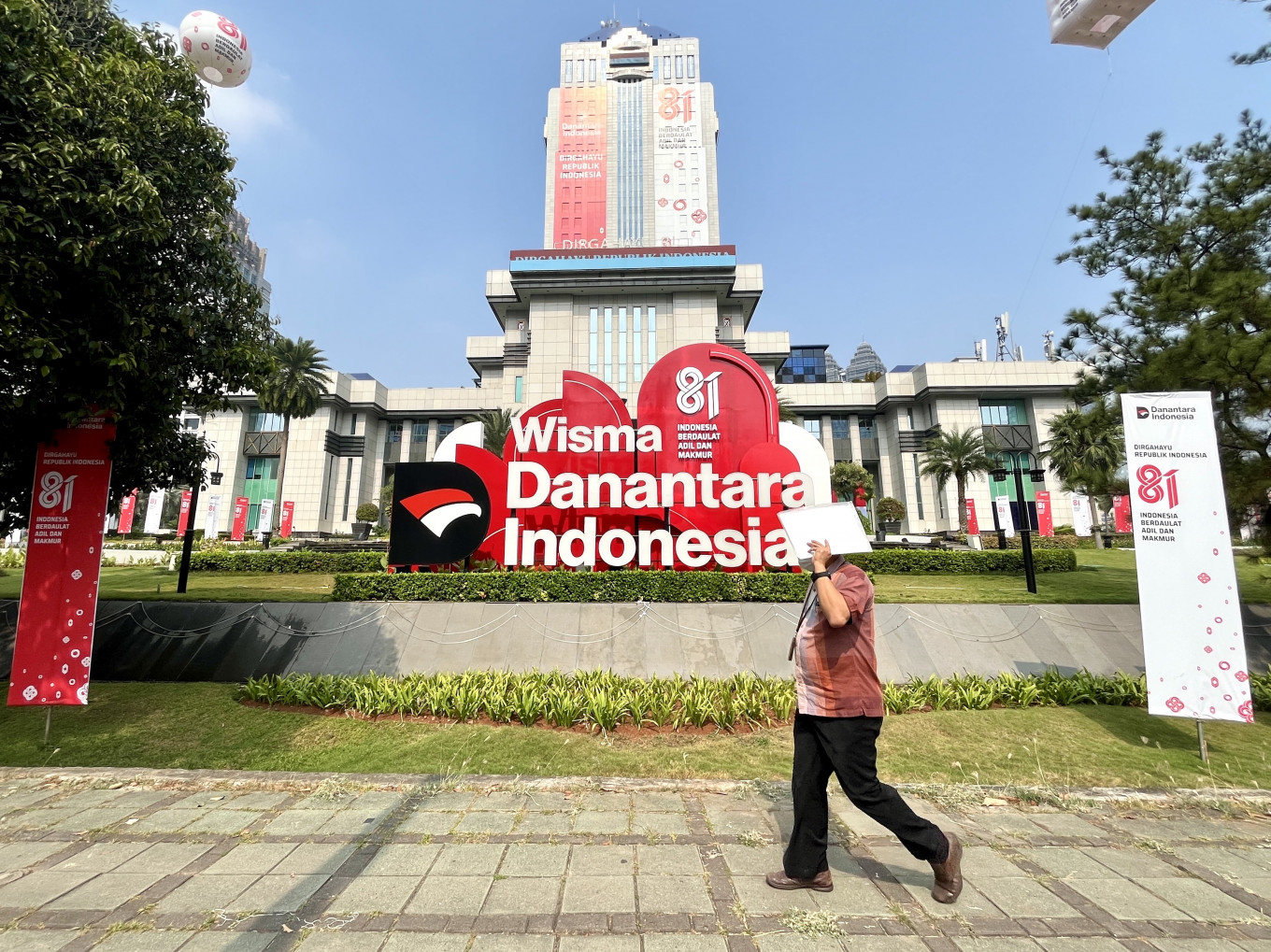 A man walks past the Wisma Danantara Indonesia building on Jl. Jend. Gatot Subroto in South Jakarta on Aug. 11, 2026. (JP/Iqro Rinaldi)
G
overnments around the world are rediscovering ownership as an instrument of economic policy. From Washington’s industrial policy and Beijing’s state-owned enterprises (SOEs) to sovereign wealth funds across Asia, states are increasingly acting not merely as regulators but as strategic shareholders. The question confronting policymakers is no longer whether governments should own corporations, but how they should govern them.
This marks a striking reversal. For more than three decades after the collapse of the Soviet Union in 1991, privatization, capital market liberalization and shareholder primacy defined the prevailing model of economic reform. Governments were encouraged to retreat from ownership, while SOEs were expected to become more like private corporations.
That consensus found its most influential expression in Henry Hansmann and Reinier Kraakman’s landmark essay, The End of History for Corporate Law, which argued that the shareholder-oriented model had effectively become the endpoint of corporate governance evolution.
The broader law-and-finance literature, particularly the work of Rafael La Porta, Florencio Lopez-de-Silanes, Andrei Shleifer and Robert Vishny, likewise emphasized investor protection and private ownership as foundations of economic development.
For much of the post-Cold War era, corporate governance ideas flowed from advanced Western economies to the rest of the world. Governments privatized SOEs, liberalized markets, strengthened investor protections and sought to insulate business decisions from political influence. At the same time, Lucian Bebchuk and Mark Roe argued that corporate governance systems remain shaped by political contexts and ownership structures, suggesting that convergence would never be complete.
China is a prominent example of this institutional divergence. Rather than privatizing strategic enterprises, Beijing corporatized them, introduced market incentives and sought to separate ownership from day-to-day management while retaining ultimate state control. The establishment of the State-owned Assets Supervision and Administration Commission (SASAC) in 2003 institutionalized the state’s role as a shareholder. As Curtis Milhaupt has observed, modern state capitalism relies less on central planning than on governments exercising influence through sophisticated corporate ownership structures.

China’s model came with significant criticisms, raising legitimate concerns about political intervention, inefficient capital allocation and distorted market competition. But it also challenged a longstanding assumption: that state ownership is necessarily incompatible with commercial performance.
More striking is that governments across different political systems and legal traditions are moving in a similar direction, rediscovering the strategic value of ownership.
The United States remains fundamentally organized around private enterprise. Yet Washington increasingly treats ownership and corporate control as matters of national security. The CHIPS and Science Act illustrates a broader industrial policy that combines public investment with strategic oversight of critical industries. More recently, the federal government has moved beyond traditional subsidies by taking a 10 percent equity stake in Intel and imposing a 15 percent revenue-sharing condition on chip exports by NVIDIA and AMD.
These developments do not mean the US is becoming China. The two countries remain profoundly different in their political systems, legal institutions and economic structures. Rather, the US illustrates a broader transformation: Governments are increasingly willing to shape corporate ownership, investment decisions and strategic control in the name of national security.
This transformation is visible across the Pacific. China’s SOEs remain the world’s most prominent example of strategic state ownership. Indonesia has recently embarked on its own experiment in state ownership through Danantara, a new state asset fund designed to consolidate and manage more than 1,000 SOEs.
Singapore’s Temasek Holdings, by contrast, represents one of the world’s most successful examples of professionally managed state ownership, demonstrating how institutional separation between political leadership and investment management can allow SOEs to operate with commercial discipline rather than bureaucratic direction.
The challenge is whether governments can govern the corporations they own. State ownership creates a distinctive governance challenge because governments simultaneously act as shareholder and regulator. Strategic ownership succeeds only when governments clearly separate those roles. International standards, including the OECD Guidelines on Corporate Governance of State-Owned Enterprises, emphasize that such separation is essential to prevent political objectives from overwhelming commercial judgment. Institutional separation also promotes board independence, managerial autonomy, accountability and commercial decision-making, which are the core objectives of modern corporate governance.
This governance challenge is increasingly universal. Whether in Washington, Beijing, Jakarta or Singapore, governments are confronting the same fundamental question: How can public ownership advance long-term national interests without undermining competition, accountability or managerial autonomy?
Recent geopolitical competition suggests that the question is no longer whether corporate governance systems will converge, but how governments increasingly employ ownership itself as an instrument of economic policy. Rather than abandoning markets, states are redefining their role within them through strategic ownership and corporate control.
Hansmann and Kraakman were largely correct that shareholder-oriented governance became the dominant model within corporations. What they could not have anticipated was the extent to which governments themselves would return as shareholders in strategically important industries.
The 20th century’s corporate governance debate centered on how corporations should be governed. The 21st century is increasingly asking a different question: How should governments govern the corporations they own?
The future of capitalism will therefore not be defined by a choice between market capitalism and state capitalism. Rather, it will depend on whether governments can exercise ownership through institutions that preserve commercial discipline, political accountability and competitive markets. As states increasingly return as strategic shareholders, designing those governance institutions is becoming one of the central corporate governance challenges of the 21st century.
---
The writer is a corporate lawyer with experience in New York, Indonesia, London and Singapore, and a graduate of Harvard Law School. This article was first published in Columbia Law School’s The CLS Blue Sky Blog.