

 Set as preferred source



Enjoy This Gifted Article!
You're reading this thanks to a The Jakarta Post subscriber.
Access is available for 30 days. For unlimited access, consider subscribing.
Please Update your browser
Your browser is out of date, and may not be compatible with our website. A list of the most popular web browsers can be found below.
Just click on the icons to get to the download page.

Can't find what you're looking for?
View all search resultsCan't find what you're looking for?
View all search resultsDespite years of constitutional reform and judicial intervention, the state's reflexive tendency to criminalize criticism of those in power remains alive and well.
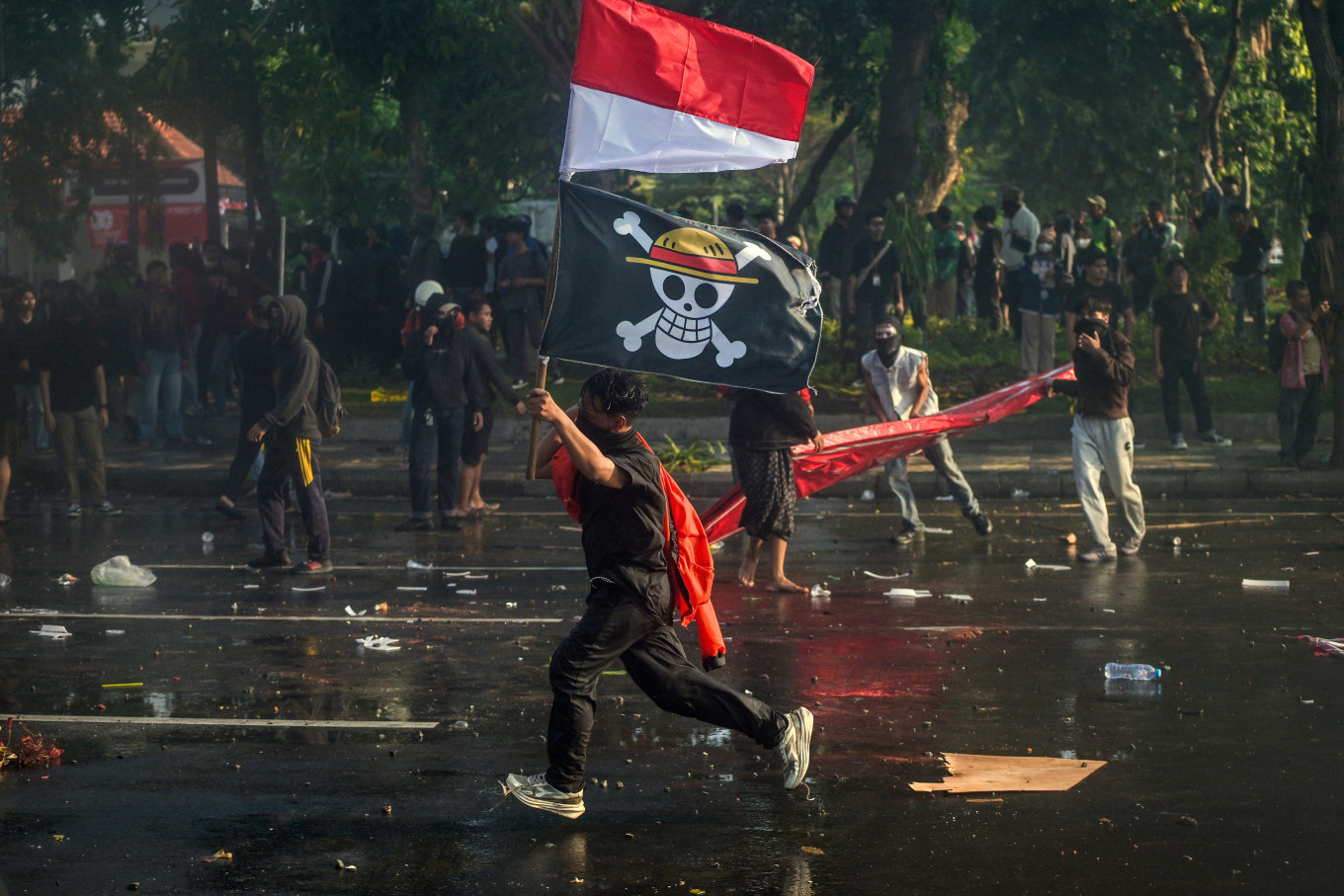 A demonstrator carries Indonesia’s national flag alongside a pirate flag from the Japanese anime One Piece, an internet symbol of protest against government policies, on Aug. 29, 2025, during a rally outside the residence of the Governor of East Java, in Surabaya. (AFP/Juni Kriswanto)
hen West Java Police arrested two social media users for mocking President Prabowo Subianto's claim that Iran has nuclear weapons, it was more than another bizarre headline - it was a warning sign. Despite years of constitutional reform and judicial intervention, the state's reflexive tendency to criminalize criticism of those in power remains alive and well.
The irony is striking. Even as the Constitutional Court has moved to narrow speech-related offenses under the Electronic Information and Transactions (ITE) Law, law enforcement and regulators appear to be finding new ways to achieve the same result: suppressing criticism and discouraging dissent.
The controversy began when Prabowo publicly stated that Iran possessed nuclear weapons. The remark drew criticism from foreign policy observers and prompted a response from the Iranian Embassy in Jakarta, which denied Tehran had developed or sought nuclear capabilities.
Two social media users who reposted and commented on the matter were subsequently arrested by West Java Police over allegations of provocation and incitement under the ITE Law and the Criminal Code.
The state has a legitimate interest in addressing genuine threats of violence.
What is troubling here is the readiness of law enforcement to transform political commentary into a criminal matter. Criticism, satire, outrage and even offensive rhetoric are inherent features of democratic discourse. If questioning a president's public statement can trigger arrest, the line between political debate and criminal liability effectively disappears.

These arrests appear to conflict with the Constitutional Court's landmark 2024 ruling No. 115. In April 2025, the court ruled that the term kerusuhan (riot or unrest) in Articles 28(3) and 45A(3) of the ITE Law must be interpreted narrowly - referring to physical disturbances of public order, not online controversy, agitation or debate.
The ruling was intended explicitly to prevent the criminalization of digital speech through vague definitions of public disorder: a heated debate on Threads or Instagram is not a riot. Yet the arrests over the Prabowo-Iran controversy suggest law enforcement continues to rely on the expansive interpretations the court sought to dismantle. Rights groups have rightly argued that the police's reasoning contradicts binding constitutional precedent.
The experience of student activist Khariq Anhar illustrates a broader pattern. Khariq was among several activists prosecuted over social media activity linked to the nationwide protests of August 2025, with prosecutors alleging their posts incited unrest. In March, the Central Jakarta District Court acquitted Khariq and his codefendants, finding no evidence their posts encouraged violence or caused the disruptions.
The ruling showed courts remain capable of distinguishing political advocacy from criminal incitement. Yet the victory was incomplete: even after acquittal, Khariq remained entangled in separate ITE Law proceedings related to satirical online content.
As human rights organizations have repeatedly observed, the process itself becomes the punishment. Arrests, detention, legal expenses and prolonged uncertainty create a powerful chilling effect, even when courts eventually reject the charges.
While the Constitutional Court sought to limit criminal liability, the government has introduced a powerful administrative mechanism that effectively bypasses those limits. Communications and Digital (Komdigi) Decree No. 127/2026 classifies "disinformation" and "hate speech" as content that disturbs society and public order, requiring digital platforms to remove flagged material within four hours of receiving a government order, with compliance monitored through the SAMAN enforcement system.
The central question is not whether governments should combat genuine hate speech or dangerous disinformation. It is who gets to decide what qualifies. Civil society organizations, including AJI, SAFEnet, ELSAM and AMSI, have warned that Decree 127 relies on elastic concepts such as "disturbing society" and "disrupting public order" - language easily weaponized against investigative journalism, political commentary and dissenting views.
Decree 127 fundamentally changes the mechanics of censorship. Previously, speech was criminalized after publication through police investigations and court proceedings.
Now content can disappear before a court ever examines its legality. A mandatory four-hour takedown deadline leaves virtually no room for independent review or due process, compelling platforms to err on the side of removal to avoid penalties. In effect, while the Constitutional Court narrowed speech-related criminal offenses, the executive branch has recreated similar powers through administrative regulation.
This also places major technology platforms, including Meta, TikTok and Google, under increasing scrutiny. These companies often present themselves as defenders of free expression, yet their commitment can weaken under government pressure.
Reporting by outlets such as Magdalene has shown platforms already restrict content in Indonesia following requests from the Komdigi Ministry. Meta's transparency reports indicate a growing number of government takedown requests across Southeast Asia, with Indonesia accounting for a significant share.
Transparency alone, however, is no longer enough. Technology companies should disclose how many requests they receive under Decree 127, how often they comply, what categories of speech are targeted, whether journalists and activists are disproportionately affected, and whether they challenge requests that conflict with international human rights standards.
Compliance without scrutiny risks transforming private platforms from neutral intermediaries into instruments of state censorship.
Indonesia's digital rights challenge must also be viewed regionally. While it is not Southeast Asia's most repressive digital environment, neither is it emerging as a defender of online freedoms.
Freedom House's Freedom on the Net 2025 report gave Indonesia a score of 48 out of 100, classifying it as "Partly Free" and citing continued prosecutions of government critics alongside expanding state oversight of digital spaces. Indonesia occupies an uncomfortable middle ground: freer than highly restrictive environments such as Vietnam and Myanmar, but lagging behind neighbors such as Malaysia and the Philippines.
What makes Indonesia's trajectory particularly concerning is the widening gap between its democratic institutions and its digital governance practices. The country retains vibrant civil society organizations, competitive elections, independent media and a judiciary still willing to uphold constitutional rights. Yet prosecutions for speech continue, activists face legal harassment and executive regulations steadily expand state control over digital discourse.
The danger is not that Indonesia will abruptly become a digital autocracy.
The greater risk is a gradual normalization of criminal prosecutions, administrative takedowns and corporate compliance as tools for suppressing lawful dissent, all while preserving the outward appearance of democratic governance.
The arrests over the Prabowo-Iran comments, the continuing legal harassment of Khariq Anhar and the implementation of Decree No. 127/2026 suggest this process is no longer hypothetical. It is already underway.
---
The writer is senior editor at The Jakarta Post and a member of Meta's independent Oversight Board. The views expressed are personal.
Share your experiences, suggestions, and any issues you've encountered on The Jakarta Post. We're here to listen.
Thank you for sharing your thoughts. We appreciate your feedback.
Quickly share this news with your network—keep everyone informed with just a single click!
Share the best of The Jakarta Post with friends, family, or colleagues. As a subscriber, you can gift 3 to 5 articles each month that anyone can read—no subscription needed!
Get the best experience—faster access, exclusive features, and a seamless way to stay updated.


