The Jakarta Post
Please Update your browser
Your browser is out of date, and may not be compatible with our website. A list of the most popular web browsers can be found below.
Just click on the icons to get to the download page.


Popular Reads
Top Results
No results found. Please check your search term and try again
Can't find what you're looking for?
View all search results
Popular Reads
Top Results
No results found. Please check your search term and try again
Can't find what you're looking for?
View all search resultsWhy the world still needs Wall Street
Other financial systems have only so much capacity to receive a large and rapid reallocation without destabilizing themselves.
Change text size
Gift Premium Articles
to Anyone
Share the best of The Jakarta Post with friends, family, or colleagues. As a subscriber, you can gift 3 to 5 articles each month that anyone can read—no subscription needed!
 Set as preferred source
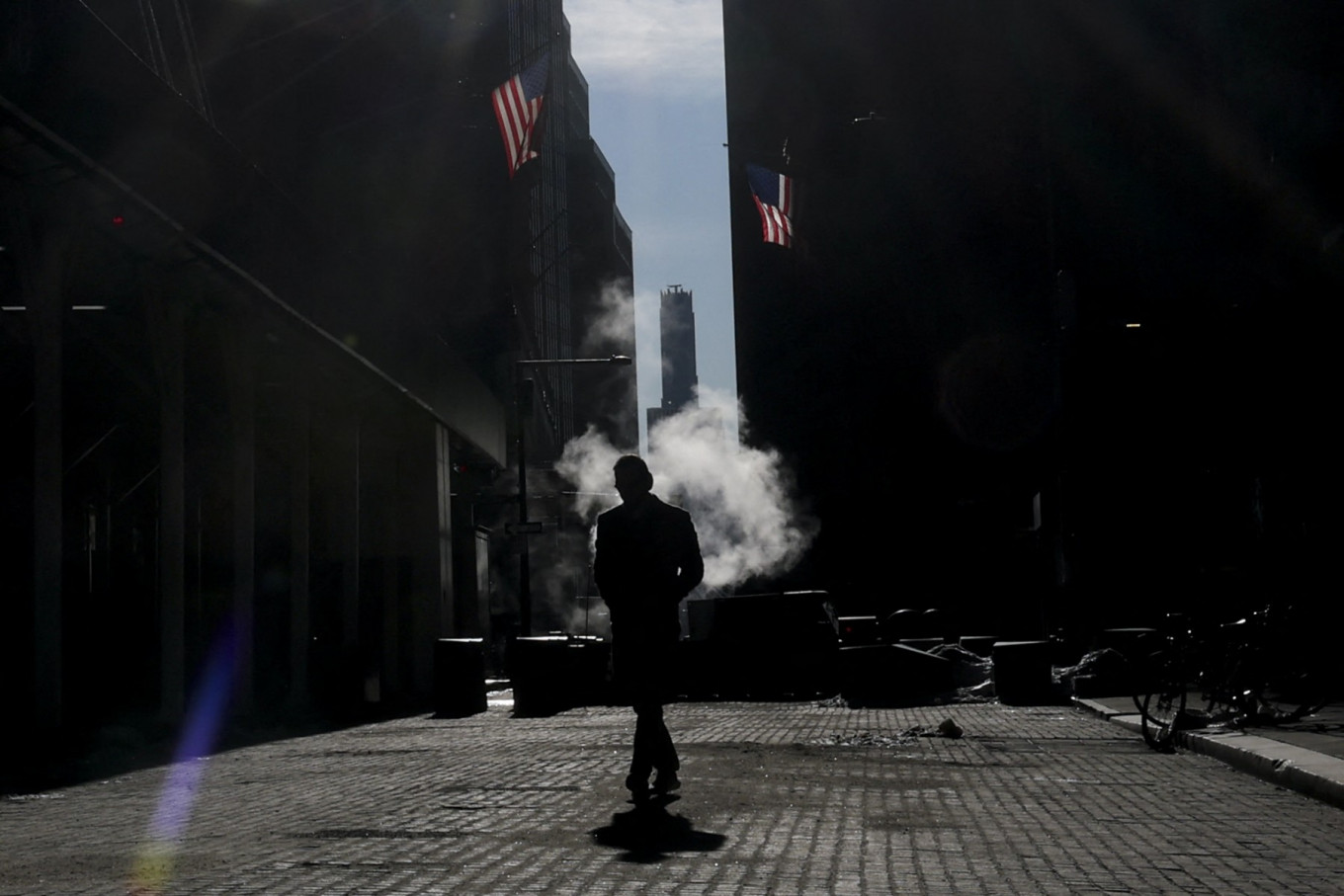 A person walks on Wall Street near the New York Stock Exchange (NYSE) on Feb. 13, 2026 in New York City, the United States. (AFP/Angela Weiss)
I
nvestors have no shortage of reasons to diversify away from the United States. America’s public debt is rising, political polarization is deepening, trade policy has become unpredictable, the rule of law is now in doubt and financial sanctions have encouraged other governments to seek alternatives to the dollar. Yet there has been no great exodus from US markets.
The dollar still accounted for 56.8 percent of allocated foreign-exchange reserves at the end of 2025, and was used in 89.2 percent of all foreign-exchange trades surveyed by the Bank for International Settlements.
These figures are usually explained by America’s economic size, legal protections, innovative companies, deep capital markets and the network effects created by the dollar’s roles in trade, credit, payments and reserves. But the main constraint is hiding in plain sight: Even if the world wanted to move several trillion dollars out of the US, where would the money go?
The problem is not a shortage of promising economies or assets. It is that other financial systems have only so much capacity to receive a large and rapid reallocation without destabilizing themselves.
We can think of this system-wide financial absorptive capacity as a market’s ability to receive, price, hedge and settle enormous capital flows without causing extreme movements in asset prices, yields or exchange rates. Absorptive capacity depends not only on the volume of securities available, but also on exchanges, banks, dealers, clearinghouses, custodians, regulators, courts, auditors, lawyers, data providers and central-bank backstops.
This distinction matters because diversification is usually considered from the viewpoint of an individual investor. A pension fund can sell US Treasuries and buy European bonds; a central bank can add gold or another currency to its reserves. Such moves are straightforward at the margin. But what happens when thousands of large institutions try to do the same thing at the same time?

Prices in destination markets would surge, yields would fall and currencies would appreciate. High-quality bonds of suitable maturity would become scarce, hedging costs would rise, and prudential or benchmark limits would start to bind. Markets that look deep in normal times might prove shallow in the face of exceptional inflows. What is sensible for one investor might be impossible for all investors together. To assume otherwise is to commit a classic fallacy of composition.