The Jakarta Post
Please Update your browser
Your browser is out of date, and may not be compatible with our website. A list of the most popular web browsers can be found below.
Just click on the icons to get to the download page.


Popular Reads
Top Results
No results found. Please check your search term and try again
Can't find what you're looking for?
View all search results
Popular Reads
Top Results
No results found. Please check your search term and try again
Can't find what you're looking for?
View all search results35 years of the Weimar Triangle: France, Germany and Poland shaping Europe’s future
The Weimar Triangle was founded on a conviction that remains as relevant today as it was 35 years ago — together, we are stronger.
Change text size
Gift Premium Articles
to Anyone
Share the best of The Jakarta Post with friends, family, or colleagues. As a subscriber, you can gift 3 to 5 articles each month that anyone can read—no subscription needed!
 Set as preferred source
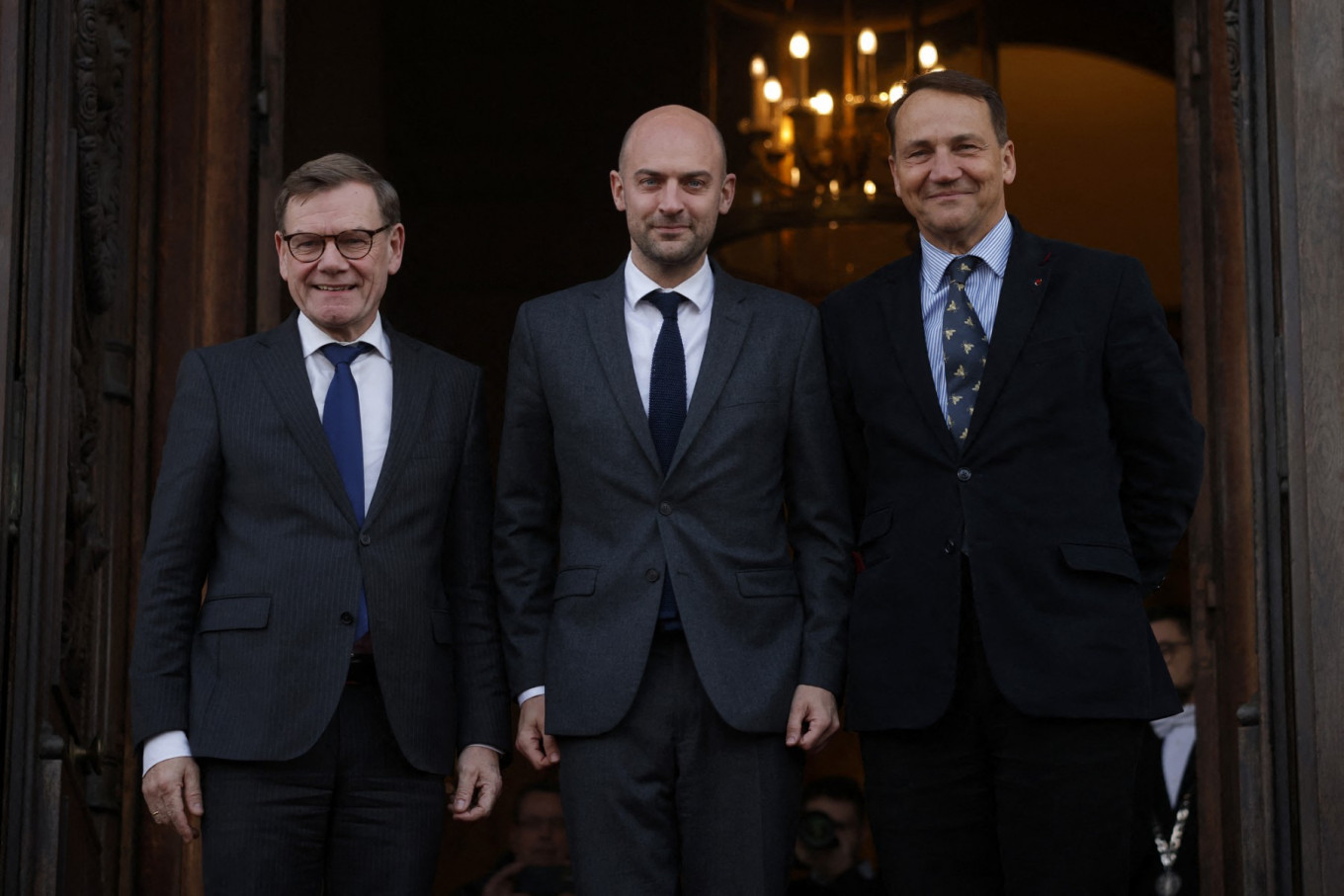 French Foreign Affairs Minister Jean-Noel Barrot (center) pose with German Foreign Minister Johann Wadephul (left) and Polish Minister of Foreign Affairs Radoslaw Sikorski on Jan. 7 upon their arrival for a Weimar Triangle and India meeting at the French Foreign ministry in Paris. (AFP/Pool/Yoan Valat)
S
ome 35 years ago, Europe stood at a historic crossroads. The Cold War was coming to an end, Germany was reunifying and Poland was emerging from decades of communist rule. Against this backdrop, on Aug. 28, 1991, the Foreign Ministers of France, Germany and Poland met in the German city of Weimar. Their meeting gave birth to what became known as the Weimar Triangle.
The idea was simple but ambitious — to build a special relationship between three countries whose histories had too often been marked by rivalry and conflict, at a moment when Poland was regaining its freedom and sovereignty. The experience of Franco-German reconciliation after 1945 offered an important inspiration. What had once seemed almost unimaginable — transforming centuries of conflict into partnership — became one of the driving forces behind European integration.
The Weimar Triangle was founded on a conviction that remains as relevant today as it was 35 years ago — together, we are stronger.
This is perhaps the most important lesson that our three countries can draw from our own history. We have not forgotten the difficult chapters of the past. On the contrary, it is precisely because we know where division and hatred can lead that we understand the value of cooperation, compromise and a Europe capable of acting together.
Over the past 35 years, the Triangle has repeatedly adapted to radically different European realities. Initially, it helped support reconciliation and anchor a newly democratic Poland in Europe. Following Poland’s accession to NATO in 1999 and to the European Union in 2004, it increasingly became a forum for discussing the future of the EU, enlargement, neighborhood policy and European affairs.
Despite the absence of formal institutions, its enduring strength lies in its ability to adapt. Today, that ability is being tested once again.

Russia’s full-scale war against Ukraine has fundamentally changed Europe’s security environment and brought the strategic perspectives of Warsaw, Paris and Berlin closer together.