The Jakarta Post
Please Update your browser
Your browser is out of date, and may not be compatible with our website. A list of the most popular web browsers can be found below.
Just click on the icons to get to the download page.


Popular Reads
Top Results
No results found. Please check your search term and try again
Can't find what you're looking for?
View all search results
Popular Reads
Top Results
No results found. Please check your search term and try again
Can't find what you're looking for?
View all search resultsThe deadliest Ebola outbreak can be stopped
Stopping the world’s fastest-moving Ebola outbreak demands more than international aid—it requires empowering the local communities and frontline workers holding the front line.
Change text size
Gift Premium Articles
to Anyone
Share the best of The Jakarta Post with friends, family, or colleagues. As a subscriber, you can gift 3 to 5 articles each month that anyone can read—no subscription needed!
 Set as preferred source
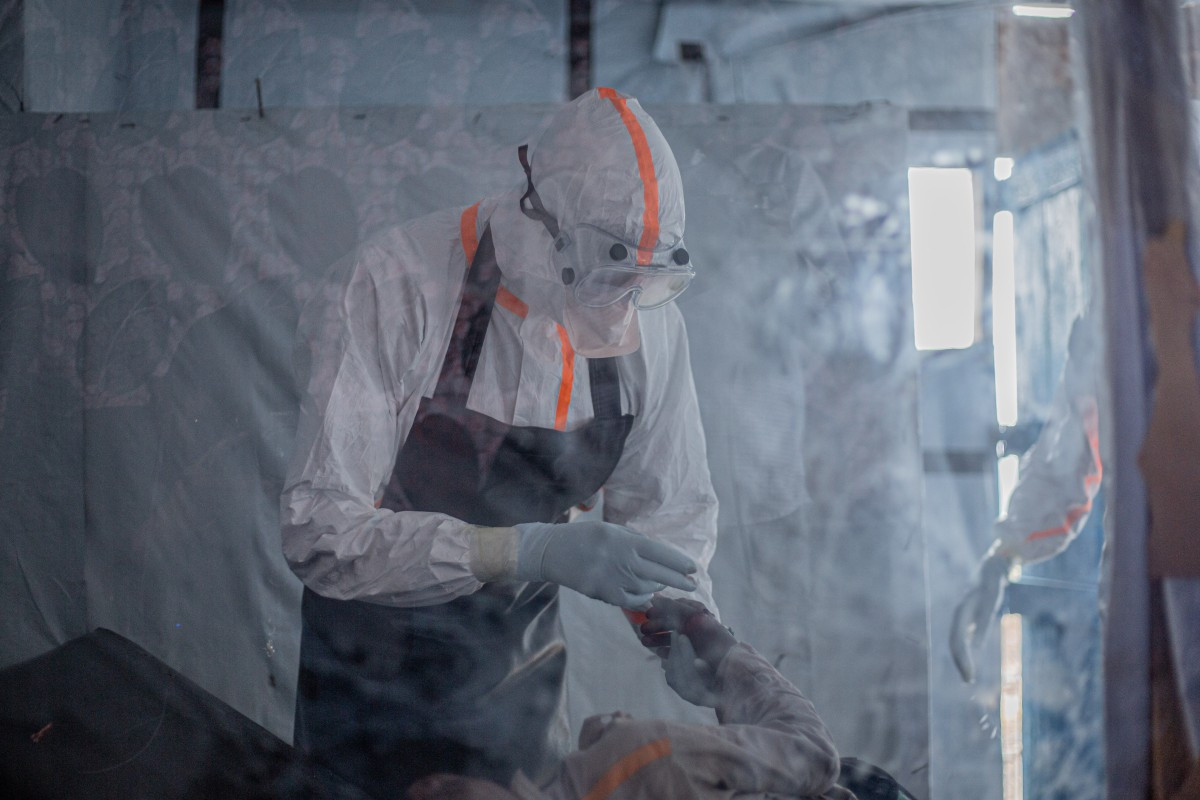 A doctor provides care to a patient with Ebola virus on July 13 at the Rwampara Ebola Treatment Center in Bunia, Ituri, in the east of the Democratic Republic of Congo. Health workers at the epicenter of the Ebola outbreak in DR Congo are threatening to strike, telling AFP on July 13 they had not been paid since the virus was detected in mid-May. The highly infectious disease has killed more than 700 people among the nearly 2,000 confirmed infected in the Democratic Republic of Congo since the outbreak was declared on May 15, according to the latest official toll published on July 14. (AFP/Benediction Murhabazi)
Whenever we travel to the Democratic Republic of the Congo (DRC), we begin by listening.
In Bunia, we met with dozens of community representatives—survivors, women, youth leaders, local organizations and frontline health workers. Their message was clear: Involve us.
They understand the local landscape. They know where families turn for care, how information spreads, and why trust breaks down. They are asking for the resources to help drive this response, and they are right.
Ebola moves through communities, but communities hold the insight needed to stop it. When local residents lead alongside national authorities and health workers—spotting symptoms early, tracing contacts, dispelling dangerous rumors and supporting dignified burials—containment accelerates significantly.
One hundred days ago, the DRC government declared the country’s 17th Ebola outbreak after confirming cases of the Bundibugyo virus. That prompted both a WHO Public Health Emergency of International Concern and an Africa Centers for Disease Control and Prevention (CDC) Public Health Emergency of Continental Security.
The scale is immense. As of Aug. 21, the DRC has recorded 5,290 confirmed cases and 2,516 deaths across 56 health zones. It is now the second-largest Ebola outbreak in history—and the fastest-spreading. Decades of armed conflict have fueled the crisis, displacing over a million people while gutting public infrastructure and essential services.

At the heart of the response are the people showing up every day: Clinicians and lab technicians providing bedside care and diagnosing cases; contact tracers and community workers mapping transmission and rebuilding trust where fear has taken root; burial teams helping grieving families honor loved ones safely.
These responders operate under relentless pressure in insecure, remote regions, and several have contracted the virus on duty. Their commitment requires immediate, tangible backing: personal protective equipment, rigorous training, steady medical supplies, on-time pay, mental health support and priority access to high-quality care if they fall ill. Protecting frontline workers is fundamental to ending transmission.
Progress is possible. Congolese responders, the WHO, Africa CDC and partners have broadened surveillance, set up field labs, equipped treatment centers, and delivered critical supplies. Uganda has already interrupted local transmission, as have health zones in South Kivu and northern Ituri. These successes prove that rapid detection, clear national leadership and deep community cooperation can sever chains of transmission.
Yet with active transmission persisting across Ituri and five other provinces, current efforts must expand two- to threefold across every pillar of the response.
Hospitals and clinics need immediate reinforcement. As of Aug. 20, 158 health workers have been infected and 45 have died. Every facility in high-risk zones requires clean water, functional sanitation, trained staff and robust infection-control protocols.
Carrying this out demands predictable, unified financing. Delayed funding costs lives; fragmented funding creates deadly blind spots. Local responders need resources before supply shelves sit empty. Rather than funding siloed initiatives, donors should back the integrated operational network established on the ground by the government, WHO and Africa CDC.
Regional mobility also requires smart coordination rather than isolation. People constantly cross borders to work, trade, study and seek medical care. Blanket travel bans and border closures disrupt local economies and humanitarian logistics without halting the virus. Instead, borders should act as coordination hubs focused on shared surveillance, rapid data exchanges and fortified health checkpoints along key transit corridors.
The mandate for the next phase is straightforward: Find every case, track every contact, and break every transmission chain, bring testing and decentralized treatment closer to affected neighborhoods, safeguard healthcare workers, reinforce regional cross-border surveillance and convert international financial pledges into immediate ground-level resources.
WHO and Africa CDC remain committed to backing the DRC, neighboring nations, and local responders with the full weight of continental and global solidarity. We have seen what works; now we must deliver that support at the scale this crisis demands.
***
Tedros Adhanom Ghebreyesus is Director-General of the World Health Organization. Mohamed Yakub Janabi is Regional Director of the WHO African Region. Jean Kaseya is Director-General of the Africa Centres for Disease Control and Prevention.