The Jakarta Post
Please Update your browser
Your browser is out of date, and may not be compatible with our website. A list of the most popular web browsers can be found below.
Just click on the icons to get to the download page.


Popular Reads
Top Results
No results found. Please check your search term and try again
Can't find what you're looking for?
View all search results
Popular Reads
Top Results
No results found. Please check your search term and try again
Can't find what you're looking for?
View all search resultsOECD is no magic lamp
Chasing elite clubs like the OECD won’t magically transform Indonesia’s economy, especially in a fractured global order where diplomatic prestige is no substitute for domestic reform.
Change text size
Gift Premium Articles
to Anyone
Share the best of The Jakarta Post with friends, family, or colleagues. As a subscriber, you can gift 3 to 5 articles each month that anyone can read—no subscription needed!
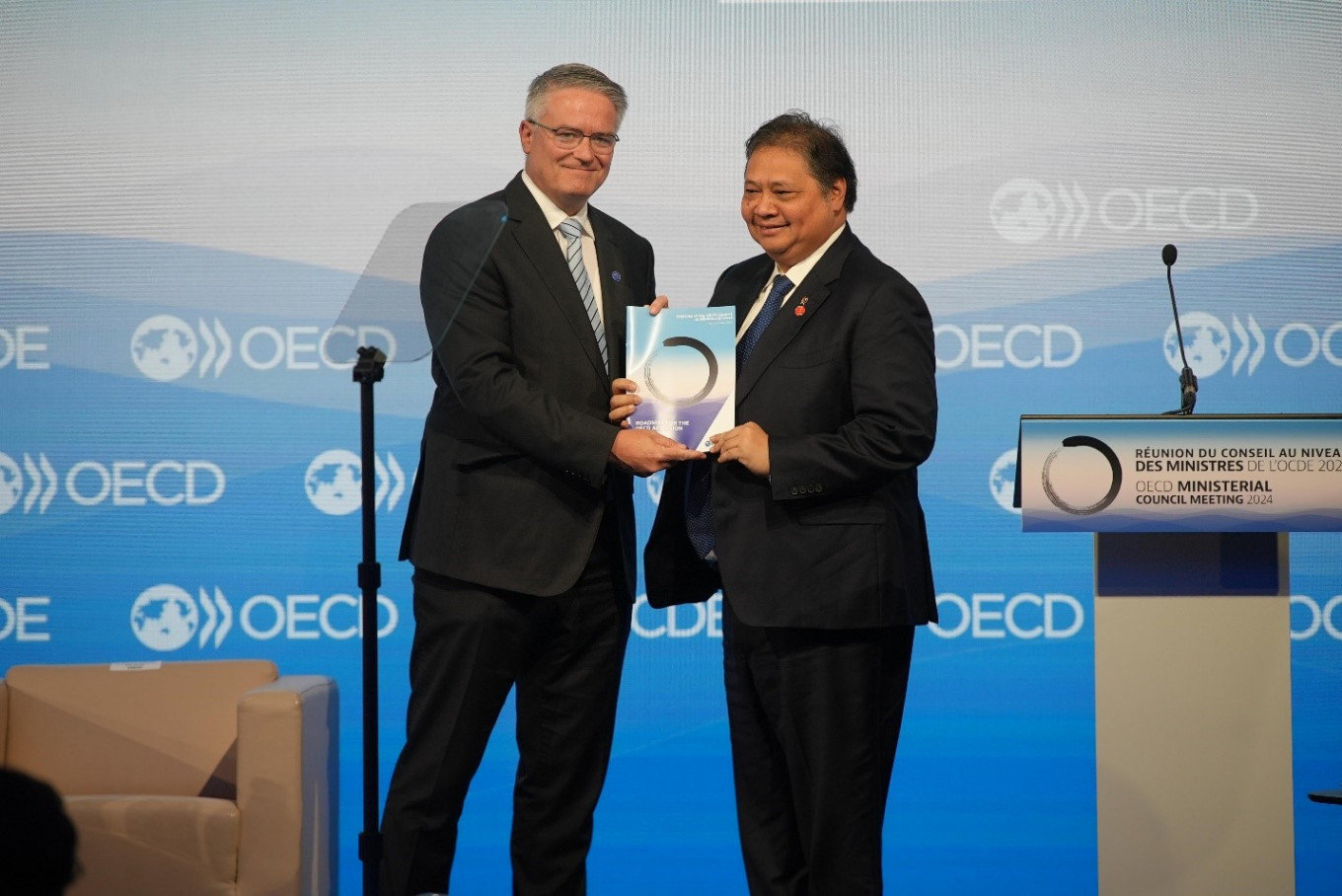 Coordinating Economy Minister Airlangga Hartarto (right) receives the Roadmap for the OECD Accession of Indonesia from the organization’s secretary-general Mathias Cormann on May 2, 2024, during the opening of the OECD Ministerial Council Meeting in Paris.
A
s United States President Donald Trump doubles down on a unilateral trade war targeting dozens of major partners, President Prabowo Subianto’s push to join multilateral pacts like the Organisation for Economic Co-operation and Development and the Japan-led Comprehensive and Progressive Agreement for Trans-Pacific Partnership (CPTPP) is setting Indonesia up for disappointment.
This ambition brings to mind the old Indonesian saying, “Melihat hujan di langit, air di tempayan ditumpahkan”: discarding what one has for a promise that might not materialize.
Jakarta has already ratified the world’s largest free trade agreement, the ASEAN-led Regional Comprehensive Economic Partnership (RCEP) linking the bloc with China, Japan, South Korea, Australia and New Zealand. Yet Indonesia has barely capitalized on it. Rather than chasing prestigious new clubs, Jakarta would do better to extract actual economic value from the trade architecture it already belongs to.
Unilateralism and minilateralism have largely displaced the traditional multilateral order, leaving the World Trade Organization sidelined. Expecting multilateral frameworks to shield Indonesia while individual nations scramble against rising tariff walls is simply wishful thinking.
Indonesia launched its OECD bid in 2023, received its accession road map in May 2024, and Coordinating Economy Minister Airlangga Hartarto has targeted full membership by next year.
Officials believe joining will unlock vast export markets across the group's 38 members, which account for roughly 75 percent of world trade, and signal to foreign investors that Indonesia adheres to developed-world standards. OECD Secretary-General Mathias Cormann has framed accession as a catalyst for regulatory reform, market competition and institutional integrity.

In practice, those high benchmarks on taxation, environmental rules, labor, governance and human rights remain well beyond Jakarta’s near-term reach. The extensive deregulation and institutional overhaul required recall the bitter medicine forced on the country by the International Monetary Fund during the 1997-1998 Asian financial crisis. Domestic resistance to such sweeping liberalization is already mounting across national and regional regulatory bodies.