The Jakarta Post
Please Update your browser
Your browser is out of date, and may not be compatible with our website. A list of the most popular web browsers can be found below.
Just click on the icons to get to the download page.


Popular Reads
Top Results
No results found. Please check your search term and try again
Can't find what you're looking for?
View all search results
Popular Reads
Top Results
No results found. Please check your search term and try again
Can't find what you're looking for?
View all search resultsAnalysis: KKI expands credit access amid rising household risks
Change text size
Gift Premium Articles
to Anyone
Share the best of The Jakarta Post with friends, family, or colleagues. As a subscriber, you can gift 3 to 5 articles each month that anyone can read—no subscription needed!
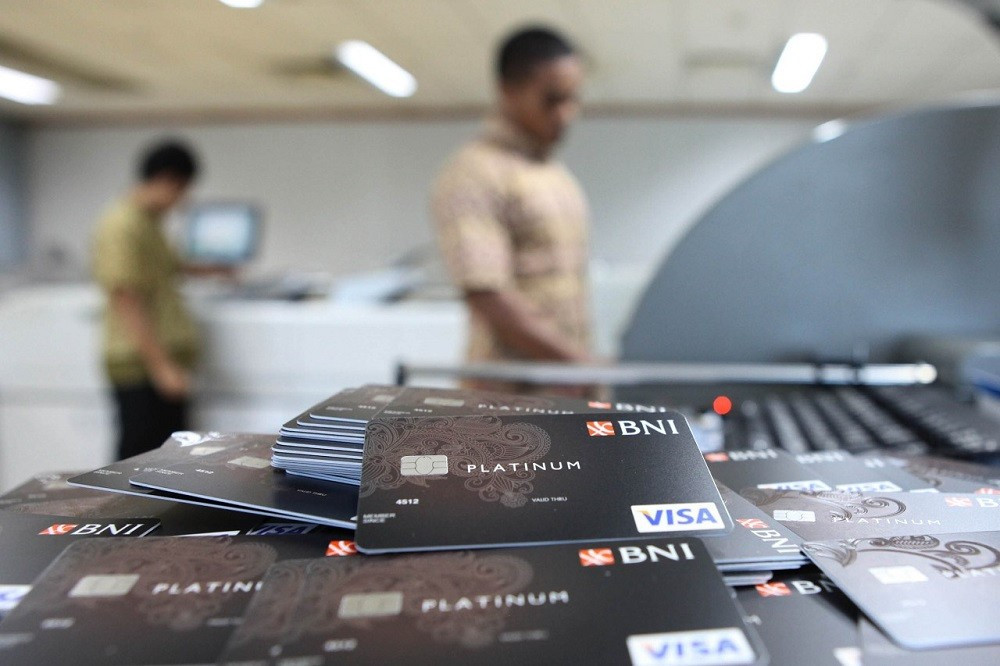 Cashless economy: State-owned bank BNI employees print credit cards on Aug. 10, 2012, at the lender’s Card Business Division in Jakarta. Bank Indonesia (BI) has cut the interest rate for credit cards from a maximum of 2 percent to 1.75 percent per month, effective on Thursday. (JP/Nurhayati)
B
ank Indonesia (BI) and the Indonesian Payment System Association (ASPI) launched Kartu Kredit Indonesia (KKI) on Aug. 17, enabling deferred QRIS payments to be processed domestically. While easier access to credit could support consumption and strengthen Indonesia’s payment ecosystem, it also carries risks. Without prudent lending standards, greater convenience could lead to higher household debt and deteriorating credit quality.
KKI builds on Indonesia’s existing QRIS payment infrastructure by allowing consumers to use the familiar QR-code payment mechanism for credit transactions. KKI transactions will be facilitated through the National Payment Gateway (GPN), enabling a larger share of retail payments to be processed domestically. This represents another step in BI’s gradual effort to strengthen domestic payment infrastructure, which began with the establishment of GPN in 2017 and continued with the launch of QRIS in 2019 to standardize QR-code payments.
QRIS has marked a significant breakthrough in Indonesia’s digital payment system by accelerating the digitalization of economic activity, particularly among micro, small and medium enterprises (MSMEs). Its reach has subsequently expanded beyond Indonesia through cross-border payment arrangements covering nine countries, including several Southeast Asian economies, as well as Japan and South Korea. QRIS transaction volume reached 12.55 billion in the first half of 2026, an increase of 100.12 percent from the same period in 2025. Its rapid adoption underscores QRIS’ growing role in expanding financial inclusion and deepening Indonesia’s digital financial ecosystem.
KKI could extend this progress into the credit-card market. Credit-card payments in Indonesia have traditionally relied heavily on global payment networks such as Visa and Mastercard, which together account for around 90 percent of the market. By providing a domestic alternative, KKI could introduce greater competition into the payment infrastructure while allowing local businesses to reduce some of the fees associated with foreign payment networks. This is particularly relevant for Indonesia, where credit-card penetration remains relatively low at around 5 percent, compared with approximately 35 percent in Thailand and 30 percent in Malaysia.
The integration of QR payments and credit cards is not entirely new in Indonesia, as Bank Mandiri has already enabled credit-card payments through QRIS. In KKI’s first phase, eight major banks will participate: Bank Mandiri, BCA, BNI, BRI, CIMB Niaga, PermataBank, Bank Mega and BSI. While the payment infrastructure will be domestic, responsibility for credit underwriting will remain with each participating bank. This distinction is important: KKI changes how credit is accessed and payments are processed, but the quality of the underlying lending will ultimately depend on banks’ credit assessments.
This is where the challenge begins. While KKI could make credit-card transactions more convenient, greater accessibility will not necessarily translate into healthy credit expansion. Overall bank lending growth has recently recovered to double digits, reaching 13.58 percent after a period of single-digit growth. Yet the recovery has not been driven primarily by household consumption.

Instead, overall credit growth has been supported by investment loans, which expanded by around 25 percent, while consumer credit grew by only 5.38 percent. Consumer credit growth has also slowed from 6.13 percent in April 2026. More importantly, signs of deterioration are emerging in credit quality. Consumer non-performing loans (NPLs) reached 2.5 percent in May 2026, up from 2.29 percent in May 2025. This suggests that efforts to expand access to consumer credit are taking place against a backdrop of increasingly strained household balance sheets.