The Jakarta Post
Please Update your browser
Your browser is out of date, and may not be compatible with our website. A list of the most popular web browsers can be found below.
Just click on the icons to get to the download page.


Popular Reads
Top Results
No results found. Please check your search term and try again
Can't find what you're looking for?
View all search results
Popular Reads
Top Results
No results found. Please check your search term and try again
Can't find what you're looking for?
View all search resultsSparring and engaging, Asia's new normal
As traditional US alliances shift and Beijing flexes its muscle, regional powers must master the delicate art of sparring with China without triggering an outright conflict.
Change text size
Gift Premium Articles
to Anyone
Share the best of The Jakarta Post with friends, family, or colleagues. As a subscriber, you can gift 3 to 5 articles each month that anyone can read—no subscription needed!
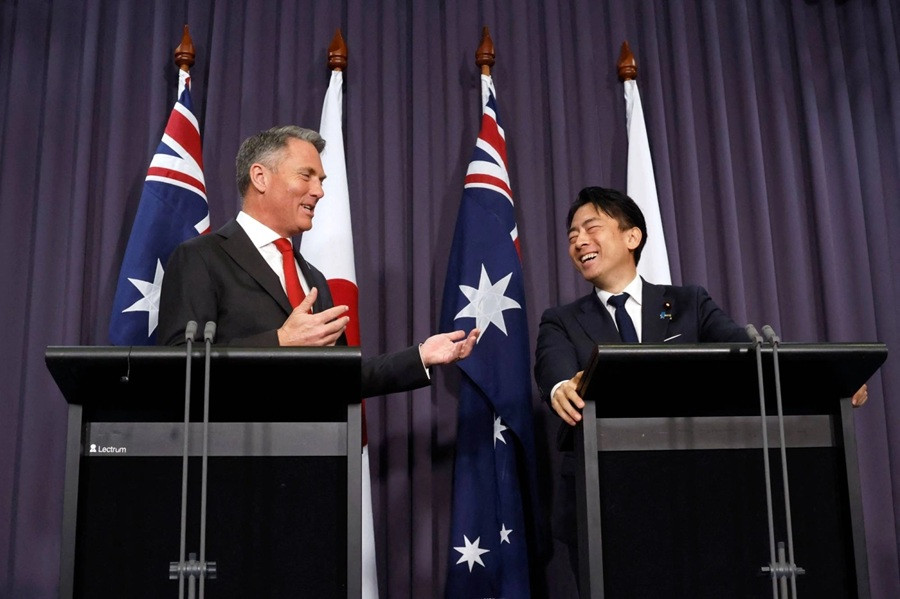 Australian Deputy Prime Minister and Minister for Defence Richard Marles (left) shares a light moment with Japanese Defense Minister Shinjiro Koizumi on Aug. 18, 2026, during a joint news conference at Parliament House in Canberra. (AFP/Jiji)
J
apanese Defense Minister Shinjiro Koizumi visited Australia on Aug. 18 to bolster Tokyo’s security ties with Canberra. Given how unpredictable and transactional the administration of President Donald Trump has become, traditional United States allies face an urgent imperative to deepen relationships, not just defensively but well beyond the security realm.
Japan and South Korea are steadily thawing ties, potentially laying the groundwork for a broader regional cooperation framework in the Asia-Pacific.
This aligns with recent remarks by Australia’s ambassador-designate to Japan, Andrew Shearer, who noted in an interview with Nikkei Asia the value of building a resilient network of like-minded regional partners. Closer alignment among Japan, South Korea, the Philippines and Australia could soon extend past defense strategy into economic policy and people-to-people exchanges.
Understandably, Beijing views these shifts with suspicion. But should China genuinely be surprised when its neighbors forge new partnerships?
China’s state-aligned media outlet Global Times reacted sharply to Shearer’s still-nascent proposal. Yet as China projects power across the region and routinely showcases its military strength, its regional rivals will inevitably seek counterweights.
While Beijing champions global cooperation, peace and development, its dominant, and increasingly assertive, posture naturally triggers pushback. China is a superpower competing neck and neck with the US, and displaying its unmatched regional capabilities is a predictable exercise of statecraft. It is equally predictable, however, that neighboring capitals will respond rather than look on passively.

These regional rivalries are inevitable, but they must be managed carefully to keep divergent interests from triggering catastrophic escalation. Even strategic competitors can build functional ties. It is a daunting task, yet hardly impossible.