The Jakarta Post
Please Update your browser
Your browser is out of date, and may not be compatible with our website. A list of the most popular web browsers can be found below.
Just click on the icons to get to the download page.


Popular Reads
Top Results
No results found. Please check your search term and try again
Can't find what you're looking for?
View all search results
Popular Reads
Top Results
No results found. Please check your search term and try again
Can't find what you're looking for?
View all search resultsCost of recentralization
It seems to have become a pattern under the government of President Prabowo Subianto. When problems erupt, the state must “be present”, as the President often puts it, which translates into asserting itself more forcefully.
Change text size
Gift Premium Articles
to Anyone
Share the best of The Jakarta Post with friends, family, or colleagues. As a subscriber, you can gift 3 to 5 articles each month that anyone can read—no subscription needed!
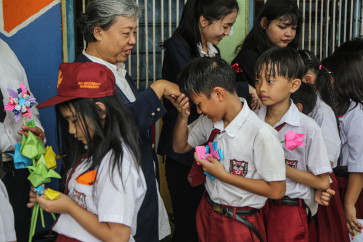
 Pupils pay respect to their teachers during a Teacher's Day celebration at an elementary school in Semarang, Central Java, on Nov. 25, 2025. (Antara/Makna Zaezar)
A
clear pattern seems to have emerged under the government of President Prabowo Subianto: whenever problems erupt, the state must “be present”, as the President often puts it, which typically translates into asserting central authority more forcefully.
This pattern extends even to the complex problems created by the administration's own policies. Tensions tend to escalate rather than dissipate, as the government continues to rely on a heavy-handed, top-down approach instead of fostering open dialogue and seeking compromise with disputing parties.
A clear example is evident in the recent plan to address escalating protests across the regions by contract workers whose salaries have gone unpaid by local administrations for months. Citing fiscal discipline, budget efficiency and widespread regional corruption, the Prabowo administration has systematically cut back on regional transfers over the past two years. This has triggered severe public service disruptions that have snowballed into a widespread hiring crisis involving contract workers under the Government Employees with Work Agreements (PPPK) scheme, most notably public school teachers.
In an effort to resolve the issue, the central government announced a plan to take over teacher recruitment entirely from regional administrations, ensuring that contract teachers are directly funded and employed through the national state budget rather than local ones. This has been paired with an ambitious plan to centralize teacher planning and recruitment to meet the administrative needs of all state schools nationwide.
This ad hoc solution illustrates how the government tends to double down and push harder when it should instead pause, listen and coordinate closely with local administrations to find a sustainable fix. This intervention directly disrupts the regional transfer mechanism, which serves as a cornerstone of equitable welfare distribution and fiscal balance across the provinces.
Alongside unpaid wages, disrupted public services and sluggish disaster response efforts have driven frustrated citizens onto the streets in a major backlash against the reduction in regional transfers. While the central government aims to pay contract workers directly without imposing further cuts on local budgets, taking unilateral control over teacher hiring represents another worrying step toward eroding regional autonomy.

This move risks triggering a massive expansion of the central bureaucracy to manage nationwide teacher recruitment, all while stripping local administrations of the legitimate authority granted to them under decentralization. Recruitment and candidate assessment have traditionally been handled by local education agencies ever since the regional offices of the education ministry were dissolved under decentralization nearly three decades ago.