The Jakarta Post
Please Update your browser
Your browser is out of date, and may not be compatible with our website. A list of the most popular web browsers can be found below.
Just click on the icons to get to the download page.


Popular Reads
Top Results
No results found. Please check your search term and try again
Can't find what you're looking for?
View all search results
Popular Reads
Top Results
No results found. Please check your search term and try again
Can't find what you're looking for?
View all search resultsFight the fires, flour power and 40 centimeters
While Indonesia dreams up airborne flour bombs to fight forest fires, its peatlands are quietly sinking out of existence—governed by an ignored 40-centimeter water rule that no aerial stunt can fix.
Change text size
Gift Premium Articles
to Anyone
Share the best of The Jakarta Post with friends, family, or colleagues. As a subscriber, you can gift 3 to 5 articles each month that anyone can read—no subscription needed!
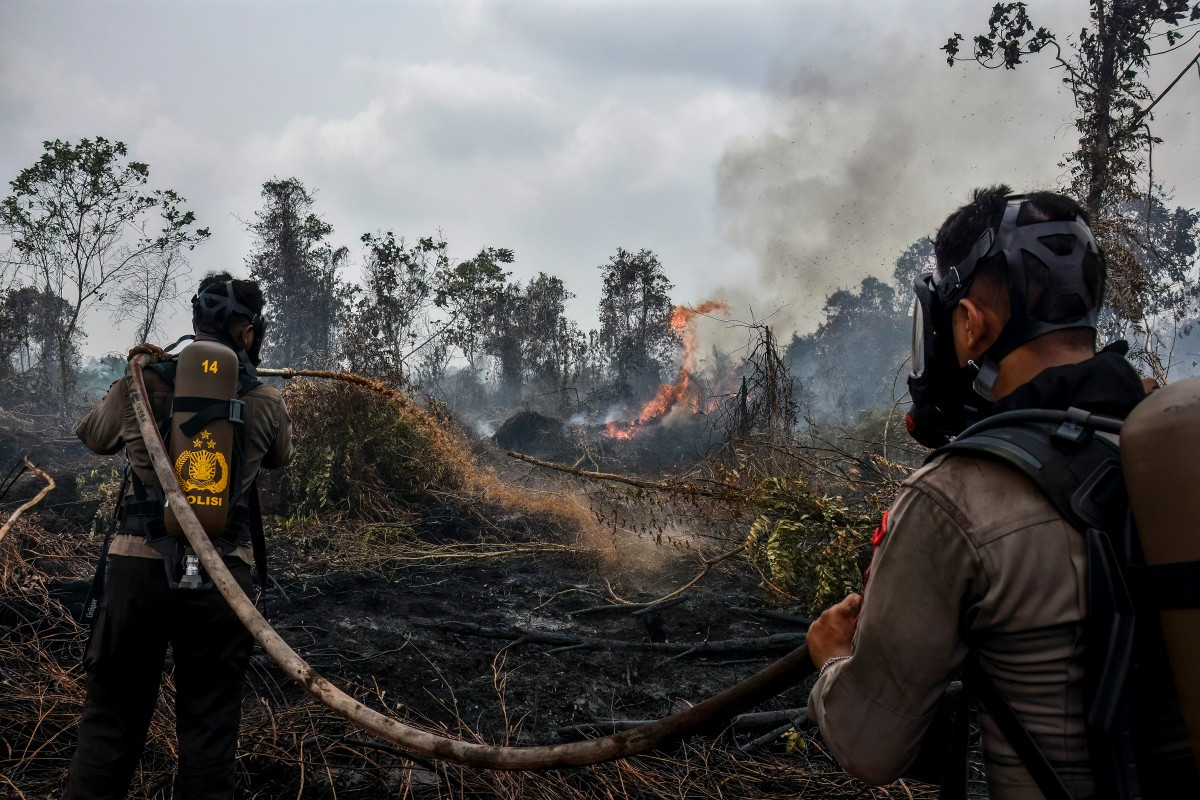 Police in firefighting gear extinguish a peatland fire at Tambang in Kampar, Riau, on Aug. 25, 2026. (AFP/Wahyudi)
A
country with little to laugh about laughed anyway. On Aug. 24, at a coordination meeting in Palembang the National Police chief offered President Prabowo Subianto an unorthodox fix for the smog blanketing South Sumatra: drop cassava flour from helicopters. Prabowo leaned in, tasked the state research agency (BRIN) with costing it out, and calculated the payload out loud: an Mi-17 helicopter carries 4 tonnes of water, so that means 4 tonnes of flour. Then he christened the tactic himself: ubi (sweet potato) bombing.
The chemistry is not so much absurd as misplaced. Aerial retardants do use plant polysaccharides, but only as thickeners, not as active suppressing agents. Starch helps water stick; it does not make water extinguish fires any better.
Yet chemistry misses the deeper issue: altitude. Peat fires do not rage on the surface; they smolder deep underground in the organic column. That is why ground crews watch doused sites reignite after dark. The only real remedy is the water table, Indonesian law mandates drainage depth at no deeper than 40 centimeters below the surface. Everything else is theater staged from 300 meters in the air.
The empirical evidence is remarkably clear. Researcher Salmayenti and colleagues compared restored peatlands with unrestored controls, demonstrating that rewetting reduced fire hot spots by up to 2.6 per square kilometer during El Niño in 2019, with deep wells consistently outperforming canal dams. Even discounted, this represents a preventive measure with a verified effect size, a rarity in Indonesian environmental governance.
Yet the state has let this infrastructure decay. When NGO Pantau Gambut inspected canal blocks across government restoration zones this year, seven out of 10 were broken, and its 10-year review showed water tables lingering below the safety threshold at 52 percent of monitored sites. The agency responsible for these works saw its mandate expire on Dec. 31, 2024, without a successor named for four months.
Meanwhile, the Forestry Ministry recorded 107,465 burned hectares through June, surging to 202,011 ha by late July, nearly doubling in a single month. An administration that evaluated aerial cassava in under a fortnight had still not released funds for ground pumps and firebreaks over the same period.

Drained peat does not merely ignite; it vanishes. Because raw peat is roughly 90 percent water, drainage causes rapid compaction, followed by steady oxidation into the atmosphere. Plantations across Southeast Asia have documented 142 cm of subsidence in the first five years after drainage, settling into an ongoing drop of roughly 5 cm annually, nearly all driven by oxidation. The ground is not simply being compressed; it is slowly burning without flame. The annual haze crisis is just this quiet combustion accelerated.