The Jakarta Post
Please Update your browser
Your browser is out of date, and may not be compatible with our website. A list of the most popular web browsers can be found below.
Just click on the icons to get to the download page.


Popular Reads
Top Results
No results found. Please check your search term and try again
Can't find what you're looking for?
View all search results
Popular Reads
Top Results
No results found. Please check your search term and try again
Can't find what you're looking for?
View all search resultsThe collapse of trust in facts: Making sense of verification on the internet
As AI and crowdsourced systems take on the job of fact checking, they promise speed but struggle to deliver trust and explainability. Until they can do all three, human verification still has a vital role to play.
Change text size
Gift Premium Articles
to Anyone
Share the best of The Jakarta Post with friends, family, or colleagues. As a subscriber, you can gift 3 to 5 articles each month that anyone can read—no subscription needed!
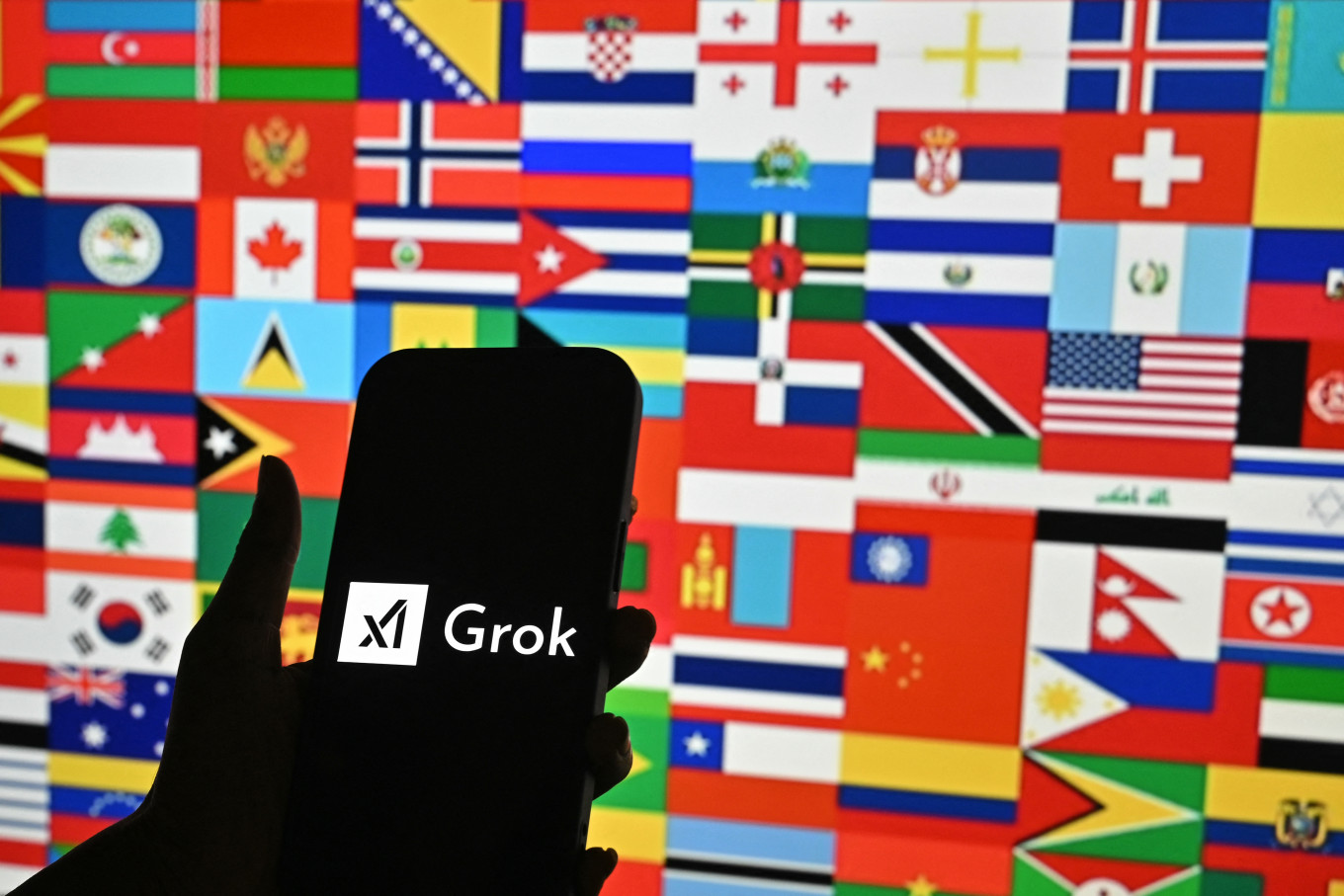 Grok-ing the future: A person holds a smartphone bearing the logo of Grok, a generative artificial intelligence chatbot developed by United States company xAI in front of the national flags of various countries on Jan. 15, 2026, in Bengaluru, India. (AFP/Idrees Mohammed)
F
or society and democracy to function, we used to depend on shared facts and a system of informed discussion and decision making. People are angry because they believe this system is failing them.
Fact checking has been around for some time, most famously by the New Yorker magazine’s unit set up in 1927, but the modern fact-checking movement got going at the start of this century.
Yet by early 2025, as we reported, that expert fact checking as a corrective or sense-making system was in retreat. Meta’s Mark Zuckerberg announced that independent fact checkers were “too politically biased and have destroyed more trust than they’ve created”. Of course, Meta had other political and economic motives for killing its third-party fact-checking program in the US. But this change carried serious consequences: once Meta pulled its support, other platforms followed. Voluntary funding, in kind and in cash, vanished. While the fact-checking community persists, the size of the community shrank.
During this time the media introduced other forms of verification as part of its reporting and social media output. The BBC replaced its fact-checking unit, Reality Check in 2023 and launched BBC Verify, built to authenticate images and video content. Australia’s public broadcaster followed suit replacing its university-partnered fact-checking unit (ABC RMIT Fact Check) with ABC Verify. Both moves respond to the same pressures, primarily a flood of suspected AI-generated content and ceaseless stories and breaking events that outpace old methods of journalistic scrutiny.
To fill the gap, three verification models now compete. Expert verification sits alongside newer AI-powered verification methods and crowdsourced contextualization. Individually, each approach is inadequate due to trustworthiness, explainability, speed, or context.
Despite X pushing users toward Grok as an on-platform fact checker, the results are clearly bad. The Digital Forensic Research Lab, set up in 2016, has studied over 130,000 X posts during the Israel-Iran conflict and found Grok routinely couldn’t tell real footage from AI-generated media, in one case calling a fabricated video of a damaged airport genuine. Researchers found the same failures during the India-Pakistan conflict and the LA immigration protests. Like all AI’s Large Language Models, Grok sounds confident. It carries no warning label. It is often wrong.

There are also limits to the detection tools built to catch AI-generated text, images and audio. Some focus on statistical patterns in writing, while others only read embedded metadata. Some only check for watermarks like Google’s SynthID. Every method is narrow, and, for now, it appears that every method can be defeated.