The Jakarta Post
Please Update your browser
Your browser is out of date, and may not be compatible with our website. A list of the most popular web browsers can be found below.
Just click on the icons to get to the download page.


Popular Reads
Top Results
No results found. Please check your search term and try again
Can't find what you're looking for?
View all search results
Popular Reads
Top Results
No results found. Please check your search term and try again
Can't find what you're looking for?
View all search resultsTo build NU anew
As state power and political patronage close in on Nahdlatul Ulama, the world’s largest Muslim organization faces a pivotal internal battle: preserve its independent moral voice, or become a rubber stamp for the ruling elite.
Change text size
Gift Premium Articles
to Anyone
Share the best of The Jakarta Post with friends, family, or colleagues. As a subscriber, you can gift 3 to 5 articles each month that anyone can read—no subscription needed!
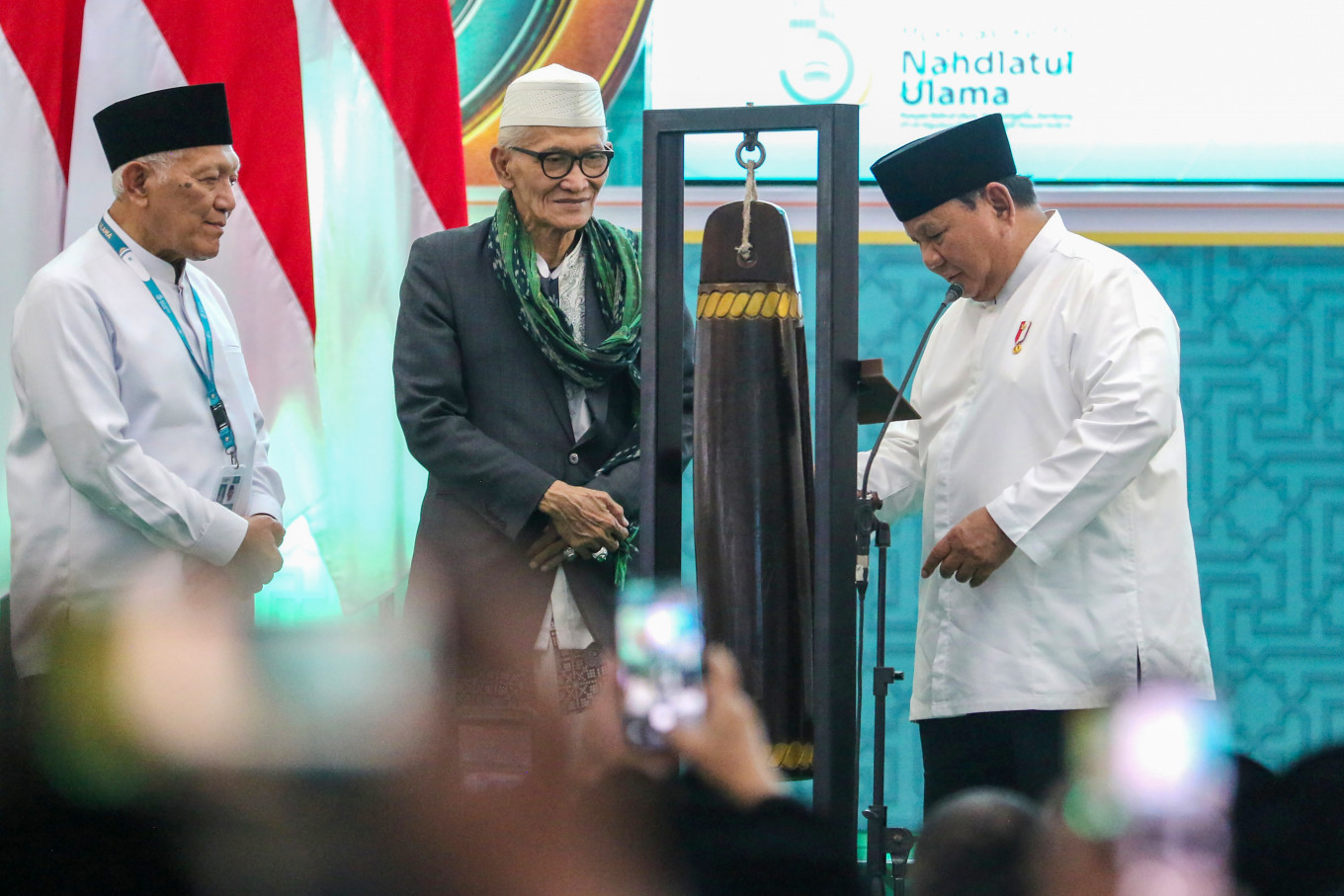 President Prabowo Subianto (right) closes the 35th Nahdlatul Ulama (NU) Congress as newly elected Rais Aam KH Miftahul Akhyar (center) and newly elected chairman of the NU Central Executive Board (PBNU) KH Abdul Hakim Mahfudz, also known as Gus Kikin, look on at Bahrul Ulum Islamic Boarding School in Tambakberas, Jombang, East Java, on Aug. 31, 2026. The 35th NU Congress elected KH Miftachul Akhyar as Rais Aam and KH Abdul Hakim Mahfudz, or Gus Kikin, as chairman of the PBNU for the 2026-2031 term. (Antara/Syaiful Arif)
T
ensions had already been brewing for weeks leading up to the 35th National Congress (muktamar) of Nahdlatul Ulama (NU), held on Aug. 27–31 at Bahrul Ulum Islamic Boarding School in Tambakberas, Jombang, East Java.
Fueling the unrest were persistent rumors of state meddling after organizers dropped Lirboyo boarding school in Kediri, a stronghold long recognized for its fierce independence under a circle of revered senior clerics (kiai sepuh) who keep national political elites at arm's length, as a choice of venue.
Once underway, the congress quickly saw dozens of supporters erupt in protest when organizers altered eligibility rules mid-stride, disqualifying a key challenger for the top post. The controversy culminated in the decision to abandon the democratic one-member, one-vote model, choosing instead to let a select council determine the organization's chairman.
The outcome matched media forecasts, with Miftachul Akhyar reelected as chief patron (rais aam), while Abdul Hakim Mahfudz, better known as Gus Kikin, a great-grandson of NU founder Hasyim Asy’ari, secured the chairmanship for the 2026–2031 term, succeeding Yahya Cholil Staquf.
An NU congress has never been a purely spiritual affair; it is a high-stakes arena where factions vie for influence and define how the world’s largest Muslim organization positions itself against state power. President Prabowo Subianto underscored this strategic value by attending both the opening and closing ceremonies, a gesture none of his predecessors made.
When Gus Kikin handed Prabowo an official NU membership card, playfully noting that eight is his favorite number just like the President's, it signaled an exceptionally warm rapport between the palace and NU's new leadership. Whether this coziness will erode NU’s moral autonomy remains to be seen.

Nevertheless, NU's entanglement with realpolitik is hardly new. Despite its formal commitment to the non-partisan Khittah 1926, prominent figures have spent the last two decades sinking deeper roots into government. During the previous administration of Joko “Jokowi” Widodo, NU elites secured key state posts, most prominently when Ma’ruf Amin became vice president while still serving as rais aam.