The Jakarta Post
Please Update your browser
Your browser is out of date, and may not be compatible with our website. A list of the most popular web browsers can be found below.
Just click on the icons to get to the download page.


Popular Reads
Top Results
No results found. Please check your search term and try again
Can't find what you're looking for?
View all search results
Popular Reads
Top Results
No results found. Please check your search term and try again
Can't find what you're looking for?
View all search resultsRowing between two reefs: Why Indonesia won't pick a side
Drilling with the Pentagon in the west while exercising with Beijing in the east isn’t Indonesia playing a double game, it’s a masterclass in surviving between two superpowers without answering to either.
Change text size
Gift Premium Articles
to Anyone
Share the best of The Jakarta Post with friends, family, or colleagues. As a subscriber, you can gift 3 to 5 articles each month that anyone can read—no subscription needed!
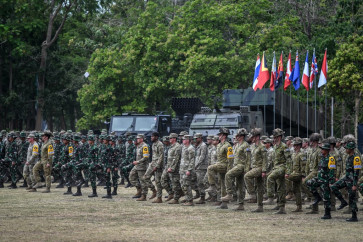
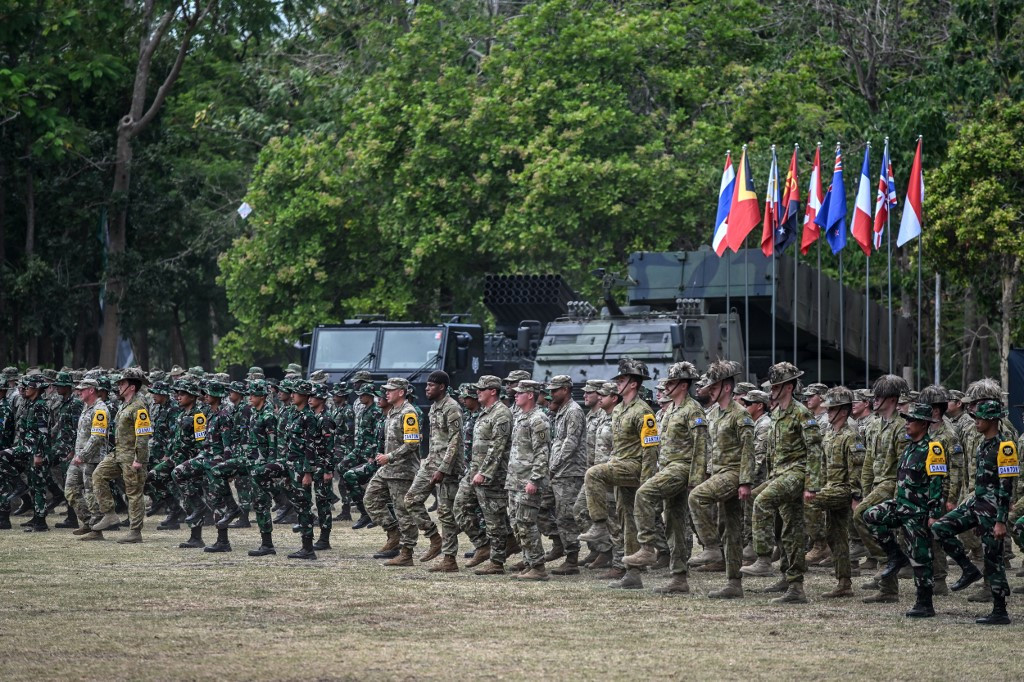 Indonesian, Australian, Singaporean and United States military personnel attend the opening ceremony of the Super Garuda Shield 2023 joint military exercise in Situbondo, East Java on Aug. 31, 2023. (AFP/Juni Kriswanto)
W
hen more than 4,700 troops from Indonesia, the United States. and 19 other partners fanned out across Sumatra, Java and Kalimantan last week for Super Garuda Shield 2026, it was easy to read it as Jakarta leaning westward.
It's the largest, most complex exercise Indonesia hosts, jungle warfare, live Stinger fires, naval maneuvers, amphibious landings, cyber and space, grown from a modest 2006 bilateral drill into an event drawing partners from Australia to Germany. Washington notes the two countries now conduct more than 170 joint military activities a year.
Three weeks earlier, a different picture unfolded. East of Taiwan, Indonesia’s frigate KRI I Gusti Ngurah Rai, returning from exercises in Russia, ran a passing exercise, communications drills, formation maneuvering, replenishment at sea, with the Chinese frigate Honghe. Beijing called it the first such exercise in those waters; Jakarta called it routine.
The week before, Indonesia held its second 2+2 dialogue with China, foreign and defense ministers together, agreeing to deepen military, maritime and technology cooperation. Later this year, the People’s Liberation Army Southern Theater Command is due back in Jakarta and Banten for Heping Garuda (Peace Garuda), the second edition of the first-ever Indonesia-China disaster relief exercise, launched in December 2024 after nearly a decade without a joint drill.
Garuda Shield in the west, a PASSEX and Heping Garuda in the east, all the same month, not inconsistency, but bebas-aktif, Indonesia’s free and active foreign policy doctrine, in practice.
Indonesia's defense ties with the two powers aren't symmetrical, and pretending otherwise would be dishonest.

With the US, the architecture is dense and legalized: normalization in 2005 after the post-East Timor embargoes lifted, followed by defense frameworks in 2010 and 2015, and the enablers that make a modern partnership function such as the Communications Interoperability and Security Memorandum of Agreement and the General Security of Military Information Agreement.