The Jakarta Post
Please Update your browser
Your browser is out of date, and may not be compatible with our website. A list of the most popular web browsers can be found below.
Just click on the icons to get to the download page.


Popular Reads
Top Results
No results found. Please check your search term and try again
Can't find what you're looking for?
View all search results
Popular Reads
Top Results
No results found. Please check your search term and try again
Can't find what you're looking for?
View all search resultsMyanmar crisis testing the promise of universal jurisdiction
Universal jurisdiction can open the courtroom doors to Myanmar’s survivors, but without cross-border political will, investigative muscle and survivor-centered networks, a growing docket of foreign cases will never amount to real accountability.
Change text size
Gift Premium Articles
to Anyone
Share the best of The Jakarta Post with friends, family, or colleagues. As a subscriber, you can gift 3 to 5 articles each month that anyone can read—no subscription needed!
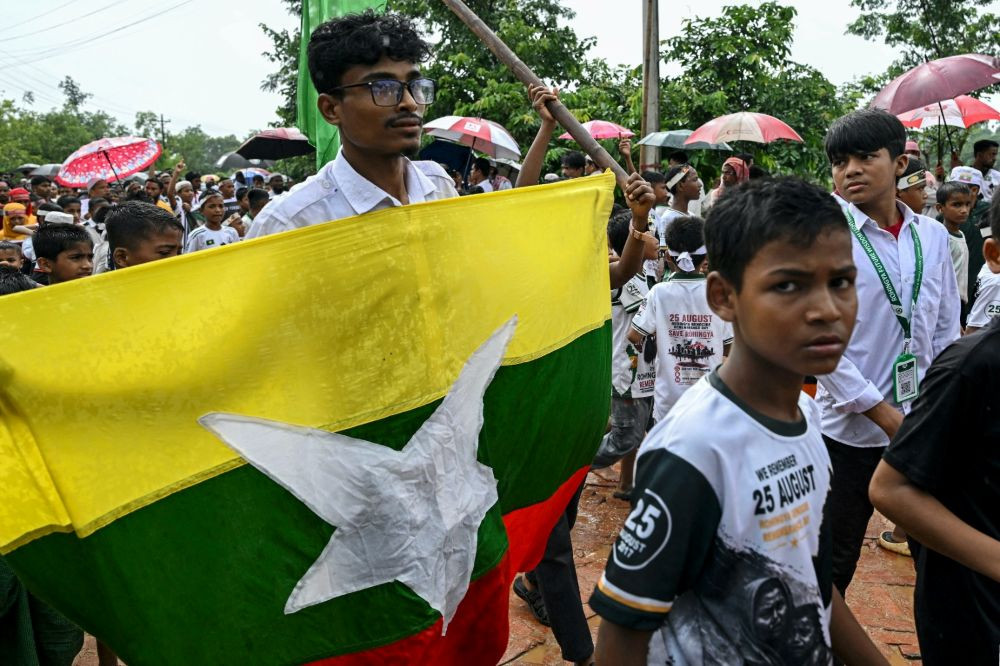 Stateless outcasts: A Rohingya man carries Myanmar's national flag on Aug. 25, 2026 during a Genocide Remembrance Day rally at a refugee camp in Cox's Bazar, Bangladesh, to mark the ninth anniversary of their mass exodus following a military crackdown. (AFP/Abdul Goni)
F
or Myanmar’s survivors, the pursuit of justice is increasingly migrating abroad. Yet the growing docket of universal-jurisdiction filings must not be mistaken for a functioning accountability system.
Universal jurisdiction empowers national courts to investigate and prosecute core international crimes regardless of where they occurred or the nationality of the perpetrators and victims. For Myanmar, this principle has ceased to be an academic theory. Instead, it is playing out as a patchwork of uneven legal experiments across Argentina, Germany, Australia, Turkey, the United Kingdom and, increasingly, Southeast Asia.
The takeaway from these efforts is unequivocal: statutory jurisdiction may open the courthouse door, but it cannot deliver justice on its own. Whether an initial petition matures into a full-scale prosecution - and ultimately yields tangible accountability - hinges on evidentiary rigor, investigative bandwidth, sustained prosecutorial will, access to the accused and meaningful survivor participation.
Argentina offers the clearest blueprint of what becomes possible when those factors converge. In 2019, the Burmese Rohingya Organisation UK petitioned Argentine courts on behalf of Rohingya victims, seeking a formal inquiry into alleged genocide and crimes against humanity. Formal proceedings commenced in 2021, driven by survivor testimony and evidentiary dossiers supplied by the UN Independent Investigative Mechanism for Myanmar. By February 2025, an Argentine federal court took the historic step of issuing arrest warrants for 25 senior Myanmar military, security and civilian figures, including junta chief Min Aung Hlaing.
These warrants are not convictions, and Buenos Aires possesses no mechanism to force Naypyidaw to extradite its brass. Nevertheless, they prove that the intersection of survivor testimony, civil society mobilization, multilateral evidentiary cooperation and prosecutorial resolve can propel an inquiry far beyond mere accusation. A domestic court can indeed impose tangible legal and diplomatic costs on perpetrators, even from halfway across the globe.
Elsewhere, systemic fissures are far more apparent. Germany boasts one of the world's most sophisticated legal architectures for adjudicating extraterritorial atrocities. Yet when 16 applicants from Myanmar, backed by Fortify Rights, filed a 2023 complaint alleging genocide, war crimes and crimes against humanity, the Federal Public Prosecutor declined to launch an investigation. The refusal laid bare a recurring reality: the mere codification of jurisdiction does not guarantee prosecutorial appetite.

Australia presents an enforcement bottleneck. In 2025, Legal Action Worldwide lodged a petition with the Australian Federal Police documenting post-2021 coup atrocities, including killings, torture, sexual violence, persecution and systematic strikes on civilians. The initiative quickly ran up against the logistical hurdles of gathering admissible evidence in a denied-access state where suspects remain well out of reach. Statutory reach cannot substitute for boots-on-the-ground investigative capacity.