The Jakarta Post
Please Update your browser
Your browser is out of date, and may not be compatible with our website. A list of the most popular web browsers can be found below.
Just click on the icons to get to the download page.


Popular Reads
Top Results
No results found. Please check your search term and try again
Can't find what you're looking for?
View all search results
Popular Reads
Top Results
No results found. Please check your search term and try again
Can't find what you're looking for?
View all search resultsIndonesia’s fiscal ambitions are too big for its finance ministers
Three finance ministers in less than two years proves Indonesia’s fiscal challenge isn’t about who manages the budget, but whether political ambition has finally outpaced economic reality.
Change text size
Gift Premium Articles
to Anyone
Share the best of The Jakarta Post with friends, family, or colleagues. As a subscriber, you can gift 3 to 5 articles each month that anyone can read—no subscription needed!
 Set as preferred source
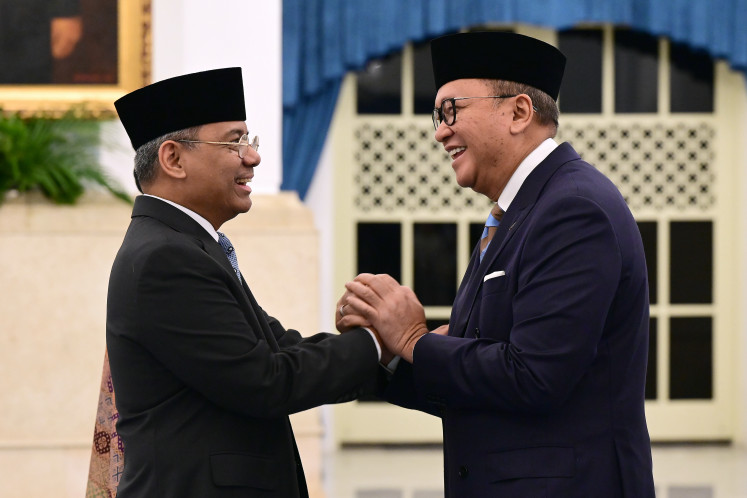
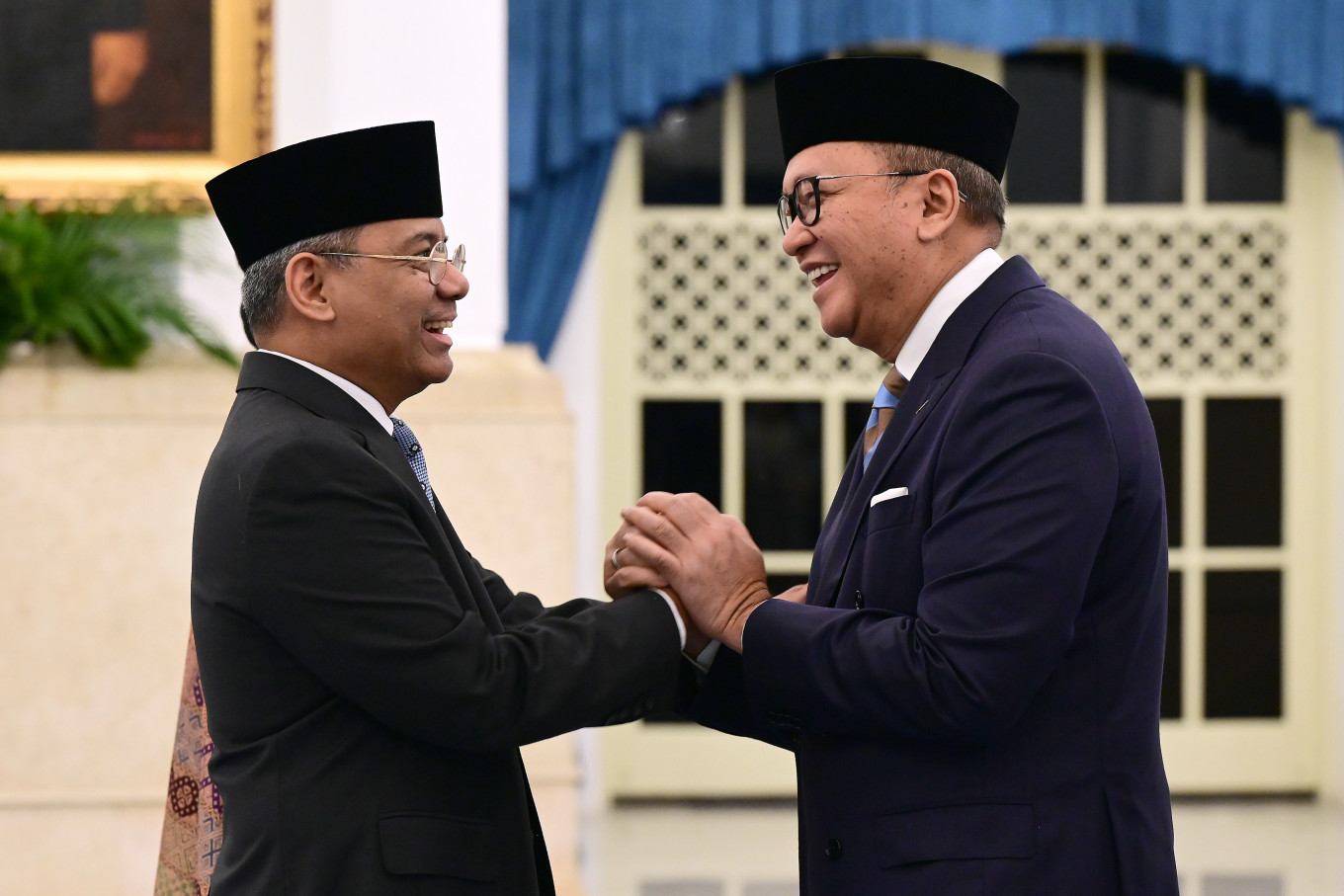 Newly appointed Finance Minister Suahasil Nazara (left) receives congratulations from Danantara Indonesia Chief Executive Officer Rosan Roeslani during a swearing-in ceremony on Sept. 14 at the Presidential Palace in Jakarta following a Cabinet reshuffle. President Prabowo Subianto appointed Nazara as finance minister for the remainder of the 2024–2029 term, replacing Purbaya Yudhi Sadewa. (Presidential Secretariat Press, Media and Information Bureau/Muchlis Jr)
F
inance ministers rarely become the story. They are expected to keep governments solvent and ensure that political ambition does not overwhelm fiscal reality. That is precisely why Indonesia’s latest cabinet reshuffle deserves attention.
In less than two years, President Prabowo Subianto has appointed three different finance ministers. Sri Mulyani Indrawati was replaced in 2025 by Purbaya Yudhi Sadewa. Barely a year later, Purbaya was dismissed and replaced by Suahasil Nazara.
That seems unlikely. Sri Mulyani spent years earning the confidence of investors, multilateral institutions and credit markets. Purbaya represented a different economic school, advocating a more expansionary fiscal strategy to accelerate growth. Suahasil is an experienced technocrat with deep knowledge of Indonesia’s fiscal institutions. All three, however, possess strong professional credentials.
If three competent individuals have occupied the same office within such a short period, perhaps the real problem lies elsewhere. The question may not be who serves as finance minister, but what the presidency now expects from the office.
That matters because the Finance Ministry is unlike any other ministry. Every administration wants more infrastructure, subsidies, industrial policy, social programs and faster growth. The finance minister is responsible for asking an inconvenient question politicians often prefer to avoid: how will all of this be financed without undermining fiscal credibility?
For decades, the Finance Ministry developed a reputation as one of the country’s strongest economic institutions precisely because it could act as a counterweight to political enthusiasm. It also preserved confidence that Indonesia would remain fiscally disciplined under political pressure. That institutional role now appears increasingly difficult.

Since taking office, Prabowo has introduced one of the most ambitious government spending agendas in Indonesia’s post-Reform history. His flagship free nutritious meal program has expanded rapidly and become one of the largest recurrent expenditure commitments in the state budget. The government has also pursued large-scale industrial policies, expanded energy subsidies, strengthened investment agency Danantara and launched the nationwide Red and White Cooperatives (KDMP) initiative.