The Jakarta Post
Please Update your browser
Your browser is out of date, and may not be compatible with our website. A list of the most popular web browsers can be found below.
Just click on the icons to get to the download page.


Popular Reads
Top Results
No results found. Please check your search term and try again
Can't find what you're looking for?
View all search results
Popular Reads
Top Results
No results found. Please check your search term and try again
Can't find what you're looking for?
View all search resultsAnalysis: Indonesia-Russia ties deepen: Might this time be different?
Change text size
Gift Premium Articles
to Anyone
Share the best of The Jakarta Post with friends, family, or colleagues. As a subscriber, you can gift 3 to 5 articles each month that anyone can read—no subscription needed!
 Set as preferred source
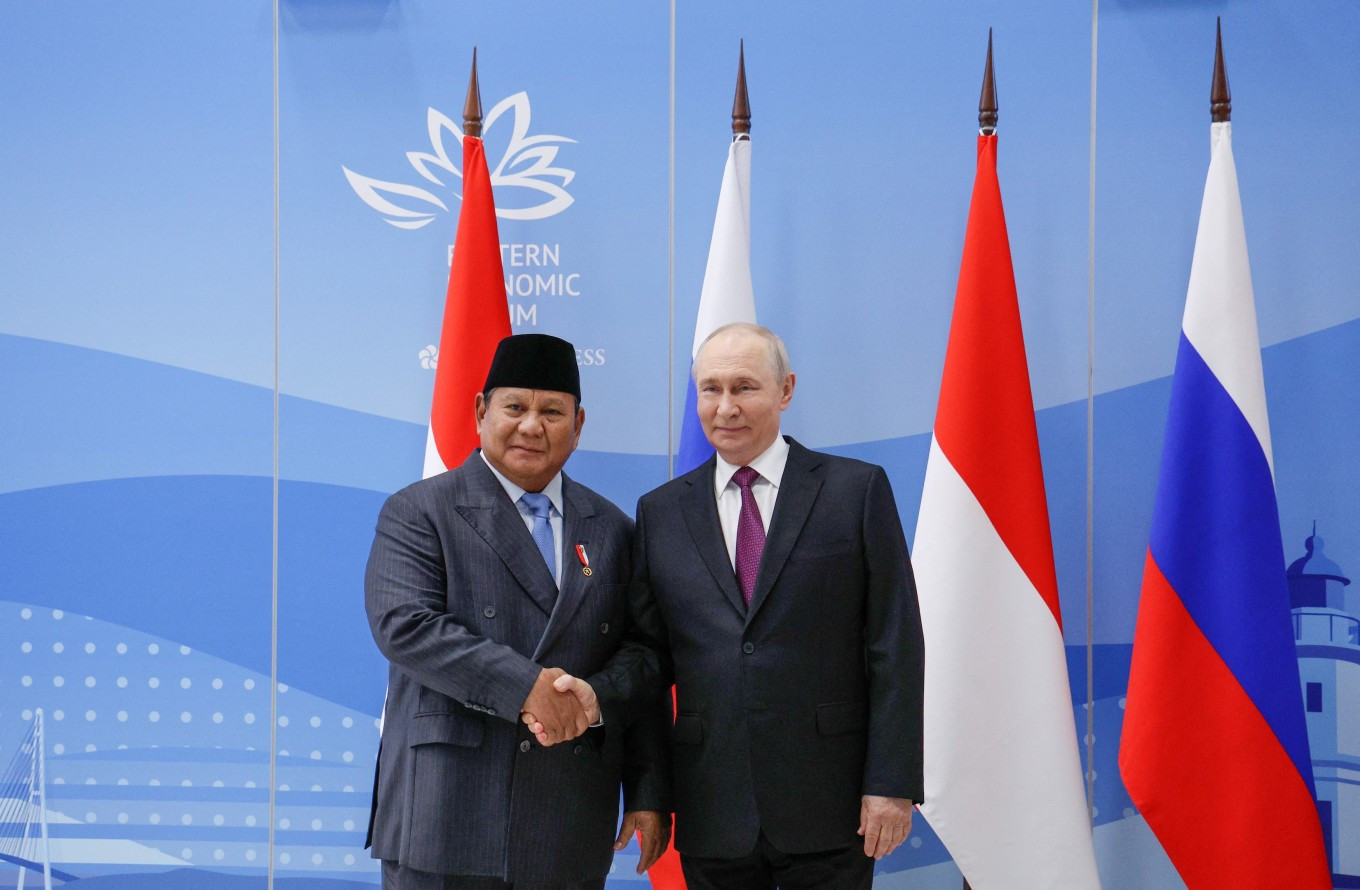 In this photograph distributed by Russian state agency Sputnik, President Prabowo Subianto and Russia's President Vladimir Putin hold a meeting on Thursday on the sidelines of the Eastern Economic Forum in Vladivostok. (AFP/ Pool/Vyacheslav Prokofyev)
A
t the 11th Eastern Economic Forum in Vladivostok, Russia, President Prabowo Subianto announced plans by Russian aluminum producer Rusal to invest in an Indonesian processing plant, part of broader efforts to deepen bilateral economic ties. Yet the planned investment comes amid intensifying geoeconomic rivalry among major powers, raising questions over whether Indonesia can deepen ties with Russia without compromising its strategic flexibility. The test is whether Indonesia can remain both bebas (free) and aktif (active).
Rusal is the world’s largest aluminum producer outside China, selling 4.2 million metric tonnes of aluminum in 2023. It expressed interest in investing in Indonesia as far back as 2014, when the company sought to build smelters in the country to expand its production base into lower-cost regions, although nothing came of the plan at the time.
This interest has been renewed in recent years, partly because of Rusal’s need to diversify its sources of raw materials after losing 40 percent of its alumina supply from Ukraine and Australia in 2022 following Russia’s invasion of Ukraine. Indonesia, meanwhile, could benefit from broader economic cooperation with Russia as a hedge against systemic risks arising from overdependence on any single economic bloc.
Indonesia-Russia ties have a long history dating back to the Cold War. In the years after independence, Indonesia enjoyed close relations with the Soviet Union, which supported the construction of landmarks including Persahabatan Hospital and Gelora Bung Karno Stadium. Relations between Indonesia and the Soviet Union deteriorated following the political upheaval of 1965 and Soeharto’s subsequent rise to power, which brought the country closer to the United States, but began to recover after his fall in 1998.
Reform-era Indonesia revived relations with the newly established Russian Federation, notably through President Megawati Soekarnoputri’s visit in 2003, which included agreements on purchases of Russian military equipment. The reestablishment of scholarships for Indonesian students wishing to study in Russia followed soon afterward.
However, economic cooperation during the Reformasi era has not always been smooth, as various projects proposed in recent decades have stalled for different reasons. In 2015, President Joko “Jokowi” Widodo launched the Kalimantan railway project, which aimed to provide 398 kilometers of rail infrastructure for transporting coal, passengers and other goods. The project was to be funded by Russian Railways, which withdrew in 2020, citing several factors, including low coal prices and a lengthy land-acquisition process.

Sanctions imposed on Russia have exacerbated the problem, with the development of an oil refinery in Tuban facing additional uncertainty following Rosneft’s inclusion on the US’ Specially Designated Nationals (SDN) list. Indonesia is now seeking to reinvigorate its partnership with Russia, with President Prabowo having visited the country four times, primarily to discuss bilateral economic and defense cooperation.