

 Set as preferred source

Enjoy This Gifted Article!
You're reading this thanks to a The Jakarta Post subscriber.
Access is available for 30 days. For unlimited access, consider subscribing.
Please Update your browser
Your browser is out of date, and may not be compatible with our website. A list of the most popular web browsers can be found below.
Just click on the icons to get to the download page.

Can't find what you're looking for?
View all search resultsCan't find what you're looking for?
View all search resultsThe new finance minister may reassure nervous markets, but the real test begins when fiscal discipline inevitably collides with President Prabowo’s expansive political ambitions.
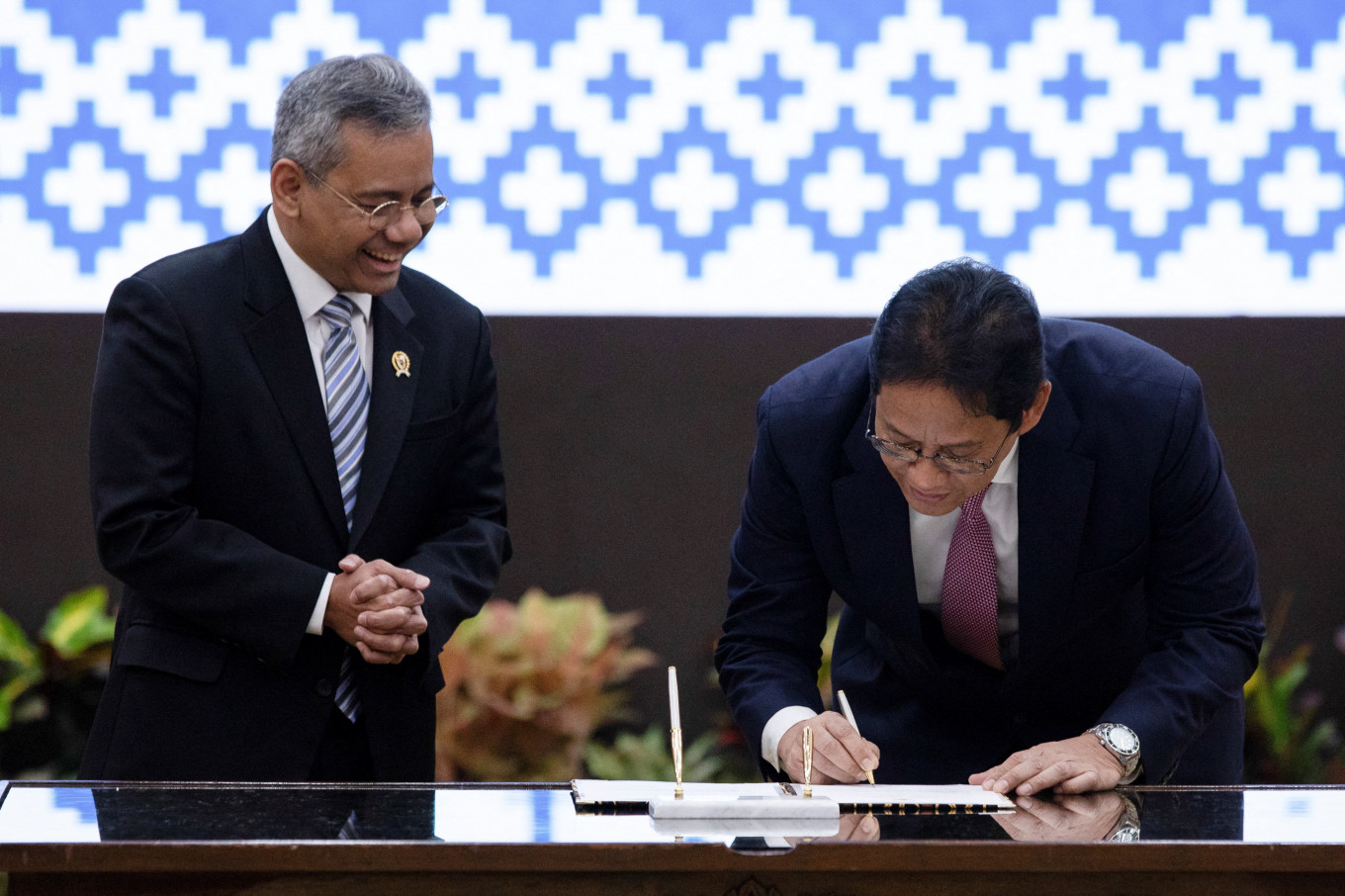 Newly appointed Finance Minister Suahasil Nazara (left) reacts as outgoing Finance Minister Purbaya Yudhi Sadewa signs a document, during a handover ceremony at the Finance Ministry, on Sept. 15, 2026. (Reuters/Garry Lotulung)
resident Prabowo Subianto has long advocated for a more interventionist state in Indonesia’s economy, championing food and energy self-sufficiency, assertive industrial policy, and an expanded role for state-owned enterprises. His first two years in office have translated that philosophy into practice, marked by mounting expenditure commitments and fiscal resources increasingly steered toward presidential priorities.
The appointment of Suahasil Nazara as Finance Minister offers an early signal of a more cautious approach to fiscal management. A former head of the Fiscal Policy Agency and deputy finance minister since 2019, Suahasil is an established fixture within Indonesia’s fiscal establishment. Investors welcomed his appointment following a period of heightened uncertainty over economic policy.
Purbaya Yudhi Sadewa’s abrupt dismissal, however, remains unexplained. Nor does Suahasil arrive with an altered presidential mandate: His task is still to fund Prabowo’s agenda. For now, the reshuffle appears less like a fundamental shift in policy direction and more like an effort to restore Indonesia’s macroeconomic credentials.
On paper, the proposed 2027 budget is reassuring. The deficit is projected at 2.4 percent of GDP, with revenue expected to rise by 6.8 percent against a modest 3.9 percent increase in expenditure.
Yet much hinges on the government’s assumption of 6 percent economic growth—which would mark Indonesia’s fastest pace since 2012. Should growth or revenues falter, maintaining the 2.4 percent target would require mid-year spending cuts, making the deficit goal far more demanding than the headline figure implies.
Revenue mobilization presents another vulnerability. While Indonesia urgently requires a stronger revenue base, leaning harder on existing taxpayers is no substitute for broadening the tax net. As the early years of former president Joko “Jokowi” Widodo demonstrated, an aggressive push for revenue risks unsettling the business community without generating durable improvements in fiscal capacity.

The 2026 budget committed Rp 335 trillion (US$13 billion) to the free nutritious meals program, alongside Rp 402.4 trillion for energy security and Rp 164.7 trillion for food security. Set against these expansive outlays, Indonesia’s tax take stagnates at roughly 10 percent of GDP.
Geopolitical conflict has compounded the fiscal arithmetic. With oil trading above US$100 a barrel, energy subsidy costs have surged and the rupiah has come under strain. The government has already revised its 2026 deficit forecast upward, pushing it uncomfortably close to the statutory 3 percent ceiling.
Reining the deficit back to 2.4 percent next year would represent meaningful fiscal consolidation, especially if energy prices remain elevated. It also leaves virtually no margin for error should optimistic growth and revenue projections fall short.
Indonesia’s 3 percent deficit ceiling has historically anchored stability, but it increasingly tells only part of the fiscal story. Transfers to regional governments were curtailed sharply in 2026, leaving several regions struggling to meet public payrolls. Protecting the central government's headline deficit has, in effect, shifted fiscal strain down the system.
Then there is sovereign wealth fund Danantara. Alongside state-owned enterprises, the fund is absorbing an expanding share of the government’s investment agenda off-budget. The IMF has warned that leveraged or underperforming Danantara assets could create substantial contingent liabilities. Debt accumulated elsewhere in the public sector still elevates Indonesia’s gross financing requirements and risks crowding out private credit.
A degree of fiscal consolidation is now essential, partly to correct imbalances the administration itself helped create. Flagship programs are notoriously difficult to scale back once funds are allocated, bureaucratic machinery is established, and public expectations are set. Shielding them demands compensatory cuts elsewhere. The alternative, continual spending growth without commensurate revenue gains, will leave subsequent budgets ill-equipped to absorb future shocks.
Prabowo cannot defer this trade-off indefinitely. The administration will inevitably have to slow certain programs, raise significantly more revenue, or accept an eroded fiscal cushion.
Suahasil represents a technocratic tradition that carries an intriguing parallel in Prabowo’s own family history. Prabowo frequently invokes his father, the economist Sumitro Djojohadikusumo, who championed state-led industrial planning while remaining an uncompromising defender of technocratic competence and macroeconomic stability.
To date, Prabowo has embraced the developmental ambitions of that heritage far more enthusiastically than its discipline. Suahasil may help restore equilibrium, but the pivotal issue is not the finance minister's orthodoxy; it is whether the president will accept the spending constraints his minister will eventually have to recommend.
Developments at Bank Indonesia warrant additional caution. Perry Warjiyo’s unexpected resignation as governor in July rattled investors, prompting fresh concerns over central bank independence. It followed an era of unusually blurred lines between monetary and fiscal policy, punctuated by Purbaya’s decision to shift substantial state cash reserves from Bank Indonesia into state-owned lenders to spur credit growth.
Indonesia spent decades institutionalizing a credible firewall between macroeconomic stewardship and short-term political pressures. Recent turbulence across both the Finance Ministry and the central bank makes that insulation less assured than it once was.
Suahasil’s stewardship brings valuable competence to economic management, but characterizing his appointment as a wholesale return to fiscal orthodoxy outpaces the facts. The president's expensive signature commitments endure, the 2027 budget relies on ambitious projections, and off-budget liabilities pose growing risks.
The true durability of this course correction will be tested when fiscal discipline inevitably collides with core political priorities. That confrontation will reveal the true extent of Suahasil’s authority. In the end, safeguarding Indonesia’s fiscal credibility, and preserving the capacity to weather future crises, depends on the choices Prabowo makes when budgetary restraint begins to extract a political price.
***
The writer is a research fellow at the Indo-Pacific Development Centre at the Lowy Institute, and an economist working on economic development and public policy.
Share your experiences, suggestions, and any issues you've encountered on The Jakarta Post. We're here to listen.
Thank you for sharing your thoughts. We appreciate your feedback.
Quickly share this news with your network—keep everyone informed with just a single click!
Share the best of The Jakarta Post with friends, family, or colleagues. As a subscriber, you can gift 3 to 5 articles each month that anyone can read—no subscription needed!
Get the best experience—faster access, exclusive features, and a seamless way to stay updated.


