The Jakarta Post
Please Update your browser
Your browser is out of date, and may not be compatible with our website. A list of the most popular web browsers can be found below.
Just click on the icons to get to the download page.


Popular Reads
Top Results
No results found. Please check your search term and try again
Can't find what you're looking for?
View all search results
Popular Reads
Top Results
No results found. Please check your search term and try again
Can't find what you're looking for?
View all search resultsIndonesia’s nickel curbs struggle to convince markets
Change text size
Gift Premium Articles
to Anyone
Share the best of The Jakarta Post with friends, family, or colleagues. As a subscriber, you can gift 3 to 5 articles each month that anyone can read—no subscription needed!
 Set as preferred source
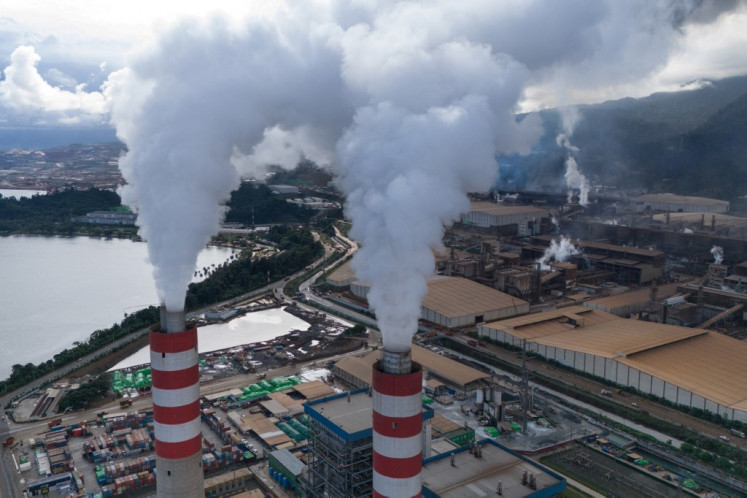
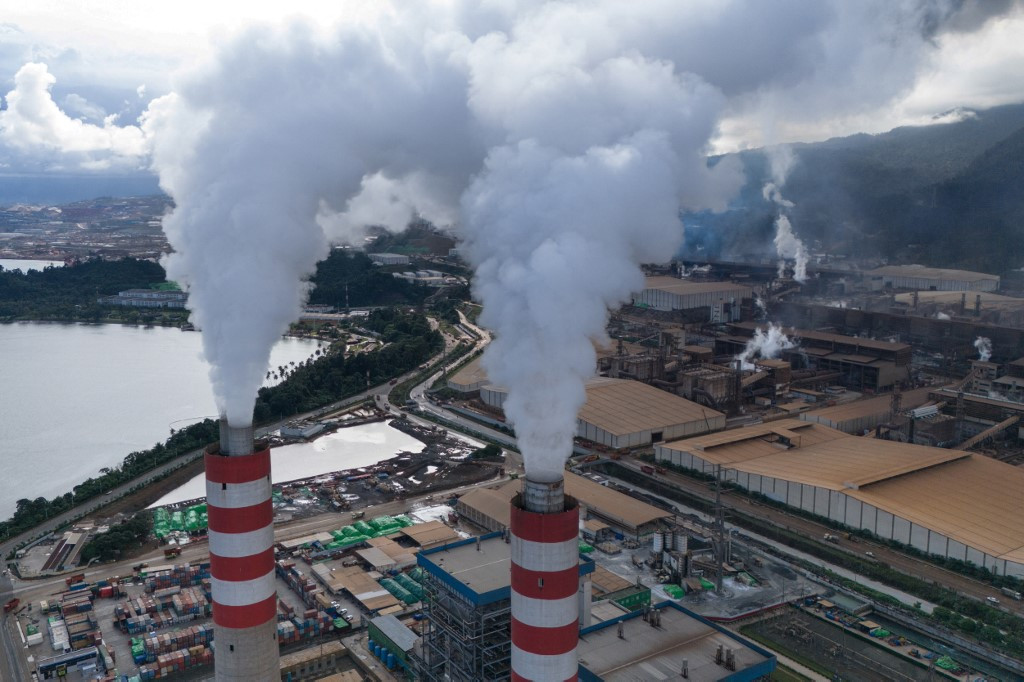 Smoke billows from nickel smelting plants at the Indonesia Weda Bay Industrial Park (IWIP) in Lelilef, North Maluku, on July 7, 2024. (AFP/Azzam Risqullah)
I
ndonesia is learning that building a dominant position in the nickel market is the easy part. Leveraging its influence over supply to control prices is proving much trickier.
The country now accounts for over 60 percent of global output of a metal used by both stainless steel makers and electric vehicle (EV) battery manufacturers.
Indonesia's dramatic rise as a nickel power is the result of a 2020 ban on exports of ore, forcing operators to build domestic processing capacity. It's become a template for other developing countries, particularly those in resource-rich Africa.
They may also want to note how difficult it is to match supply with demand once you're the world's largest producer.
Jakarta has this year cut mining quotas, stepped up environmental controls and adjusted ore pricing to rein in its runaway nickel sector.
A commitment to slash mining quotas from last year's 379 million metric tonnes to 250 million to 260 million tonnes propelled the London Metal Exchange nickel price to a May high of US$20,000 per tonne.

The price is now back down at $16,500 as the market loses confidence that Jakarta can tame its nickel tiger.
Policymakers' dilemma has been how to reduce mined output without disadvantaging their nickel processors, some of whom have only begun ramping up production this year.
A mid-year review of the quota system has resulted in higher allocations to specific operators.
French group Eramet, for example, is restarting operations at its Weda Bay mine after being forced to suspend work in May when it had exhausted its 2026 quota.
The full extent of the upward creep is difficult to ascertain since neither Jakarta nor its nickel operators disclose details.
Moreover, it's clear some operators have adjusted to lower domestic mining rates by turning to imports, primarily from the Philippines.
Indonesia lifted imports of Philippine ore by 50 percent to 15.3 million tonnes last year and arrivals were up by another 67 percent year-on-year at 11.4 million tonnes from January to July, according to the World Bureau of Metal Statistics (WBMS), which collects data from official sources.
Another smaller stream of imports is now also arriving regularly from the Solomon Islands.
It's worth remembering that if all the country's nickel processing plants were operating at capacity, they would need 315 million tonnes of ore per year, according to the Indonesian Nickel Miners Association.
Balancing that captive demand with mining rates is still very much a work in progress.
The nickel market had high hopes at the start of the year that Jakarta could do enough to prevent another year of global supply surplus.
The International Nickel Study Group drastically revised its estimate of expected 2026 market balance in April to factor in lower output in Indonesia.
Its forecast was for a modest 32,000-tonne deficit this year, compared with an expected 261,000-tonne surplus when it previously met in October 2025.
Yet global exchange stocks of refined nickel have been creeping steadily higher.
Combined inventory held by the LME, both on-warrant and off-warrant, and the Shanghai Futures Exchange currently stands at 478,000 tonnes, enough to supply the global market for seven weeks.
In truth, the surplus may be higher than implied by visible stocks.
China shows every sign of stockpiling the metal to capitalise on the current low pricing environment.
The country imported 170,000 tonnes of refined nickel in the first seven months of this year, up 28 percent year-on-year and the highest import rate since 2016.
Given China's own refined nickel output has been growing at a fast clip, thanks to Indonesian flows of raw material, the inference is that some of these imports are for strategic rather than commercial purposes.
The one positive takeaway for Jakarta is that the surplus would have been much higher this year had it done nothing to restrain its production growth.
At least the price is trading above $16,000 per tonne rather than below, as was the case over much of 2025.
But prices are still barely above the break-even point for even some of Indonesia's producers.
What Indonesia and the nickel market really need is more demand.
There are encouraging signs.
Stainless steel production grew by 5 percent year-on-year in the first half of 2026 according to industry association Worldstainless. EV sales are accelerating just about everywhere outside the United States market.
But there's a lot of nickel sitting in exchange storage to feed any short-term demand surge, which means that Indonesia's work to control both production and pricing is far from over.
---
The writer is a Reuters columnist. The views expressed are personal.