The Jakarta Post
Please Update your browser
Your browser is out of date, and may not be compatible with our website. A list of the most popular web browsers can be found below.
Just click on the icons to get to the download page.


Popular Reads
Top Results
No results found. Please check your search term and try again
Can't find what you're looking for?
View all search results
Popular Reads
Top Results
No results found. Please check your search term and try again
Can't find what you're looking for?
View all search resultsA dangerous loophole awaits agrarian reform law
Behind the reformist rhetoric of Indonesia’s new Agrarian Law lies a dangerous corporate loophole: a legal apparatus designed not to return land to the people, but to legitimize its capture by the powerful.
Change text size
Gift Premium Articles
to Anyone
Share the best of The Jakarta Post with friends, family, or colleagues. As a subscriber, you can gift 3 to 5 articles each month that anyone can read—no subscription needed!
 Set as preferred source
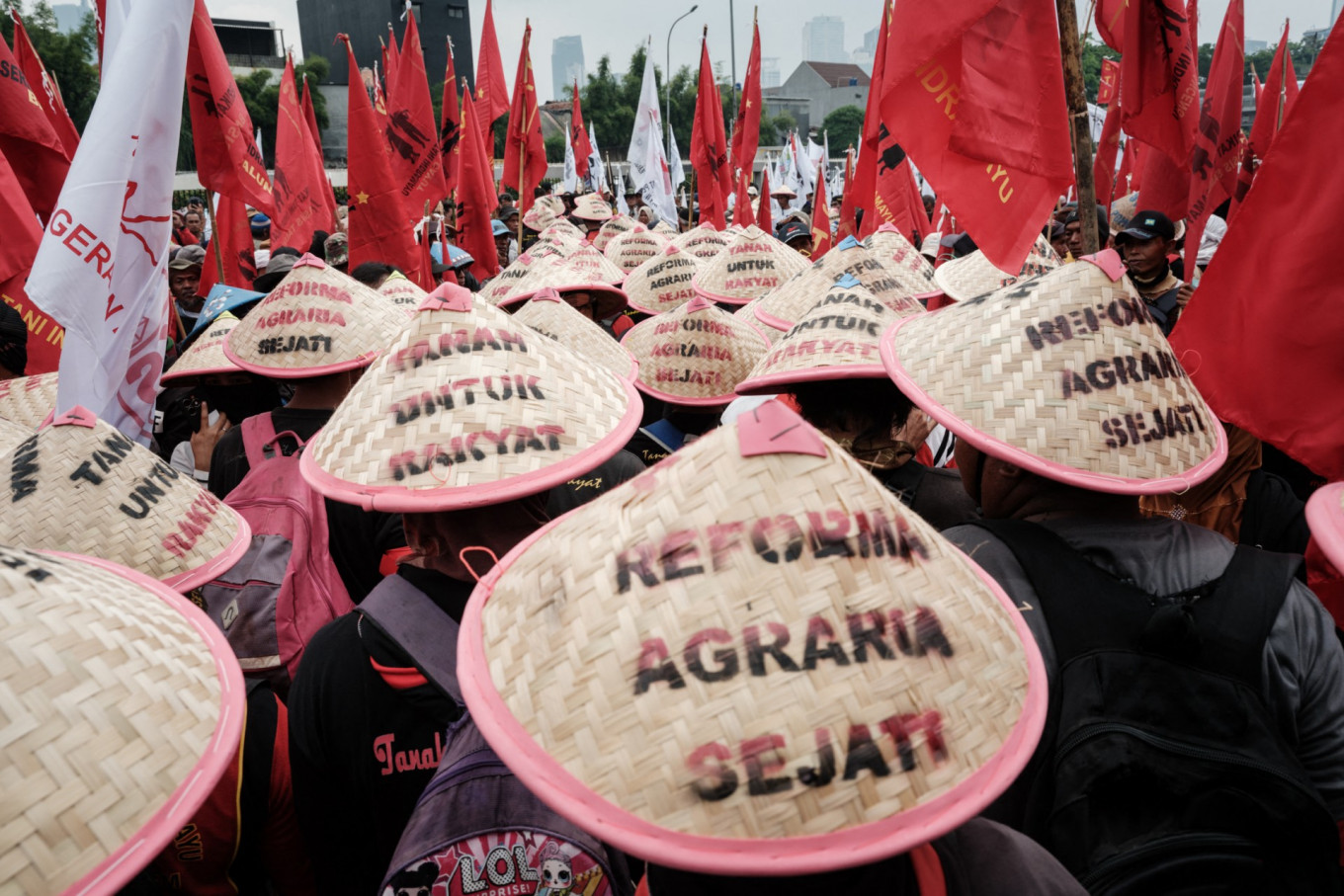 Farmers wearing hats reading “True agrarian reform“ protest on Sept. 24, 2024, against what they described as the government's failure to implement agrarian reforms as they commemorate the National Farmers' Day in front of the Senayan legislative complex in Central Jakarta. (AFP/Yasuyoshi Chiba)
T
he House of Representatives approved the Agrarian Reform Law on Sept. 22, opening a contentious new chapter in Indonesia’s land governance. Lawmakers and the government have framed the legislation as a landmark breakthrough - a decisive answer to public demands that have languished for six decades.
In their telling, the statute equips the state with a potent instrument to settle long-standing disputes while restructuring ownership. Yet that reassuring narrative demands rigorous scrutiny: behind the rhetoric of justice, the law's institutional safeguards remain fragile.
Viewed through the lens of spatial political economy, this narrative conceals a structural contradiction. Beneath the language of asset redistribution and democratization lies what amounts to a classic “spatial fix”: a legal mechanism designed to reorganize territory for large-scale capital accumulation. Rather than sheltering smallholder farmers, traditional fishers and indigenous communities, the law risks carving out an expansive legal corridor for agribusiness oligarchs and extractive conglomerates to entrench their territorial control.
The shift is stark when contrasted with the spirit of the 1960 Basic Agrarian Law. Born out of a decolonizing, socio-nationalist ethos, the 1960 framework treated the state’s right to control land primarily as a public trust - a constitutional mandate to prevent excessive concentration and defend land’s social function.
The 2026 law, by contrast, pivots toward a market-driven logic. Land is treated less as the bedrock of communal life and more as an economic commodity engineered to facilitate private investment.
This ideological turn fundamentally alters how the state approaches concentrated ownership. While the government pledges to curb excessive holdings by private conglomerates and state-owned enterprises (SOEs), the legal architecture introduces loopholes that invite moral hazard and legitimize sweeping land consolidation.

Provisions governing ownership limits appear progressive at first glance, yet the text establishes no explicit numerical ceiling on corporate holdings. Instead, both minimum and maximum thresholds are deferred to implementing government regulations. This creates a vulnerable bargaining arena ripe for regulatory capture, offering agribusiness and mining lobbies an open invitation to negotiate generous, malleable caps behind closed doors.