The Jakarta Post
Please Update your browser
Your browser is out of date, and may not be compatible with our website. A list of the most popular web browsers can be found below.
Just click on the icons to get to the download page.


Popular Reads
Top Results
No results found. Please check your search term and try again
Can't find what you're looking for?
View all search results
Popular Reads
Top Results
No results found. Please check your search term and try again
Can't find what you're looking for?
View all search resultsAnalysis: Bahlil takes on new role, questions remain over its purpose
Change text size
Gift Premium Articles
to Anyone
Share the best of The Jakarta Post with friends, family, or colleagues. As a subscriber, you can gift 3 to 5 articles each month that anyone can read—no subscription needed!
 Set as preferred source
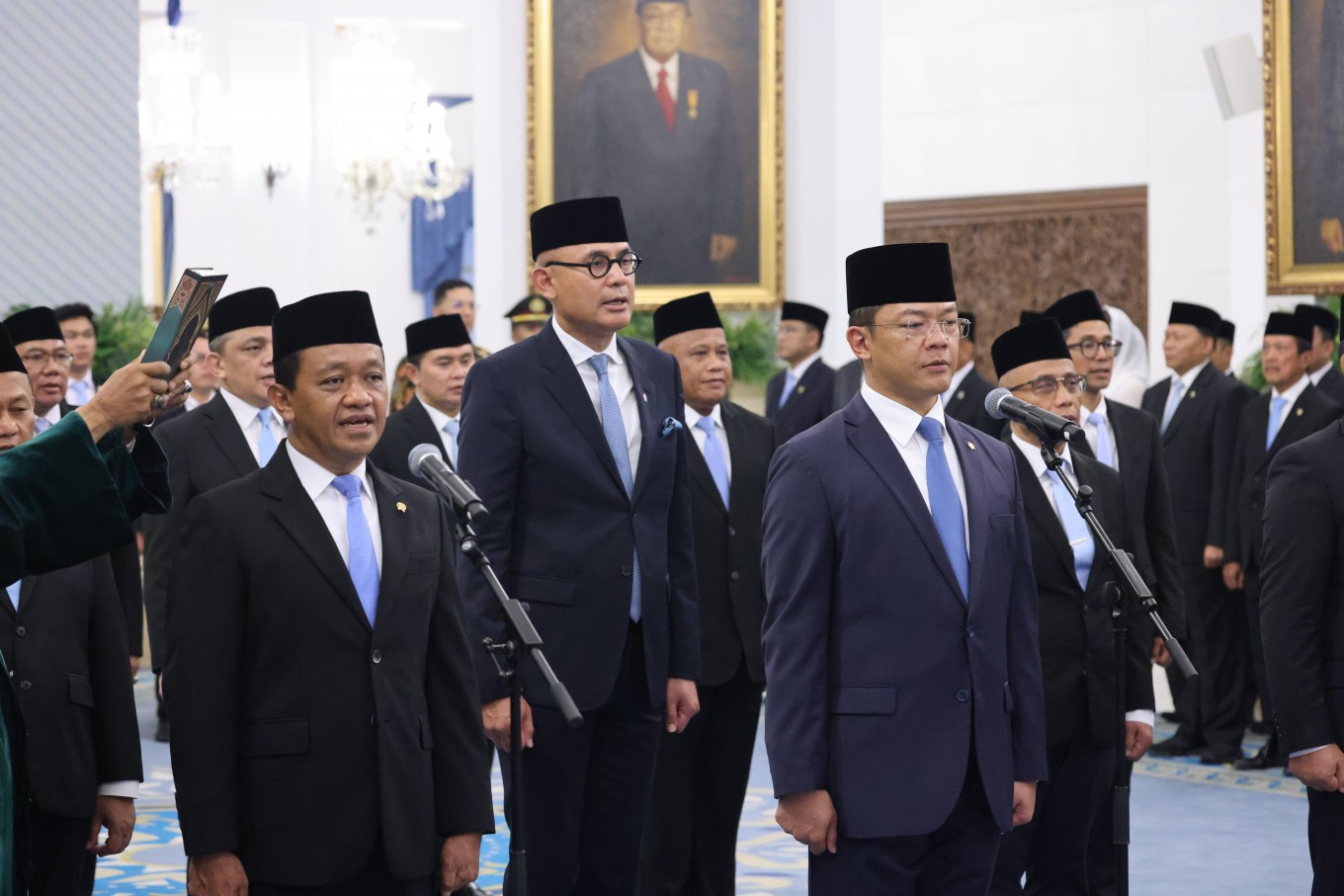 Bahlil Lahadalia is sworn in as coordinating downstream and energy transition minister on Oct. 1 at the State Palace in Jakarta. ( Government Communication Agency/-)
B
ahlil Lahadalia’s latest appointment as coordinating downstream and energy transition minister gives him an unusually broad mandate, as he will also retain his position as energy and mineral resources minister, though the scope of the newly established coordinating ministerial post is yet to be clearly defined in terms of authority and jurisdiction. The arrangement seems to be in line with the government’s continuing prioritization of downstream industrial development, but raises a central question: Will the new post improve coordination on Indonesia’s downstream and energy transition agenda or simply add another layer of bureaucracy?
Bahlil was installed in his new post on Oct. 1 during the seventh reshuffle of President Prabowo Subianto’s cabinet and will fulfill the duties of his new office from the energy ministry for the time being. He described the dual role as a national responsibility, saying that downstream development and the energy transition needed to be consolidated to accelerate their implementation. According to Bahlil, around 90 percent of downstream investment was in sectors overseen by the energy ministry. He has declined to say whether a new appointee would eventually replace him as energy minister.
The choice of Bahlil is not entirely unexpected. Before heading the energy ministry, he was appointed investment and downstream minister after the portfolio was expanded from investment alone. He has also led the Downstream and Energy Security Acceleration Task Force since its establishment on Jan. 3 last year under Presidential Decree No. 1/2025, which grants it broad authority, including over marine and forest areas as well as to sanction parties obstructing downstream efforts. Bahlil’s new post therefore brings together areas that he has been closely involved in already.
The government has targeted downstream development across 28 commodities, with investment projected to reach US$618 billion by 2040. The government's experience with downstream nickel projects illustrates both the scale of the agenda and the trade-offs involved. Downstream nickel development helped increase export value from $780 million in 2018 to $6.8 billion in 2023. At the same time, the rapid expansion of nickel processing contributed to the growth of captive coal capacity, which reached 15.2 gigawatts (GW) by mid-2024, complicating the country’s energy transition.
The downstream agenda also extends beyond mining and energy-intensive industries. In the poultry sector, for example, the government has sought to strengthen domestic production and local supply chains. Yet tighter import licensing under Trade Minister Regulation No. 11/2026 for soybean meal and feed wheat, both key poultry feed ingredients, contributed to supply bottlenecks and higher input costs. At the same time, weaker-than-expected demand from Prabowo’s flagship free nutritious meal (MBG) program left farmers squeezed between rising feed costs and falling egg prices, contributing to protests in Central Java, Yogyakarta and South Sulawesi in August.
The energy transition is the other major pillar of Bahlil’s expanded mandate. One of the government's most ambitious initiatives is a 100 gigawatt-peak (GWp) solar power program. Bahlil said on Sept. 22 that the government would revise state electricity firm PLN’s Electricity Supply Business Plan (RUPTL) to accommodate the program and was considering accelerating tenders for the first 25-30 GW. He also said the government could simplify the procurement process and directly appoint economically viable companies. The solar program is estimated to require $70-73 billion in investment, with its first phase of 5.5 GW already launched this year and domestic production given priority.

Critics have questioned whether creating another senior ministerial post is the best way to address coordination problems. A new institution could complicate government coordination and add to the fiscal burden, contrary to President Prabowo's efficiency agenda. Indonesia now has eight coordinating ministers and 41 ministries, while critics have pointed out that the total should range around 25-30 ministries. In comparison, Singapore has 18 ministries, China 24 and Vietnam 14.