The Jakarta Post
Please Update your browser
Your browser is out of date, and may not be compatible with our website. A list of the most popular web browsers can be found below.
Just click on the icons to get to the download page.


Popular Reads
Top Results
No results found. Please check your search term and try again
Can't find what you're looking for?
View all search results
Popular Reads
Top Results
No results found. Please check your search term and try again
Can't find what you're looking for?
View all search resultsIndia-Indonesia: Multipolarity and Global South
India maintains that a global multipolar order must start with a multipolar Asia, rejecting both a US-dominated unipolar structure and a China-centric "Asia for Asians" model.
Change text size
Gift Premium Articles
to Anyone
Share the best of The Jakarta Post with friends, family, or colleagues. As a subscriber, you can gift 3 to 5 articles each month that anyone can read—no subscription needed!
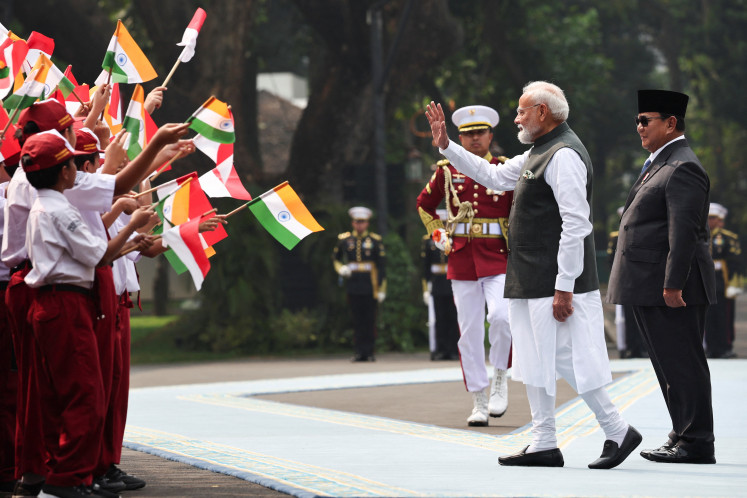
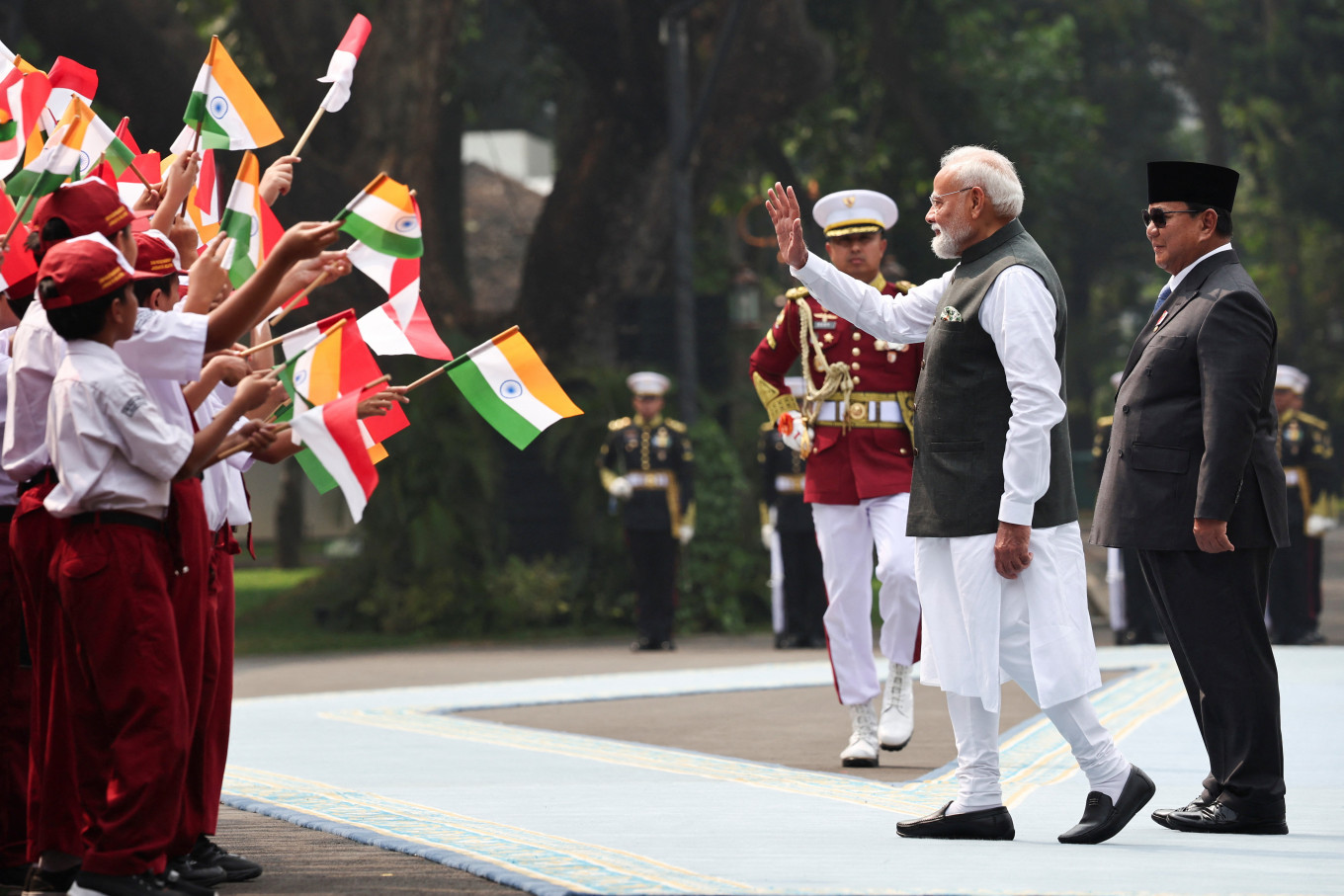 Indian Prime Minister Narendra Modi (center right) accompanied by Indonesian President Prabowo Subianto (right), waves to students during a welcoming ceremony upon their meeting at the State Palace in Central Jakarta on July 7, 2026. (Reuters/Willy Kurniawan)
I
ndia rejects a binary or zero-sum Cold War mindset. Instead, it engages all major global players, including the United States, Russia, China, Southeast Asia and Europe, simultaneously to maximize national interest and strategic autonomy.
This concept holds relevance in the current times amid severe turbulence in geopolitics. The concept of multipolarity was championed in recent weeks through a series of statements by India’s External Affairs Minister S. Jaishankar. In his words, India views the global order as rapidly transitioning toward multipolarity, driven by emerging middle powers pursuing independent and transactional foreign policies.
A multipolar world requires countries to preserve freedom of choice, making independent decisions rather than bowing to single-power blocs. India positions itself as a champion for developing nations and the Global South, articulating concerns regarding the "4Fs", food, fuel, fertilizer and finance, and pushing for institutional reforms like United Nations Security Council restructuring.
New Delhi pushes for a more pluralistic and representative international architecture, notably demanding a permanent seat on the UN Security Council through reform efforts like the "G4" (with Japan, Germany and Brazil) alongside participation in BRICS, the Shanghai Cooperation Organisation and Quad
A true global multipolar order must have a multipolar Asia at its center, achieved through the consolidation of independence and expanded freedom of choice for Asian nations. India maintains that a global multipolar order must start with a multipolar Asia, rejecting both a US-dominated unipolar structure and a China-centric "Asia for Asians" model. In this context, partnership between India and Indonesia acquires more relevance than ever.
India considers ASEAN, and particularly Indonesia, as an important pole. The nations believe in multi-alignment, not military alliances. India and Indonesia focus on issue-based cooperation and avoid bloc politics. Both countries also share developmental goals. Peace is the foundation for these visions. Both share a desire to become digital economies and uplift the poor. Indonesia’s national programs mirror India’s in many ways.

India and Indonesia serve as core pillars for a multipolar Asia and a balanced Indo-Pacific, promoting multi-alignment and strategic autonomy over great-power blocs. Both nations view a stable global order as dependent on a multipolar Asia. Both coordinate closely within global governance platforms like the G20, the Indian Ocean Rim Association (IORA) and the UN to champion the interests of the Global South and institutional reforms. Their long-term growth trajectories align through Indonesia's vision of Golden Indonesia 2045 and India’s target of Viksit Bharat 2047.


Your Opinion Matters
Share your experiences, suggestions, and any issues you've encountered on The Jakarta Post. We're here to listen.
Enter at least 30 characters
0
/ 30
Thank you
Thank you for sharing your thoughts. We appreciate your feedback.