The Jakarta Post
Please Update your browser
Your browser is out of date, and may not be compatible with our website. A list of the most popular web browsers can be found below.
Just click on the icons to get to the download page.


Popular Reads
Top Results
No results found. Please check your search term and try again
Can't find what you're looking for?
View all search results
Popular Reads
Top Results
No results found. Please check your search term and try again
Can't find what you're looking for?
View all search resultsUsing locally produced processed foods for a safer feeding program
To end recurring food poisoning outbreaks linked to the flagship free meals program, we must rethink the kitchen: Blending freshly cooked meals with safely processed local foods is the key to scaling without sickening our children.
Change text size
Gift Premium Articles
to Anyone
Share the best of The Jakarta Post with friends, family, or colleagues. As a subscriber, you can gift 3 to 5 articles each month that anyone can read—no subscription needed!
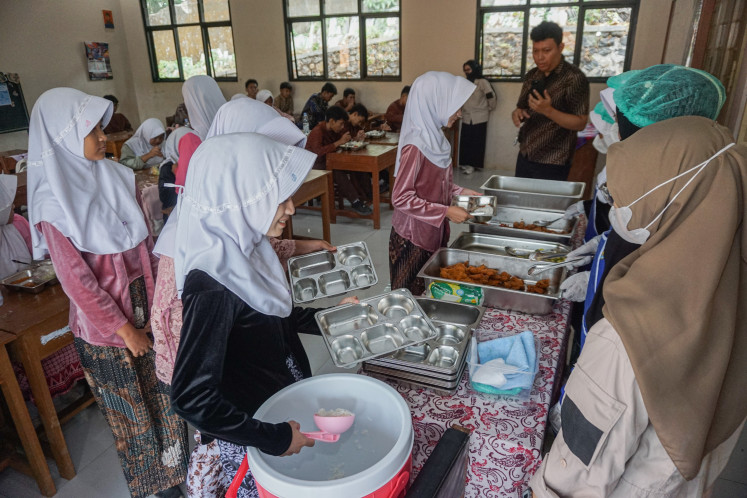
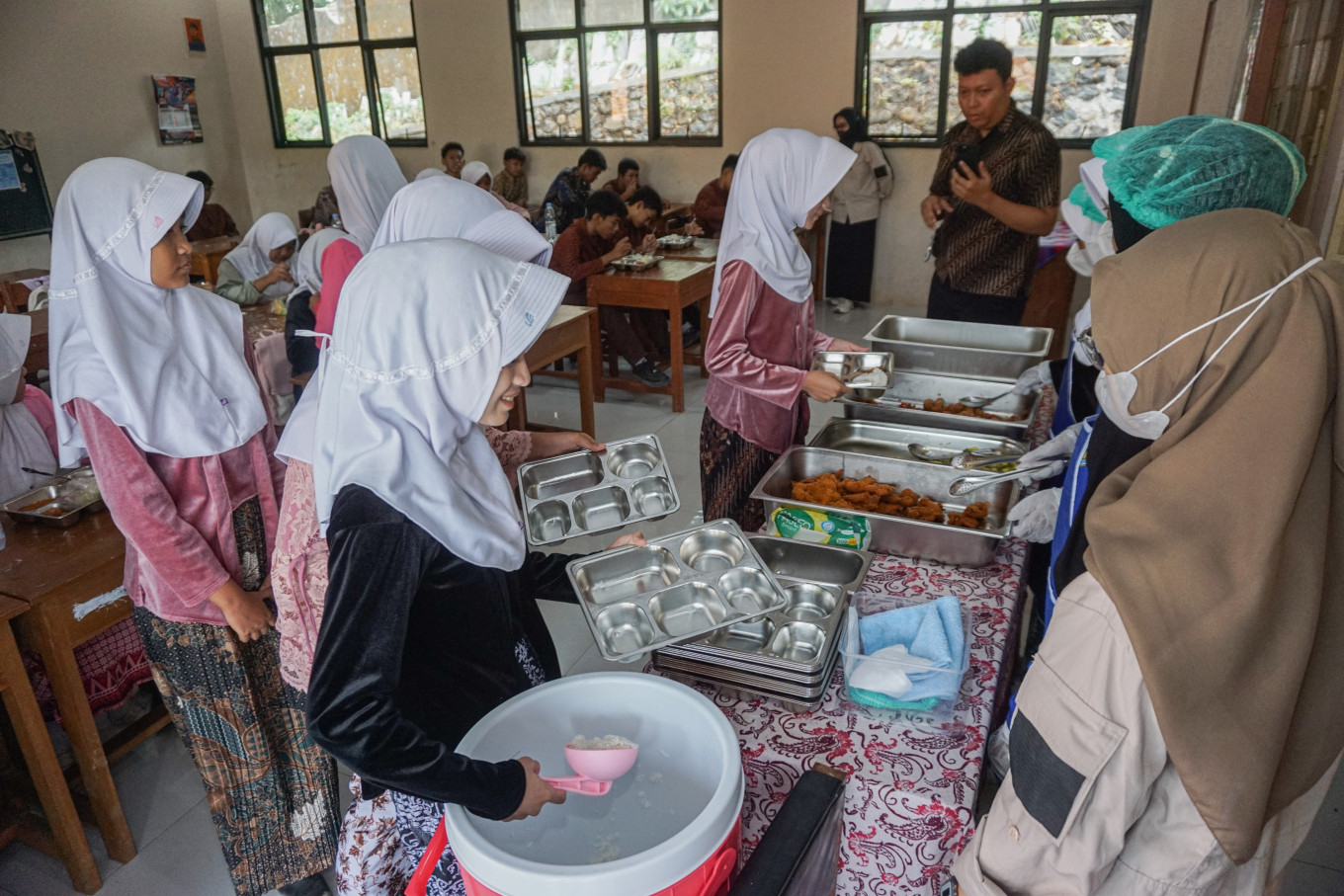 Students select side dishes at a buffet-style lunch on Oct. 8, 2026, provided via the government’s free nutritious meal (MBG) program at SMPN 2 Kandeman junior high school in Batang regency, Central Java. (Antara/Harviyan Perdana Putra)
B
illed as the government’s signature program, the free nutritious meals (MBG) rollout is ironically confronting a serious food safety challenge, evident in recurring outbreaks of suspected food poisoning among beneficiaries.
As of March 12, 2026, the Food and Drug Monitoring Agency (BPOM) had recorded 69 suspected outbreaks associated with the program, affecting 6,383 people.
However, Health Ministry surveillance data through Sept. 2 revealed that the free meals program caused 50,059 food poisoning cases in 560 incidents across 36 provinces and 245 regencies/cities, a tally closely mirrored in the 43,838 suspected cases through late August reported by the Network for Education Watch (NEW) Indonesia.
The World Health Organization defines a foodborne disease outbreak as "the occurrence of two or more cases of a similar foodborne disease resulting from the ingestion of the same food". Each outbreak therefore represents a systemic cluster rather than an isolated incident.
These recurrent events must not be allowed to become the “new normal” in a national nutrition program that aims to reach nearly 50 million students and 10 million breastfeeding and pregnant women and toddlers this year.
Against this backdrop, World Food Day 2026 offers a timely opportunity to rethink how such large-scale initiatives are engineered. This year’s theme, “Innovate today. Nourish tomorrow”, is especially pertinent. For the free meals program, innovation must extend beyond standard kitchen-level sanitation controls to include a structural redesign of the food provision system itself.

At present, nutrition fulfillment service units (SPPG), the formal name for the program's designated kitchens, essentially function as mass catering facilities. Most meals require raw ingredients to be received, stored, prepped, cooked, portioned, packed, transported and consumed within a narrow, high-stress operational window.