The Jakarta Post
Please Update your browser
Your browser is out of date, and may not be compatible with our website. A list of the most popular web browsers can be found below.
Just click on the icons to get to the download page.


Popular Reads
Top Results
No results found. Please check your search term and try again
Can't find what you're looking for?
View all search results
Popular Reads
Top Results
No results found. Please check your search term and try again
Can't find what you're looking for?
View all search resultsWhat it will take to make JKN financially sustainable
Bailouts and premium hikes buy time. Only evidence-based decisions, standardized care and smarter purchasing can keep national health insurance solvent.
Change text size
Gift Premium Articles
to Anyone
Share the best of The Jakarta Post with friends, family, or colleagues. As a subscriber, you can gift 3 to 5 articles each month that anyone can read—no subscription needed!
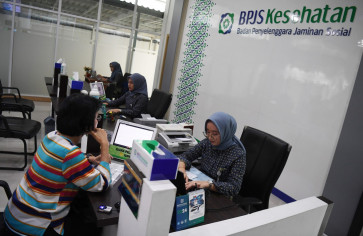
 A Health Care and Social Security Agency (BPJS Kesehatan) official (right) assists a customer on May 14, 2024, at the agency's South Jakarta office. (Antara/Akbar Nugroho Gumay)
E
very few months, the familiar cycle repeats: The National Health Insurance (JKN) fund runs short, and the government steps in. This time, the rescue arrives as an additional Rp 20 trillion (US$1.1 billion) in the 2026 state budget, scheduled for disbursement in October and November. The injection will keep hospital claims flowing, but it does nothing to resolve why the deficit persists.
The figures are stark. National health insurer BPJS Kesehatan recorded an audited deficit of approximately Rp 10.93 trillion in 2024 and an unaudited shortfall of Rp 14.49 trillion in 2025. In 2024, premium income stood at Rp 165.3 trillion against program spending of Rp 175.1 trillion. By February 2026, the claims ratio had climbed to 111.8 percent. Yet premiums have not been adjusted since 2020.
Conventional debate invariably focuses on whether premiums must rise. Periodically, they likely should. But raising premiums is a politically contentious remedy that arrives late and is quickly eroded by escalating healthcare costs. A sustainable JKN demands a complementary, more critical conversation: not merely how much revenue is collected, but how effectively it is spent.
Every pharmaceutical product or medical device admitted to the National Formulary or the e-catalogue constitutes a recurring commitment of public funds. Health Technology Assessment (HTA) enables policymakers to evaluate that commitment against demanding scientific and economic evidence: How much additional clinical benefit does an intervention deliver, and at what cost to the fund?
This is not an argument against innovation. It is an argument for ensuring that every approval and every rejection rests on transparent, defensible evidence rather than lobbying, precedent, or short-term fiscal convenience. The same rigor must continue post-listing as clinical data evolves and market prices shift. Decisions anchored in health economics are fundamentally more sound, objective, and defensible to clinicians, patients, and taxpayers alike.
Consider ischemic stroke, the primary cause of mortality among noncommunicable diseases in Indonesia. Alteplase, a thrombolytic agent, is effective only when administered within a narrow therapeutic window, typically within a few hours of symptom onset. Administered in time, it significantly reduces both mortality and long-term morbidity.

This matters as much to the balance sheet as to the patient: an individual who regains functional independence incurs vastly lower downstream costs in rehabilitation, long-term care, repeat hospitalizations, and lost productivity than one who survives with severe disability. This is precisely the calculus HTA is designed to model: upfront cost versus downstream health gains and net savings.