The Jakarta Post
Please Update your browser
Your browser is out of date, and may not be compatible with our website. A list of the most popular web browsers can be found below.
Just click on the icons to get to the download page.


Popular Reads
Top Results
No results found. Please check your search term and try again
Can't find what you're looking for?
View all search results
Popular Reads
Top Results
No results found. Please check your search term and try again
Can't find what you're looking for?
View all search resultsWho will pay to preserve tropical forests?
For too long, it has been more profitable to destroy tropical forests than to conserve them, even though they provide services essential for the survival of many countries and for the welfare of us all.
Change text size
Gift Premium Articles
to Anyone
Share the best of The Jakarta Post with friends, family, or colleagues. As a subscriber, you can gift 3 to 5 articles each month that anyone can read—no subscription needed!
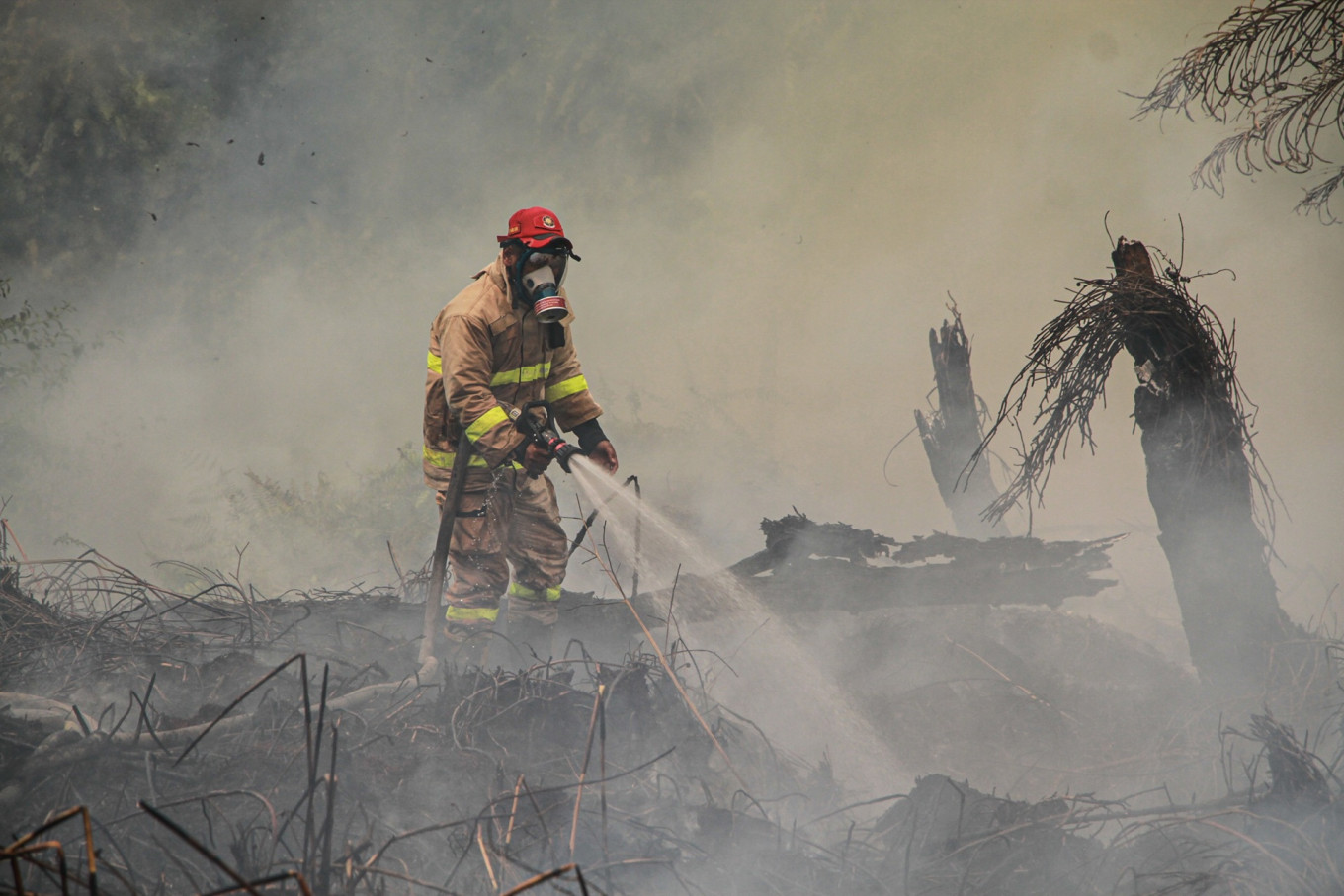 A firefighter sprays water to extinguish a fire on Aug. 26 in Palangkaraya, Central Kalimantan. (Antara/Auliya Rahman)
T
he enormous climate, water and biodiversity benefits generated by tropical forests accrue to the entire world. But hardly any of the economic value created is captured by the countries and communities that safeguard them. The Tropical Forest Forever Facility (TFFF) was launched at last year’s United Nations Climate Change Conference (COP30) in Belém, Brazil, to start correcting this imbalance.
For too long, it has been more profitable to destroy tropical forests than to conserve them, even though they provide services essential for the survival of many countries and for the welfare of us all. The Amazon recycles nearly half of its rainfall and exports moisture that shapes precipitation patterns across South America and beyond. The Congo Basin, with its peatlands that store roughly 30 billion tonnes of carbon, is one of the planet’s great carbon reservoirs, while many of the plant and animal species in Borneo are found nowhere else on Earth.
Moreover, across the tropics, forests support the livelihoods of hundreds of millions of people — including indigenous communities whose stewardship is often essential for maintaining them — while also sustaining local cultures and bolstering food and water security.
But market prices do not adequately reflect these benefits, creating an economic barrier that all tropical regions bump up against: in the short term, clearing a hectare of forest can generate more income than protecting it, even when the long-term costs of forest loss are much greater. As a result, cattle ranching and agricultural expansion exert enormous pressure on the Amazon, small- and large-scale agriculture contribute to forest conversion in the Congo Basin, and industrial plantations have transformed sylvan landscapes in Southeast Asia.
Worryingly, a recent brief by the UN Sustainable Development Solutions Network emphasizes that international public finance remains far below the estimated investment required for conserving tropical forests, and that competition for declining official development aid is intensifying.
Grants and concessional loans remain indispensable for strengthening institutions, protecting rights, restoring degraded landscapes and supporting activities with large social and ecological returns but limited commercial returns. Yet, traditional development finance alone cannot close the gap. Nor should scarce public resources be used simply to absorb risks for private investors.

This is where the TFFF comes in. It is designed to provide eligible tropical-forest countries with predictable, long-term payments for maintaining forest cover and meeting agreed performance criteria. This changes the economic incentives: according to the TFFF’s current model, countries will forgo around US$400 per deforested hectare. Because each hectare of standing tropical forest increases a country’s payment, policymakers may be more willing to implement robust national strategies that complement the TFFF, like Reducing Emissions from Deforestation and Forest Degradation (REDD+).



Your Opinion Matters
Share your experiences, suggestions, and any issues you've encountered on The Jakarta Post. We're here to listen.
Enter at least 30 characters
0
/ 30
Thank you
Thank you for sharing your thoughts. We appreciate your feedback.