The Jakarta Post
Please Update your browser
Your browser is out of date, and may not be compatible with our website. A list of the most popular web browsers can be found below.
Just click on the icons to get to the download page.


Popular Reads
Top Results
No results found. Please check your search term and try again
Can't find what you're looking for?
View all search results
Popular Reads
Top Results
No results found. Please check your search term and try again
Can't find what you're looking for?
View all search resultsCan education alone solve development problems?
Renovated classrooms and technical training mean little if graduates enter an economy that lacks the capital, institutions and markets to put their skills to work.
Change text size
Gift Premium Articles
to Anyone
Share the best of The Jakarta Post with friends, family, or colleagues. As a subscriber, you can gift 3 to 5 articles each month that anyone can read—no subscription needed!
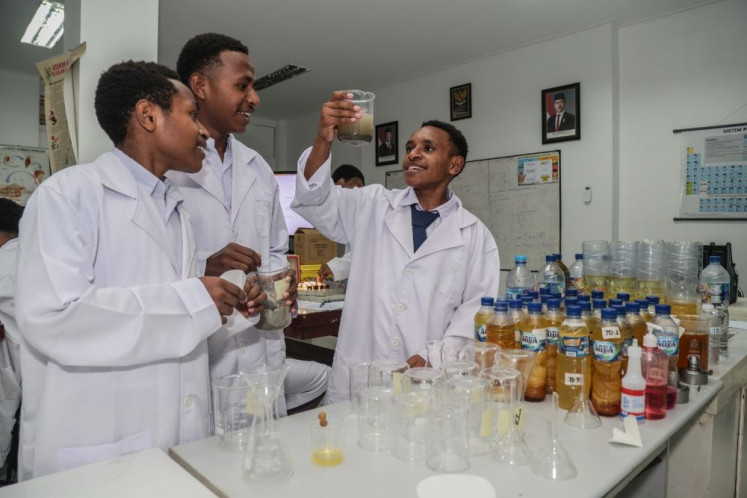
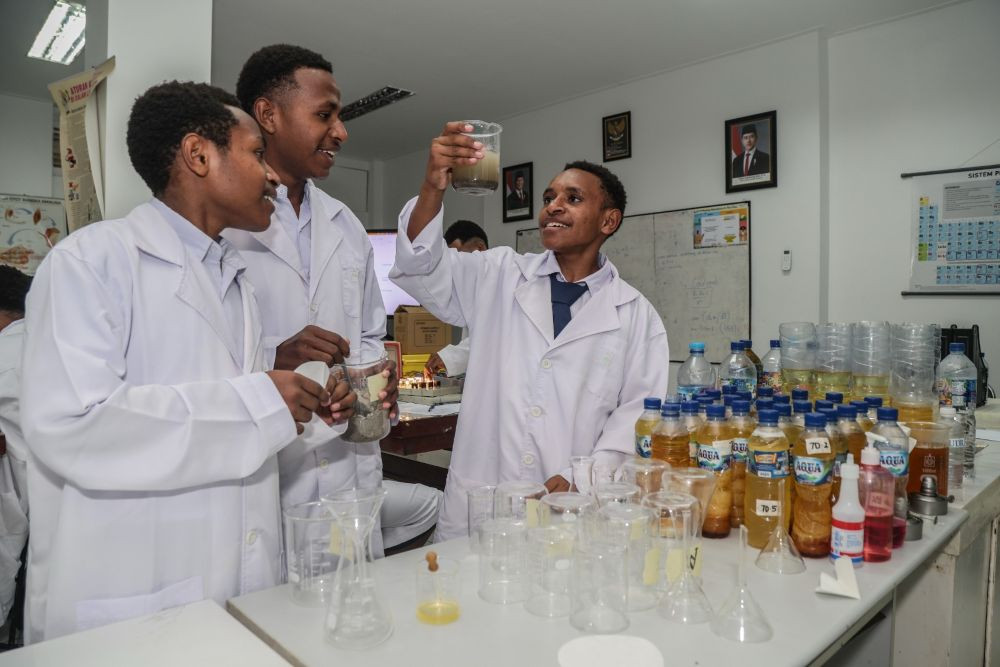 Blended learning: Seventh graders take part on Nov. 5, 2026 in a class on processing used cooking oil in the chemistry laboratory at Sekolah Asrama Taruna Papua (SATP), a boarding school in Mimika regency, Central Papua, which provides a Papuan contextualized curriculum integrated with national and international standards for a student body comprising more than 1,100 children from the Amungme and Kamoro communities as well as five related subtribes. (Antara/Andri Saputra)
O
n Oct. 27, the Primary and Secondary Education Ministry reported that school revitalization and construction programs had reached 55,451 educational institutions during 2025–2026. This is a substantial infrastructure achievement, particularly where inadequate facilities obstruct learning.
However, the figure alone cannot establish how much children's learning or development has improved. That distinction raises a broader question about Indonesia's recurring tendency to treat education as a panacea for national challenges. When weak innovation prompts calls for entrepreneurship education and low productivity prompts calls for technical training, are these interventions addressing the underlying constraints, or merely delivering outputs that governments can readily count?
Education is indispensable. Hanushek and Woessmann linked cognitive skills to economic growth, while the World Bank distinguished mere attendance from actual learning. Yet learning and the eventual application of what is learned remain separate outcomes.
My concern with this distinction stems from 24 years in industry, teaching more than 16 semester-long cohorts of entrepreneurship students and doctoral research on entrepreneurial formation in Indonesia. These experiences have led me to examine the conditions that determine whether acquired capabilities can actually be exercised. While they do not represent every Indonesian family, school, or enterprise, they provide a grounded basis for questioning conventional policy assumptions.
The foundational conditions emerge before formal schooling begins. Children observe how adults respond to disagreement, mistakes and authority, and these repeated interactions shape their expectations of what is permissible or risky. Bronfenbrenner and Morris framed development through ongoing interactions between individuals and their environments, while Grusec examined parental socialization within family dynamics.
Consequently, children enter the classroom with vastly different histories, even when presented with an identical curriculum. Early influences matter without permanently fixing the adults they will become; schools can challenge inherited assumptions, but they cannot assume every child starts from the same baseline of initiative, responsibility, or inquiry.

Parents, moreover, do not raise children in an economic vacuum. Employment security, working hours, household income, and financial strain directly affect family life. Conger et al. reviewed the pathways connecting socioeconomic pressures to family processes and child development.