The Jakarta Post
Please Update your browser
Your browser is out of date, and may not be compatible with our website. A list of the most popular web browsers can be found below.
Just click on the icons to get to the download page.


Popular Reads
Top Results
No results found. Please check your search term and try again
Can't find what you're looking for?
View all search results
Popular Reads
Top Results
No results found. Please check your search term and try again
Can't find what you're looking for?
View all search resultsThe FPI and Betawi people: Our urban poor problem
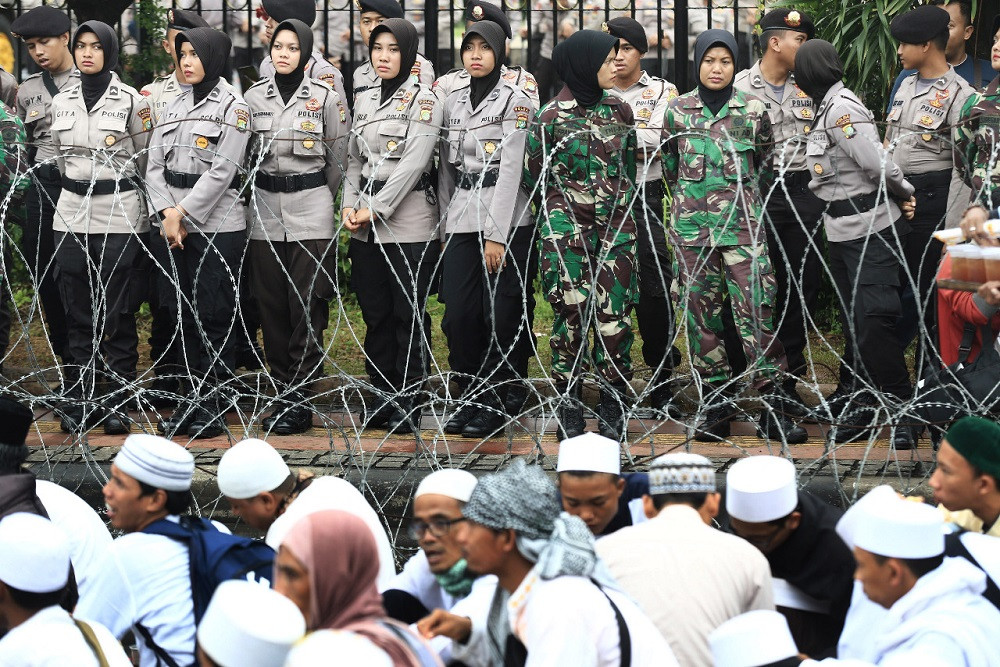
The newly banned Islam Defenders Front (FPI), an Islamic organization known for its tendency to commit acts of violence, provided Betawi people with ideological legitimacy to ransack alcoholic beverage sales, prostitution and other sinful acts according to Islamic teachings.
Change text size
Gift Premium Articles
to Anyone
Share the best of The Jakarta Post with friends, family, or colleagues. As a subscriber, you can gift 3 to 5 articles each month that anyone can read—no subscription needed!
F
rankly speaking, our knowledge of urban lives and their physical surroundings is often more superficial rather than profound. Among skyscrapers and other symbols of modernity and progress in Jakarta, the existence of Betawi people, natives of Jakarta, for instance, remained unrecognized until some of them embraced a new kind of radicalism.
The newly banned Islam Defenders Front (FPI), an Islamic organization known for its tendency to commit acts of violence, provided Betawi people with ideological legitimacy to ransack alcoholic beverage sales, prostitution and other sinful acts according to Islamic teachings.
Consequently, Betawi people in the FPI not only sent a stern message to non-Muslims that they were going to create an Islamic state by implying sharia but also ironically positioned themselves as the common enemy of the majority of Jakarta inhabitants. Actually, like most good religious people, non-Muslims in Jakarta are quite happy with the FPI’s conservative stance against such sinful acts.
It is well understood that regardless of their beliefs, religious people share the common view that the consumption of alcoholic beverages, prostitution and gambling are satanic acts that should be perished, if not limited at all. But their bad habit of committing violence gives outsiders a picture that they desire more than eradicating such sinful acts.
Betawi people – once known for their vast land ownership – are among those who lose the game in modern – Darwinian – capitalistic Jakarta. Regeneration of these people takes place but then fails to produce a stronger, richer, more educated and more competitive new generation. The Betawi people, who were the majority inhabitants of Jakarta up until the 1940s, then slowly became the marginalized minority as urbanization began in the 1950s.
Si Doel Anak Betawi (Doel Son of Betawi), a popular 1990s TV series, shows how far Betawi people had fallen behind newcomers in Jakarta. They slowly had declined from generations of land owners (their great-great grandfathers) and farmers, to generations of oplet (public minivan) drivers and now ojek (motorcycle taxi) riders. From this point we absolutely can take note that the unemployment rate among Betawi people in their productive age is quite high.
In Tanah Abang district, from generation to generation, Betawi people silently inherited the oplet driver-ojek rider profession without making any complaints, until a local charismatic cleric calling himself habib founded in 1998 the FPI, a mass organization that promoted a set of religious views. In Islamic Betawi tradition, habib is a cleric with special genealogical status: a descendant of Prophet Muhammad.