The Jakarta Post
Please Update your browser
Your browser is out of date, and may not be compatible with our website. A list of the most popular web browsers can be found below.
Just click on the icons to get to the download page.


Popular Reads
Top Results
No results found. Please check your search term and try again
Can't find what you're looking for?
View all search results
Popular Reads
Top Results
No results found. Please check your search term and try again
Can't find what you're looking for?
View all search resultsOn Myanmar: Call for dialogue, not sanctions
It is impossible to see Suu Kyi becoming a has-been of Myanmar politics. Nor will the generals consign themselves to historical oblivion.
Change text size
Gift Premium Articles
to Anyone
Share the best of The Jakarta Post with friends, family, or colleagues. As a subscriber, you can gift 3 to 5 articles each month that anyone can read—no subscription needed!
T
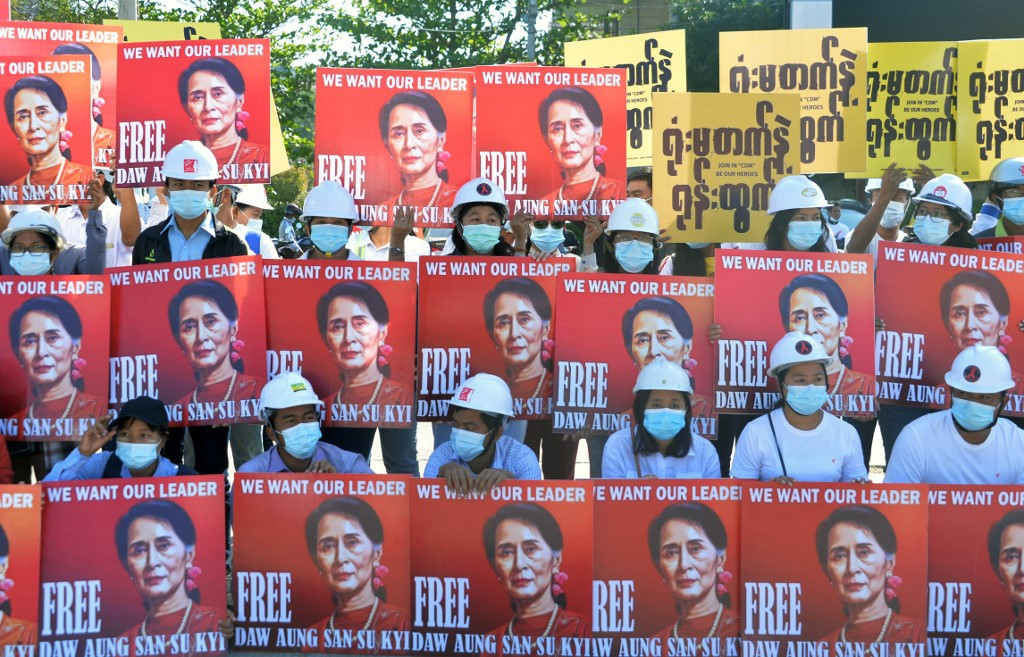
wo turns of events in Myanmar are disturbing. The first is the military coup. The second is the imposition of sanctions on the country by the United States, the United Kingdom and Canada.
The coup itself does reflect political regression. But the solution must be to achieve a state where the military and elected politicians will be able to work together again. That rapprochement calls for dialogue between them and with international interlocutors such as the US, ASEAN, China, Russia and India.
What will complicate the possibilities of a dialogue will be the imposition and possible expansion of international sanctions. Already, US President Joe Biden has ordered a series of punitive measures against Myanmar’s military leadership, including robust export controls, a freeze on cooperative US assets and a halt to billion-dollar government funds. The UK and Canada have joined in, and it is not impossible that the scope of sanctions will be widened in the months to come.
The sanctions, and even their expansion, will not work. Measures against Myanmar’s military, known as the Tatmadaw, will not loosen its historical grip on the levers of power. If anything, the measures will hurt ordinary citizens eventually by undermining their economic access to the West. At the same time, the sanctions will push the Tatmadaw closer to China and Russia, two countries that have broken international ranks with America by not making democracy the centerpiece of their foreign relations.
In that global context, what the West could do today is draw a parallel between the possible political evolution of Myanmar and the extant record of Indonesia, which has avoided direct political influence by the military ever since the departure of the Soeharto regime in 1998. Indonesia has been democratic since then.
Myanmar was ruled by the armed forces from 1962 until 2011, when a new government inaugurated a return to civilian rule. During those five decades, the country was characterized by an autarchic economy that paralleled its desire to remain free of foreign political control. There was nothing wrong with the political desire; all countries wish to translate their sovereignty and territorial integrity into the practical ability to make domestic decisions without having to kowtow to foreign powers. That concrete ability rests on the degree of domestic cohesiveness that a nation possesses.
In this context, the military is an institution that is drawn from the people at large and that does not owe its power to the shifting political bases and passing electoral alliances that shape democratic contestation. Hence, conceivably, the military could enhance national unity, development and security, particularly in post-colonial societies that have to handle the pernicious economic and social legacies of imperialism as best as they can. "Military" is not a bad word in politics. Myanmar is an example of that. Pakistan is another. Indonesia itself is yet another, of course.