The Jakarta Post
Please Update your browser
Your browser is out of date, and may not be compatible with our website. A list of the most popular web browsers can be found below.
Just click on the icons to get to the download page.


Popular Reads
Top Results
No results found. Please check your search term and try again
Can't find what you're looking for?
View all search results
Popular Reads
Top Results
No results found. Please check your search term and try again
Can't find what you're looking for?
View all search resultsToward full privatization, transformation of Garuda
in the long run, the debilitating financial problems besetting Garuda will raise the question of whether it is still relevant to keep the airline as a flag carrier.
Change text size
Gift Premium Articles
to Anyone
Share the best of The Jakarta Post with friends, family, or colleagues. As a subscriber, you can gift 3 to 5 articles each month that anyone can read—no subscription needed!
 Set as preferred source
S
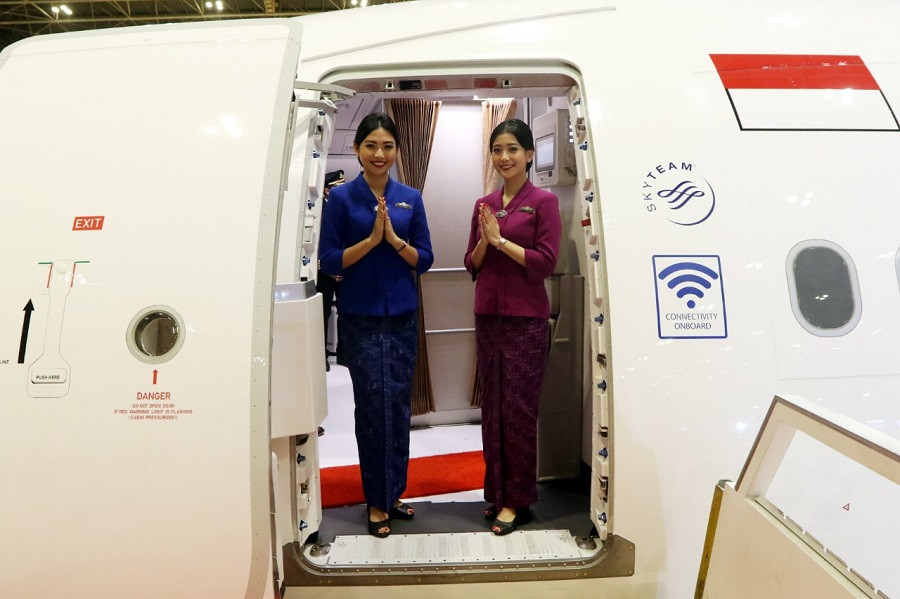
tate-owned airline Garuda Indonesia reported a loss of US$712.73 million in the first semester of 2020. As of June 30, 2020, the flag carrier booked $917.28 million in total income, down 58.18 percent year-on-year from $2.19 billion.
As of Dec. 31, 2020, Garuda's equity stood at $1.9 billion — $7.5 billion in total assets and $9.57 billion in liabilities. Worse, throughout last year, Garuda only made $1.01 billion, less than one-third of its 2019 mark of $3.3 billion.
The COVID-19 pandemic was one of the main factors contributing to Garuda’s financial downturn, which is also the case of the world’s airline industry. For example, Garuda has to pay the rental fee of 101 aircraft that have remained idle during the pandemic due to a sharp decrease in occupancy rates.
Even before the pandemic, Garuda operated too many fleets in terms aircraft variation, potentially leading to inefficiency. Now, its rental debt has reached Rp 1 trillion per month. The figure will increase exponentially every month if the outstanding debts are not paid immediately.
A number of measures have been taken to save Garuda. For its debts, Garuda has promised the House of Representatives to negotiate them with several lessors. On the other hand, in December 2020, the government through the Finance Ministry agreed to provide an injection in the amount of Rp 8.5 trillion, together with other financially troubled state-owned enterprises (SOE). To this date, though, Garuda has only received Rp 1 trillion in total.
Both measures may be effective in the short term. However, in the long run, the debilitating financial problems besetting Garuda will raise the question of whether it is still relevant to keep the airline as a flag carrier — a concept that allows the government to own majority shares — or whether it is about time to consider full privatization, with Indonesian investors owning a minimum of 51 percent shares in Garuda.
The aforementioned minimum figure for Indonesian shareholders is important to ensure Garuda’s Indonesian nationality survives, as it will be locked within bilateral and multilateral air service agreements. Both models commonly require effective control, proven through the majority ownership of shares and airlines with the same nationality. The failure to do so means losing the rights to several international routes.