The Jakarta Post
Please Update your browser
Your browser is out of date, and may not be compatible with our website. A list of the most popular web browsers can be found below.
Just click on the icons to get to the download page.


Popular Reads
Top Results
No results found. Please check your search term and try again
Can't find what you're looking for?
View all search results
Popular Reads
Top Results
No results found. Please check your search term and try again
Can't find what you're looking for?
View all search results'Replacements': a time-lapse VR journey from a Javanese village to a dystopian megacity
Change text size
Gift Premium Articles
to Anyone
Share the best of The Jakarta Post with friends, family, or colleagues. As a subscriber, you can gift 3 to 5 articles each month that anyone can read—no subscription needed!
 Set as preferred source
F
rench-Indonesian illustrator and director Jonathan Hagard’s award-winning collaboration with Japanese animators is a fascinating, yet poignant experience depicting the multi-faceted modern transition and the futility of the capitalist centralized urban model.
Virtual reality (VR) transforms digital storytelling and introduces contemporary art to exciting new frontiers. The immersive experience, via head-mounted displays, headphones and sometimes hand controls, persuades our brains that we are situated elsewhere, transporting us to a new virtual location. VR is increasingly entering the 21st century modern experience. Utilized in video gaming, it is the fundamental platform of the metaverse -- the interactive future of the internet. Yet, until recently, VR has been an unexplored territory within Indonesian art.
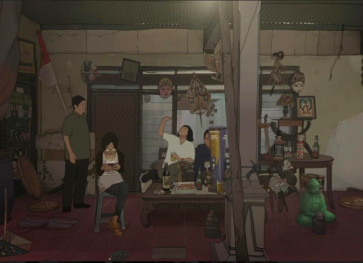
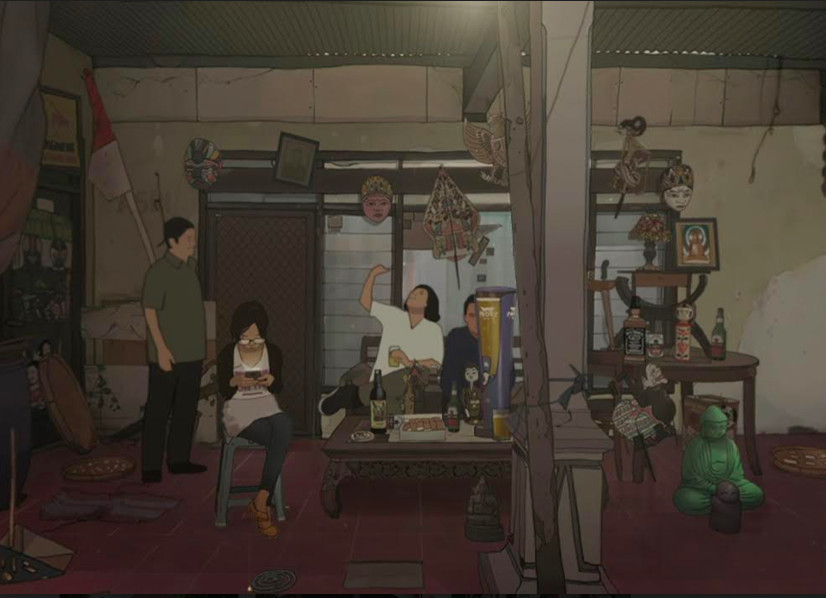
Indonesia’s first VR artwork, “Replacements”, is a 360 degree happening locating the viewer in the center of the simulation. Within 12 minutes, via stylized imagery, we transition from 1980 to 2020. The video begins in a tranquil village. A timber dwelling in a spacious front yard then gives way to a concrete family home. Adults sit casually in conversation; the gentle twitter of birds from nearby trees greets us. Our eyes scan around, identifying familiar cultural and daily items. Then, turning our heads, the village scenario and the vast blue sky unfolds. For the novice yet to experience VR, the initial isolation from the real world, except for gravitational forces, may be confronting.
The view unfolds from traditional warung to small stores to the modern mini-mart. Trees disappear as overhead, power lines and condominiums materialize. Advertising becomes ubiquitous, and an overhead freeway appears. Seasonal rains flood the area, yet the deluges have become greater and increasingly littered over the years. Politics blasts from loudspeakers. Skyscrapers rise up from the haze, dwarfing us in perspective. A giant mosque manifests as do images of political leaders. Many icons of Java's rich traditions and heritage dissolve with modernization's chaos. The swift urban, environmental, political and cultural transformation grounds us within the harsh reality of the so-called "Muslim megacities."
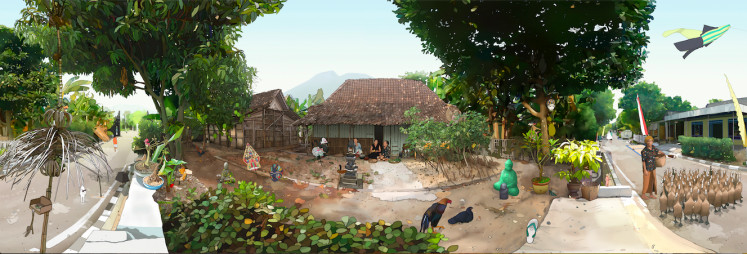
“Completed in early 2020, “Replacements” is based upon archive research, fiction, personal experience and the memories of the Central Javanese village where my mother was raised. The focal dwelling is my grandmother’s house. Her words, 'Remember your roots to understand your future', are my driving inspiration,” Hagard told The Jakarta Post. “My first VR venture, “Replacements”, required three years of work, including two years of intense production. This video follows Time Lapse, a short film I made in 2008, with a similar narrative.”
Hagard’s compelling animation premiered in Indonesia during Domesticity IX, his solo exhibition that closed on May 15 at Kayu located at the House of Masks and Puppets Setia Darma in Ubud, Bali. Hagard was invited to exhibit by the international art project Lucie Fontaine, which has previously presented events in Prague; Stockholm; Miami and New York, the United States; and the Balinese artist-in-residency program Project Etere.