Can't find what you're looking for?
View all search resultsCan't find what you're looking for?

View all search resultsPresident Zelensky warns Ukrainians of new attacks from Moscow.
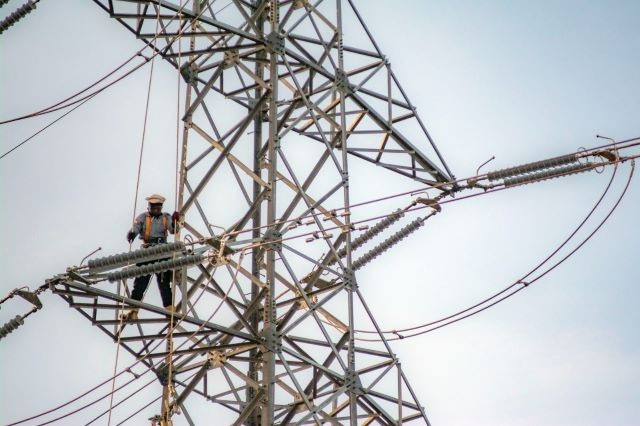
he United States was set to announce new aid on Tuesday to help Ukraine restore electricity as its people faced another week of brutal cold and darkness after Russian missile strikes on its power grid caused rolling blackouts.
Russia has targeted Ukraine's power plants, transmission and distribution facilities and water pumping stations since early October, with each barrage having greater impact than the last as damage accumulates and winter sets in.
Ukrainian President Volodymyr Zelensky has said he expects new attacks that could be as bad as last week's bombardment, which left millions of people with no heat, water or power.
US Secretary of State Antony Blinken, who arrived in Bucharest early on Tuesday, will announce new assistance to help restore Ukraine’s power transmission capacity, a senior State Department official told reporters on condition of anonymity.
Washington has been working with US utilities and hardware providers and with European nations to locate equipment that can restore Ukraine's high-voltage transmission stations, the official said.
Ukrainian Foreign Minister Dmytro Kuleba told a gathering of seven Nordic and Baltic foreign ministers that his country needed transformers and improved air defenses.
Kyiv and its allies say Russia's attacks on civilian infrastructure are war crimes. Moscow denies its intent is to hurt civilians but said last week their suffering would not end unless Ukraine yielded to Russia's demands, without spelling them out.
In Kyiv, snow fell and temperatures were hovering around freezing as millions in and around the capital struggled to heat their homes.
Christmas trees would be erected, minus lights, throughout the battered city in a defiant display of holiday spirit, officials said.
"We cannot allow Putin to steal our Christmas," Mayor Vitali Klitschko told the RBC-Ukraine news agency that in an interview.
Ukrainian energy company Naftogaz has asked the US Agency for International Development to help with additional natural gas volumes for the heating season, the company's chief executive said.
DTEK, Ukraine's biggest private electricity producer, said it would reduce electricity supply by 60 percent for its consumers in Kyiv.
National grid operator Ukrenergo said on Monday it had been forced to resume regular emergency blackouts across the country.
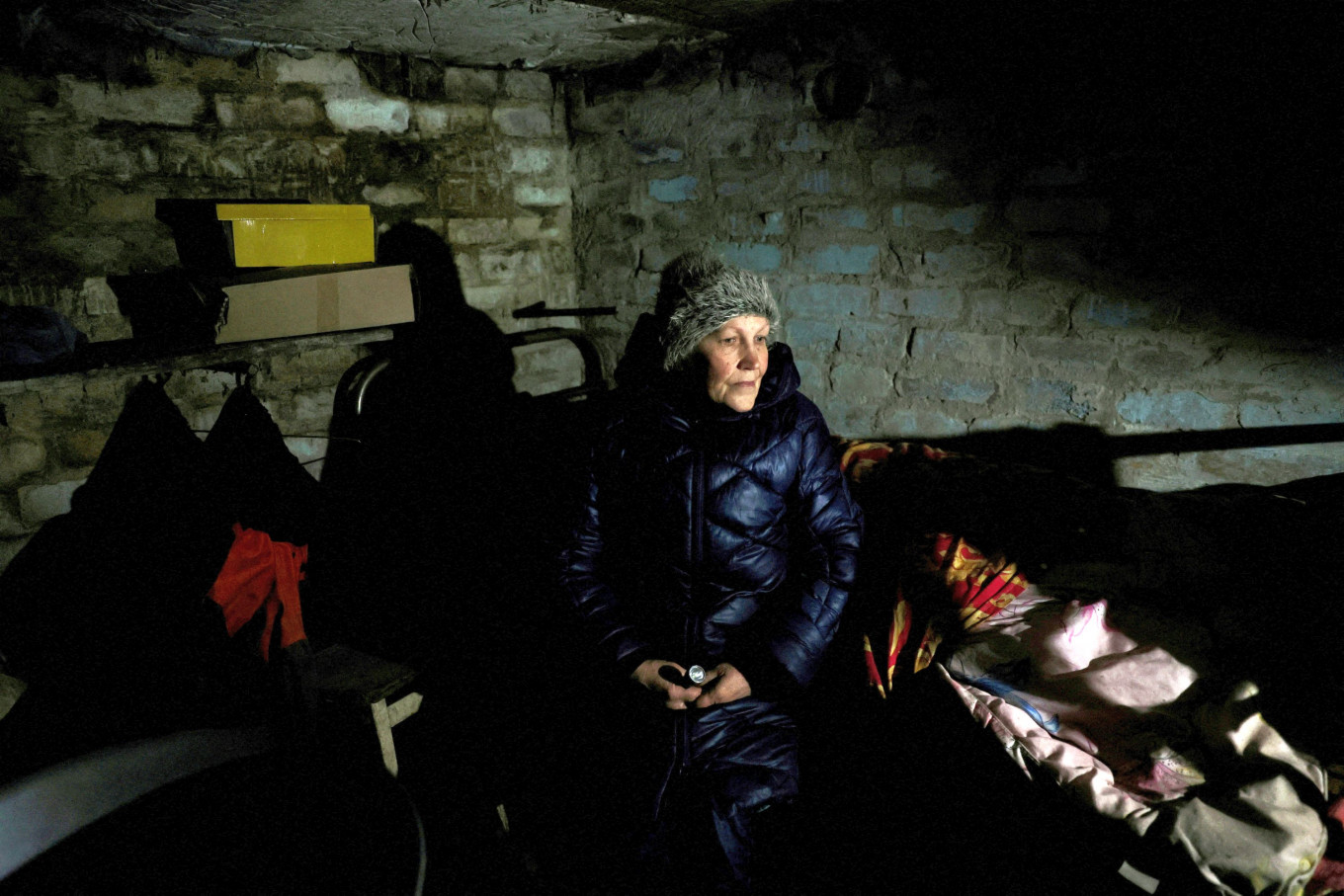
Near the frontline in the eastern town of Siversk, Viktor and Ludmila Syabro, 68 and 61 respectively, said they had been living underground since power was cut off in April as Russian assaults shattered their hometown.
Without water or gas, the couple hope to install a wood-burning stove to make life underground more bearable during winter.
In Kherson city, which has lacked electricity and heat since Russian forces abandoned it earlier this month, regional Governor Yaroslav Yanushevych said that 24 percent of customers now had electricity, including partial power in the city center.
New phase
Along front lines in eastern Ukraine, the onset of winter is ushering in a new phase of the conflict, after several months of Russian retreats, with intense trench warfare along heavily fortified positions.
With Russian forces having pulled back in the northeast and withdrawn across the Dnipro River in the south, the front line is only around half the length it was a few months ago, making it harder for Ukrainian forces to find weakly defended stretches to attempt a new breakthrough.
Ukraine's armed forces general staff said late on Monday that Russian forces were heavily shelling towns on the west bank of the Dnipro River, including Kherson, abandoned by Moscow earlier this month.
Russia kept up heavy shelling of key targets Bakhmut and Avdiivka in Donetsk province, and to the north bombarded areas around the towns of Kupiansk and Lyman, both recaptured recently by Kyiv, the Ukrainian military said.
Ukrainian forces had damaged a rail bridge north of the Russian-occupied southern city of Melitopol that has been key to supplying Russian forces dug in there.
Reuters could not independently verify battlefield reports.
Russia launched what it calls its "special military operation" on Feb. 24 to demilitarize its neighbor and protect Russian speakers. Ukraine and Western nations have dismissed this as a baseless pretext for invasion.
The Pentagon is considering a Boeing proposal to supply Ukraine with cheap, small precision bombs fitted onto abundantly available rockets, allowing Kyiv to strike far behind Russian lines as the West struggles to meet demand for more arms.
NATO’s meeting
In the meantime, NATO chief Jens Stoltenberg would call on allies to pledge more winter aid for Ukraine at a meeting on Tuesday and Wednesday, after its president told residents to brace for another week of cold and darkness due to Russian attacks on infrastructure.
NATO foreign ministers meeting in Bucharest will focus on ramping up military assistance for Ukraine such as air defense systems and ammunition, even as diplomats acknowledge supply and capacity issues, but also discuss non-lethal aid as well.
Part of this non-lethal aid—goods such as fuel, medical supplies, winter equipment and drone jammers—has been delivered through a NATO assistance package that allies can contribute to and which Stoltenberg aims to increase.
Share your experiences, suggestions, and any issues you've encountered on The Jakarta Post. We're here to listen.
Thank you for sharing your thoughts. We appreciate your feedback.
Quickly share this news with your network—keep everyone informed with just a single click!
Share the best of The Jakarta Post with friends, family, or colleagues. As a subscriber, you can gift 3 to 5 articles each month that anyone can read—no subscription needed!
Get the best experience—faster access, exclusive features, and a seamless way to stay updated.