The Jakarta Post
Please Update your browser
Your browser is out of date, and may not be compatible with our website. A list of the most popular web browsers can be found below.
Just click on the icons to get to the download page.


Popular Reads
Top Results
No results found. Please check your search term and try again
Can't find what you're looking for?
View all search results
Popular Reads
Top Results
No results found. Please check your search term and try again
Can't find what you're looking for?
View all search resultsSearching infrastructure-financing solutions
Based on a 2021 Asian Development Bank (ADB) report, it was found that an infrastructure financing scheme with value capture and value creation can be implemented in Indonesia.
Change text size
Gift Premium Articles
to Anyone
Share the best of The Jakarta Post with friends, family, or colleagues. As a subscriber, you can gift 3 to 5 articles each month that anyone can read—no subscription needed!
 Set as preferred source
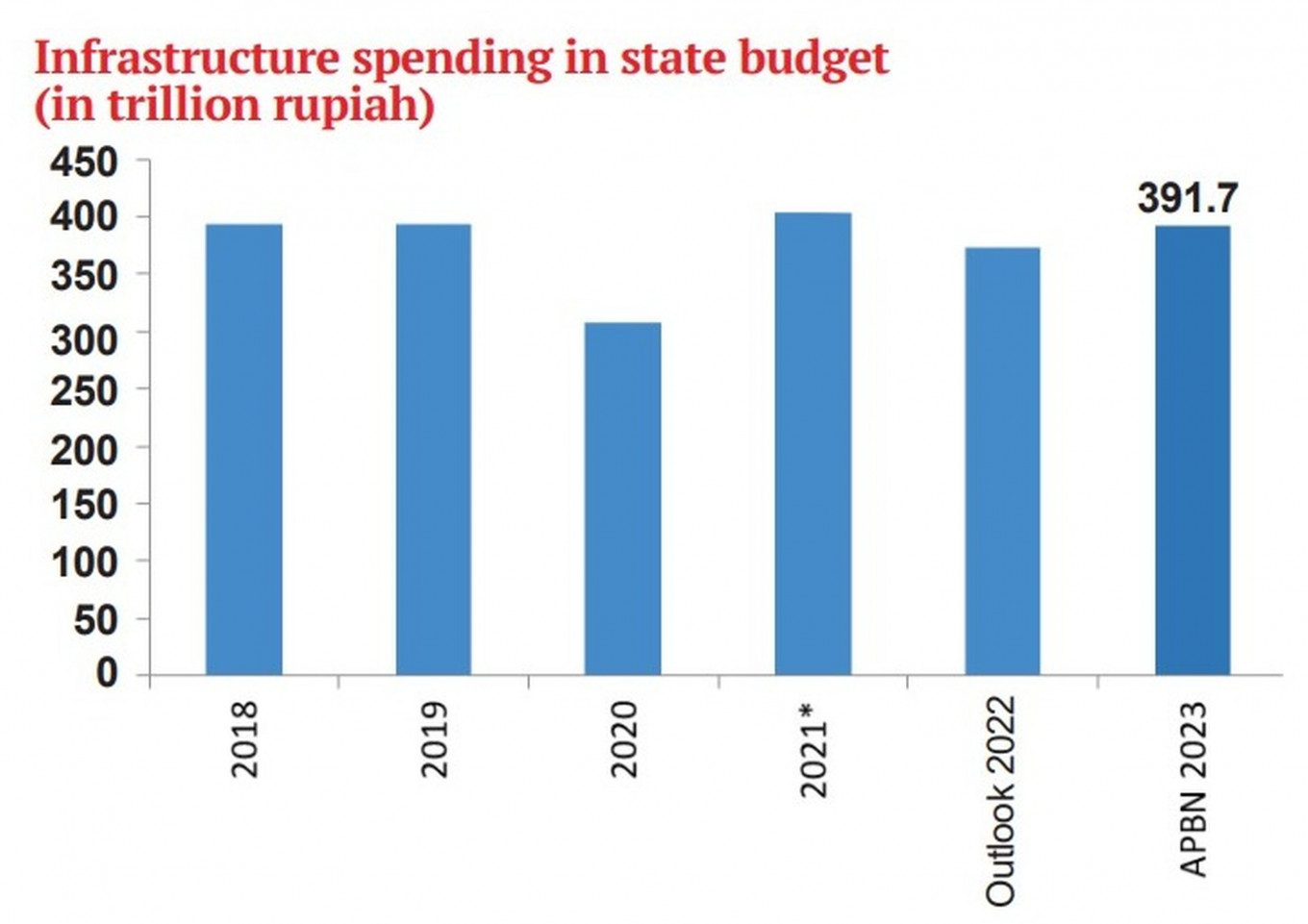
Government capacity to finance infrastructure is still limited.
We estimate that the state budget will only be able to finance 30 percent of the infrastructure financing needs in accordance with the 2020-2024 National Medium-Term Development Plan (RPJMN), which amounts to Rp 6.4 quadrillion (US$426.49 million). The funding requirement for infrastructure development on average is Rp 1.28 quadrillion per year. Meanwhile, in the 2023 State Budget the allocation for infrastructure spending is Rp 391.7 trillion, only 30 percent of the infrastructure financing needs per year.
The problem of infrastructure financing is an important problem that needs to be resolved. An alternative financing option other than using government funding is by inviting in the private sector. However, inviting the private sector to participate is not easy because it requires certainty of returns in the future. In general, the characteristics of infrastructure investment are long-term investments with large capital. In the early stages of infrastructure operations, a special purpose/project vehicle (SPV) will experience a negative cash flow for five to seven years from the infrastructure project operating. After that, the project will experience a positive cash flow and generally the breakeven point of infrastructure projects occurs after 15 years of project operation.
Currently, the government is giving a big role to State Own Enterprises (SOEs) in the construction sector in building infrastructure. The government provides capital through state capital injections and guarantees. However, the need for huge infrastructure financing pushes SOE construction companies to take on high debt burdens, which is one of the reasons for their unhealthy financial conditions. These conditions have been exacerbated by the global economic slowdown. The weakening global economy has left several SOEs in the construction sector unable to sell assets because investors tend to be cautious in investing, including investing in the infrastructure sector.
On the other hand, banks also have limitations in long-term financing. On average, bank loans have a term of five to 10 years while the breakeven point for infrastructure projects occurs in the 15th year after the project operates.
The government actually has been trying to find alternative infrastructure financing by deepening financial markets. Several SOEs in the infrastructure sector have issued capital market instruments to finance infrastructure development such as asset-based securitization (KIK EBA), limited participation mutual funds (RDPT) and infrastructure investment funds (DINFRA).
Last, the government in 2020 also established a sovereign wealth fund called the Indonesia Investment Authority (INA). The objective of the INA is to obtain funds from abroad, which are used to finance infrastructure. We believe that the INA can be an alternative for infrastructure financing, but it takes longer and is not a single solution to overcome infrastructure financing in the short term. This is because the INA is also an investment fund manager, which requires it to provide investment returns to its investors. Thus, we believe that it will be difficult for the INA to finance infrastructure projects that have a low rate of return on investment. In fact, most current infrastructure projects have a low internal rate of return (IRR), which is below 13 percent. This situation mainly occurs in infrastructure projects outside Java. Going forward, we estimate that these infrastructure financing instruments are still insufficient to fund infrastructure in Indonesia.