The Jakarta Post
Please Update your browser
Your browser is out of date, and may not be compatible with our website. A list of the most popular web browsers can be found below.
Just click on the icons to get to the download page.


Popular Reads
Top Results
No results found. Please check your search term and try again
Can't find what you're looking for?
View all search results
Popular Reads
Top Results
No results found. Please check your search term and try again
Can't find what you're looking for?
View all search resultsUS negotiators leaving without a peace deal with Iran
The talks in Islamabad were the first direct US-Iranian meeting in more than a decade and the highest-level discussions since the 1979 Islamic Revolution.
Change text size
Gift Premium Articles
to Anyone
Share the best of The Jakarta Post with friends, family, or colleagues. As a subscriber, you can gift 3 to 5 articles each month that anyone can read—no subscription needed!
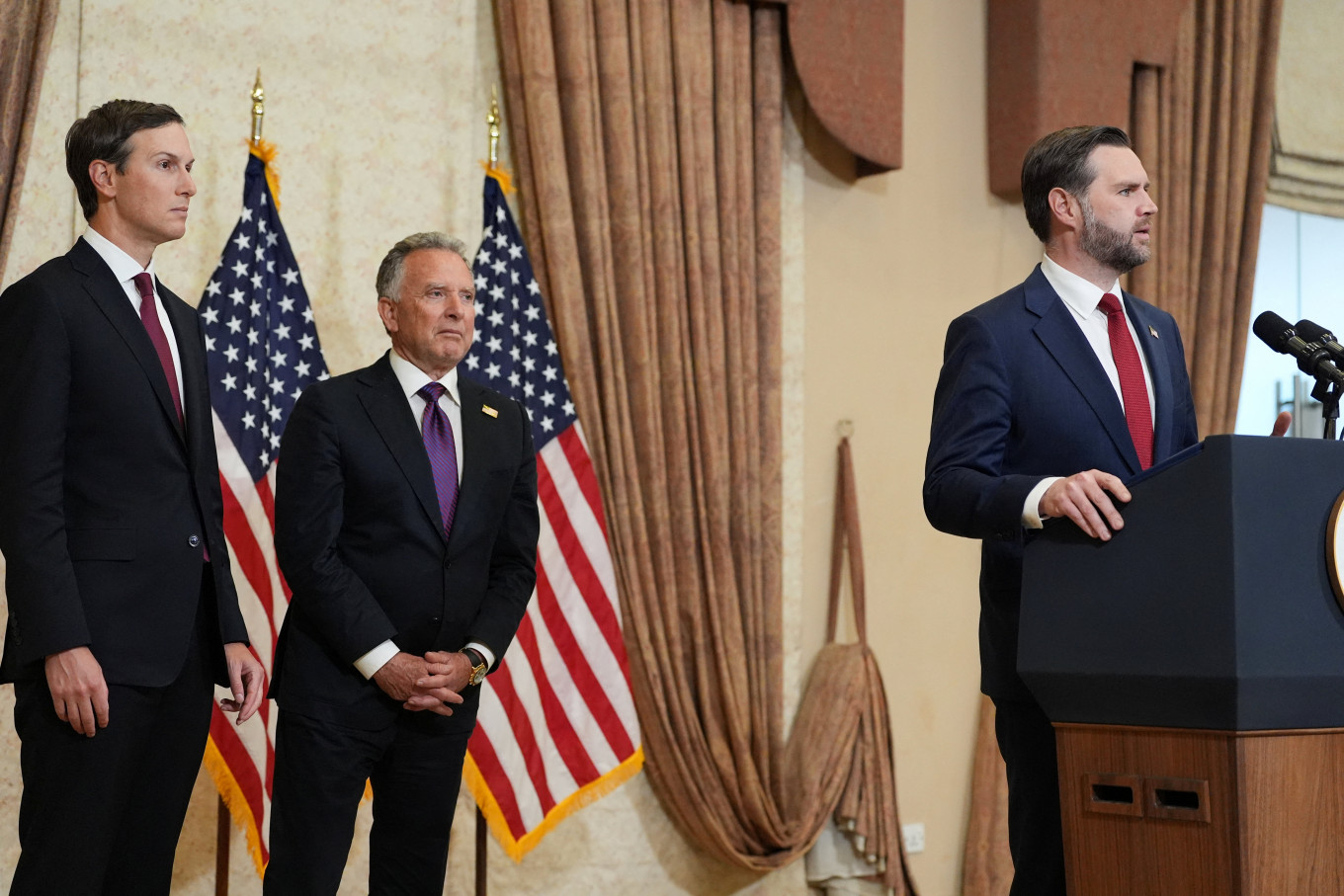 United States Vice President JD Vance (right) speaks during a news conference after meeting with representatives from Pakistan and Iran as Jared Kushner (left), and Steve Witkoff, Special Envoy for Peace Missions listen on Sunday, April 12, 2026, in Islamabad, Pakistan. (Reuters/pool/Jacquelyn Martin)
U
nited States Vice President JD Vance said on Sunday that his negotiating team was leaving Pakistan after not reaching a deal with Iran after 21 hours of negotiations.
Vance cited shortcomings in the talks and said Iran had chosen not to accept American terms, including to not build nuclear weapons.
"The bad news is that we have not reached an agreement, and I think that's bad news for Iran much more than it's bad news for the United States of America," Vance said. "So we go back to the United States having not come to an agreement. We've made very clear what our red lines are."
Vance said he talked with US President Donald Trump half a dozen times during the talks.
The talks in Islamabad were the first direct US-Iranian meeting in more than a decade and the highest-level discussions since the 1979 Islamic Revolution.
The outcome could determine the fate of the fragile two-week ceasefire and the reopening of the Strait of Hormuz, a choke point for about 20 percent of global energy supplies that Iran has blocked since the war began. The conflict has sent global oil prices soaring and killed thousands of people.
In a post on X, Iran's government said that the talks had concluded and technical experts from both sides would exchange documents.
"Negotiations will continue despite some remaining differences," the post added, though it did not say when they would restart.
Vance, special envoy Steve Witkoff and Trump's son-in-law Jared Kushner met Iranian Parliamentary Speaker Mohammad Baqer Qalibaf and Foreign Minister Abbas Araqchi for two hours before a rest, according to a source from mediator Pakistan.
The Iranian delegation arrived on Friday dressed in black in mourning for late Supreme Leader Ayatollah Ali Khamenei and others killed in the war. They carried shoes and bags of some students killed during the US bombing of a school next to a military compound, the Iranian government said. The Pentagon has said the strike is under investigation but Reuters has reported that military investigators believe the US was likely responsible for it.
"There were mood swings from the two sides and the temperature went up and down during the meeting," another Pakistani source said in reference to the first round of talks.
For the US-Iran talks, Islamabad, a city of more than 2 million people, was locked down with thousands of paramilitary personnel and army troops on the streets.
Pakistan's mediating role is a remarkable transformation for a nation that was a diplomatic outcast a year ago.
Strait of Hormuz
As the talks started, the US military said it was "setting the conditions" to start clearing the Strait of Hormuz.
The Strait of Hormuz is central to the ceasefire talks. The US military said two of its warships had passed through the strait and conditions were being set to clear mines, while Iran's state media denied any US ships had transited the waterway.
Before the talks began, a senior Iranian source told Reuters the US had agreed to release frozen assets in Qatar and other foreign banks. A US official denied agreeing to release the money.
As well as the release of assets abroad, Tehran is demanding control of the Strait of Hormuz, payment of war reparations and a ceasefire across the region including in Lebanon, according to Iranian state TV and officials.
Tehran also wants to collect transit fees in the Strait of Hormuz.
Trump's stated goals have shifted, but as a minimum he wants free passage for global shipping through the strait and the crippling of Iran's nuclear enrichment programme to ensure it cannot produce an atomic bomb.
US ally Israel, which actively persuaded Washington to join the Feb. 28 attacks on Iran that launched the war, has also been bombing Tehran-backed Hezbollah militants in Lebanon and says that conflict is not part of the Iran-US ceasefire.
Mutual distrust is high.