TheJakartaPost
Please Update your browser
Your browser is out of date, and may not be compatible with our website. A list of the most popular web browsers can be found below.
Just click on the icons to get to the download page.


Popular Reads
Top Results
No results found. Please check your search term and try again
Can't find what you're looking for?
View all search results
Popular Reads
Top Results
No results found. Please check your search term and try again
Can't find what you're looking for?
View all search resultsPutin, Xi hail 'unyielding' ties in talks after Trump visit
Change text size
Gift Premium Articles
to Anyone
Share the best of The Jakarta Post with friends, family, or colleagues. As a subscriber, you can gift 3 to 5 articles each month that anyone can read—no subscription needed!
 Set as preferred source
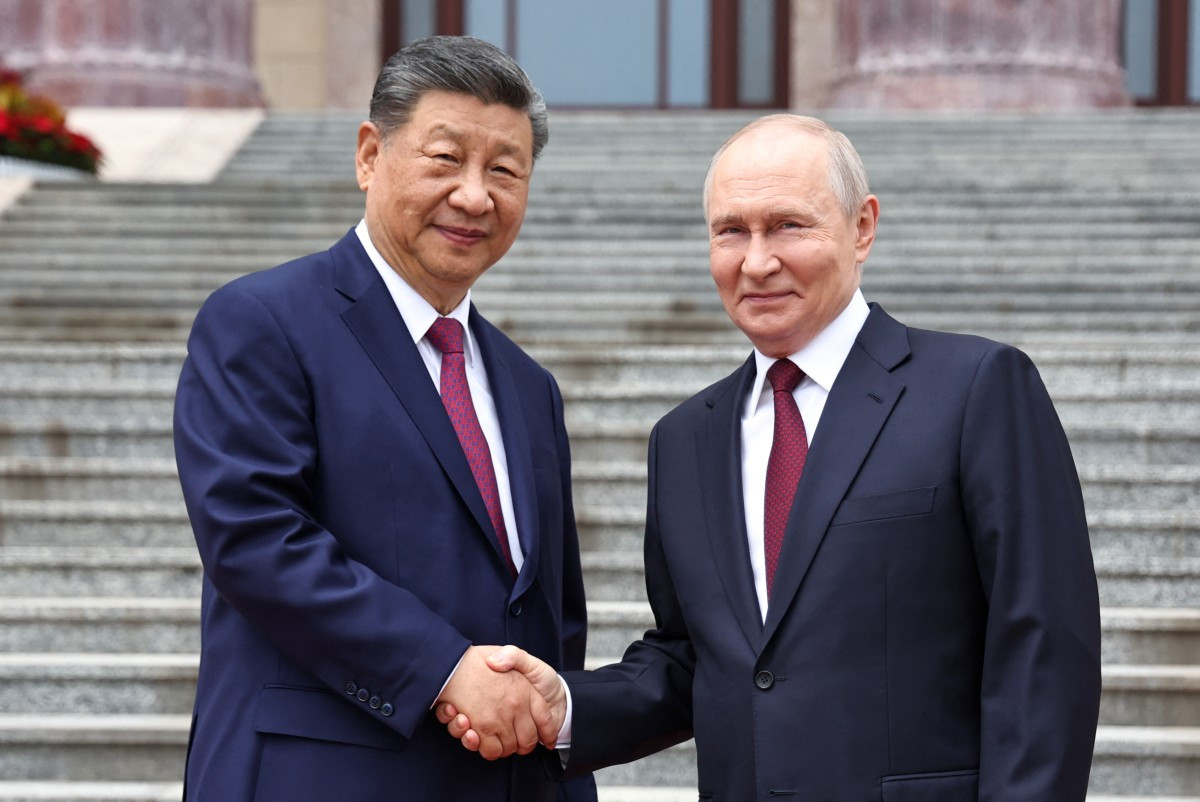 In this pool photograph distributed by the Russian state agency Sputnik, Russia's President Vladimir Putin (right) and China's President Xi Jinping shake hands during a welcome ceremony at the Great Hall of the People in Beijing on May 20, 2026. (AFP/Pool/Alexander Kazakov)
P
resident Xi Jinping hailed China and Russia's "unyielding" ties in talks with Vladimir Putin on Wednesday, as the pair met to underscore their alliance days after Donald Trump's visit to the Asian superpower economy.
After the US president was received with pomp last week but left without major breakthroughs including on help with reopening the Strait of Hormuz, Putin's visit will be scrutinized for tangible takeaways.
Putin is however weakened by years of Russia's war on Ukraine, as sanctions by Western powers put a squeeze on energy revenues and increased Moscow's dependence on China, the main buyer of Russian oil.
The US war on Iran has however hampered crude and gas flows, giving an opportunity to Putin to offer Russian energy sources as an alternative.
Analysts believe that Putin could use the visit to push for progress on the major "Power of Siberia 2" natural gas pipeline from Russia to China through Mongolia – a land alternative to crude imported by sea from the Middle East.
Opening talks in Beijing's opulent Great Hall of the People, Putin and Xi were quick to laud their countries' special ties as they extended their treaty of "friendly cooperation".
Beijing and Moscow have "continuously deepened our political mutual trust and strategic coordination with a resilience that remains unyielding", Xi told the Russian leader, according to Chinese state media.
Putin, meanwhile, told Xi relations had reached an "unprecedentedly high level" despite "unfavorable external factors", without naming any third country, video from Russian media showed.
Xi warned of "unilateral and hegemonic countercurrents running rampant", in a veiled swipe at the United States.
'Old friend'
Xi has played host to a series of world leaders as an increasingly unpredictable United States under Trump pushed many to shore up alliances with Beijing, and the war in Iran has further accelerated the trend.
Russia-China ties have deepened since Moscow launched its invasion of Ukraine in 2022, with Putin visiting Beijing every year since as his country is shunned by Western powers.
Putin's visit promises to be less opulent than Trump's, emphasizing that "the Xi-Putin relationship does not require that kind of performative reassurance", said Patricia Kim from the Brookings Institution in Washington.
Xi welcomed Putin with open arms as an "old friend" when he last visited Beijing in September 2025 – language the Chinese leader did not extend to Trump last week.
Both Putin and Xi view ties as "structurally stronger and more stable" than those between China and the United States, she told AFP.
Read also: Trump touts 'fantastic’ deals with Xi but markets underwhelmed
Beijing has regularly called for talks to end the war in Ukraine but has never condemned Russia for sending in troops, presenting itself instead as a neutral party.
But with Russia reliant on sales to China to sustain its war effort, "Putin does not want to lose that support", Asia Society's Lyle Morris told AFP.
Middle East priorities
When it comes to the US-Israeli war on Iran, though, China and Russia may have different priorities.
Russia has sought to capitalize on the energy crisis and rocketing oil prices spurred by the closure of the Hormuz strait.
Russia's top diplomat Sergei Lavrov had said after meeting Xi in April that Russia could "compensate" for China's energy shortages as the Middle East war hits global supplies.
China, however, wants the Middle East conflict concluded as soon as possible.
Xi underlined in talks with Putin that further hostilities in the Middle East is "inadvisable" as he said a "comprehensive ceasefire is of utmost urgency".
"[China] relies on the freedom of the world's major waterways to sustain its economic activities, and would prefer that the standoff in the Strait of Hormuz end sooner rather than later," James Char of Singapore's Nanyang Technological University told AFP.