The Jakarta Post
Please Update your browser
Your browser is out of date, and may not be compatible with our website. A list of the most popular web browsers can be found below.
Just click on the icons to get to the download page.


Popular Reads
Top Results
No results found. Please check your search term and try again
Can't find what you're looking for?
View all search results
Popular Reads
Top Results
No results found. Please check your search term and try again
Can't find what you're looking for?
View all search resultsIndonesia, US and allies launch annual military drill
Indonesia maintains a neutral foreign policy, what it calls "free and active," as it walks a diplomatic tightrope seeking good relations with both Washington and Beijing.
Change text size
Gift Premium Articles
to Anyone
Share the best of The Jakarta Post with friends, family, or colleagues. As a subscriber, you can gift 3 to 5 articles each month that anyone can read—no subscription needed!
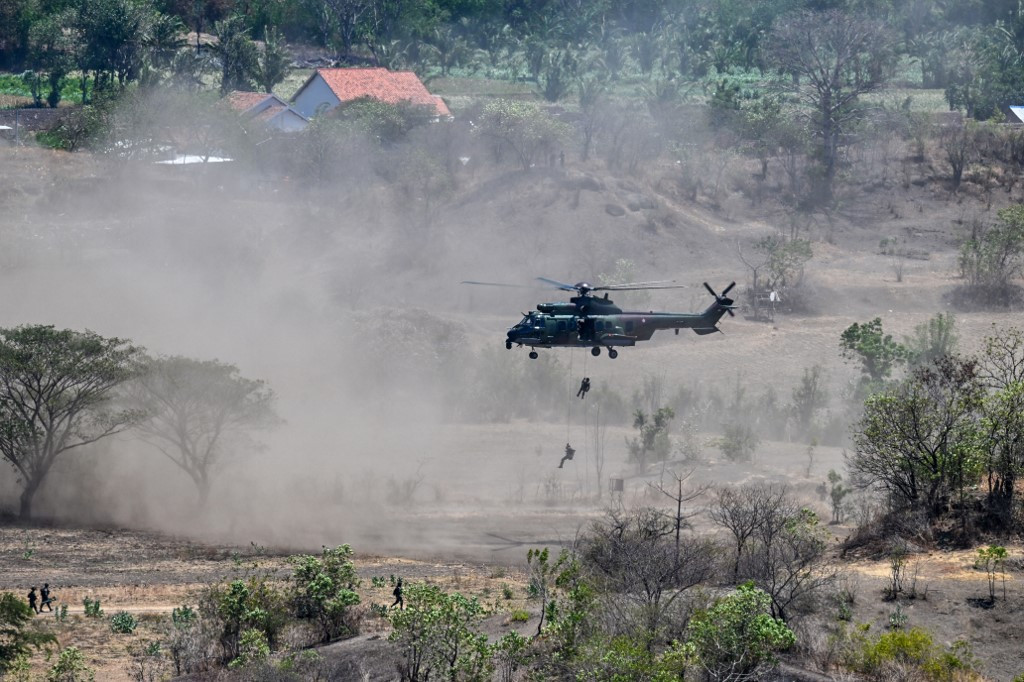 Indonesian Military personnel rappel from the Indonesian Air Force H-225 M Caracal helicopter during the Super Garuda Shield 2024 joint military exercise including Indonesia, Japan, Singapore, Australia, Britain and the US in Situbondo, East Java on September 6, 2024. (AFP/Juni Kriswanto)
I
ndonesia, the United States and more than a dozen allies launched annual joint military exercises Monday to boost defence capabilities and "deter aggression" in the Asia-Pacific region.
Indonesia maintains a neutral foreign policy, what it calls "free and active," as it walks a diplomatic tightrope seeking good relations with both Washington and Beijing.
The country held a joint navy drill with China this month that was blasted by Taiwan as a "provocation".
Indonesia, the United States and certain allies have taken part in the annual drills, known as "Super Garuda Shield", for nearly two decades.
This year's edition will entail 4,700 soldiers from countries including Britain, France and Japan drills in several locations including Sumatra and Kalimantan until September 11.
Timor Leste, Italy, Thailand and other nations have sent observers.
Patrick J. Ellis, commander of the US Fourth Infantry Division, said the exercise was critical for "building the human architecture that keeps the Indo-Pacific safe."
"The security landscape of the Indo-Pacific is complex and readiness cannot be surged when a crisis begins," he said at a military school in Bandung, east of Jakarta, where the drills officially kicked off.
The exercises will include special forces infiltration training and cyber defence drills, Ellis added.
Indonesia elevated its defence cooperation with the United States to that of a "Major Defence Cooperation Partnership" in April.
Ellis said Monday that was a testament to role of the world's third-largest democracy as a "vital anchor to regional stability".
China's foreign and defence ministers travelled to Indonesia this month for talks with their counterparts, agreeing on greater political and military cooperation.
Last week, China and Indonesia agreed to boost military ties and work closely on minerals, energy and technology.
Foreign Minister Wang Yi said both sides agreed to support each other's core interests and will cooperate more in energy and mineral resources.
Resource-rich Indonesia, a $1.4 trillion G20 economy, has vast deposits of nickel, tin, copper, gold and bauxite and is the world's largest exporter of palm oil and of thermal coal, with China among its top buyers.
China dominates investment in Indonesia's nickel processing sector, but recent policy changes, including on exports and tighter mining quotas, have pushed some companies to seek alternative supplies elsewhere.
Later this year, the two countries will hold their own joint military exercises under "Heping Garuda" -- a recurring drill focused on humanitarian assistance, disaster relief and military-to-military cooperation.
Indonesia joined the BRICS bloc of emerging economies last year that includes Russia and China.
But President Prabowo Subianto has also signed a trade deal with US President Donald Trump and joined his so-called "Board of Peace".