The Jakarta Post
Please Update your browser
Your browser is out of date, and may not be compatible with our website. A list of the most popular web browsers can be found below.
Just click on the icons to get to the download page.


Popular Reads
Top Results
No results found. Please check your search term and try again
Can't find what you're looking for?
View all search results
Popular Reads
Top Results
No results found. Please check your search term and try again
Can't find what you're looking for?
View all search resultsIndonesia calls for more transparent cross-border copyright governance at 35-country forum
Change text size
Gift Premium Articles
to Anyone
Share the best of The Jakarta Post with friends, family, or colleagues. As a subscriber, you can gift 3 to 5 articles each month that anyone can read—no subscription needed!
 Set as preferred source
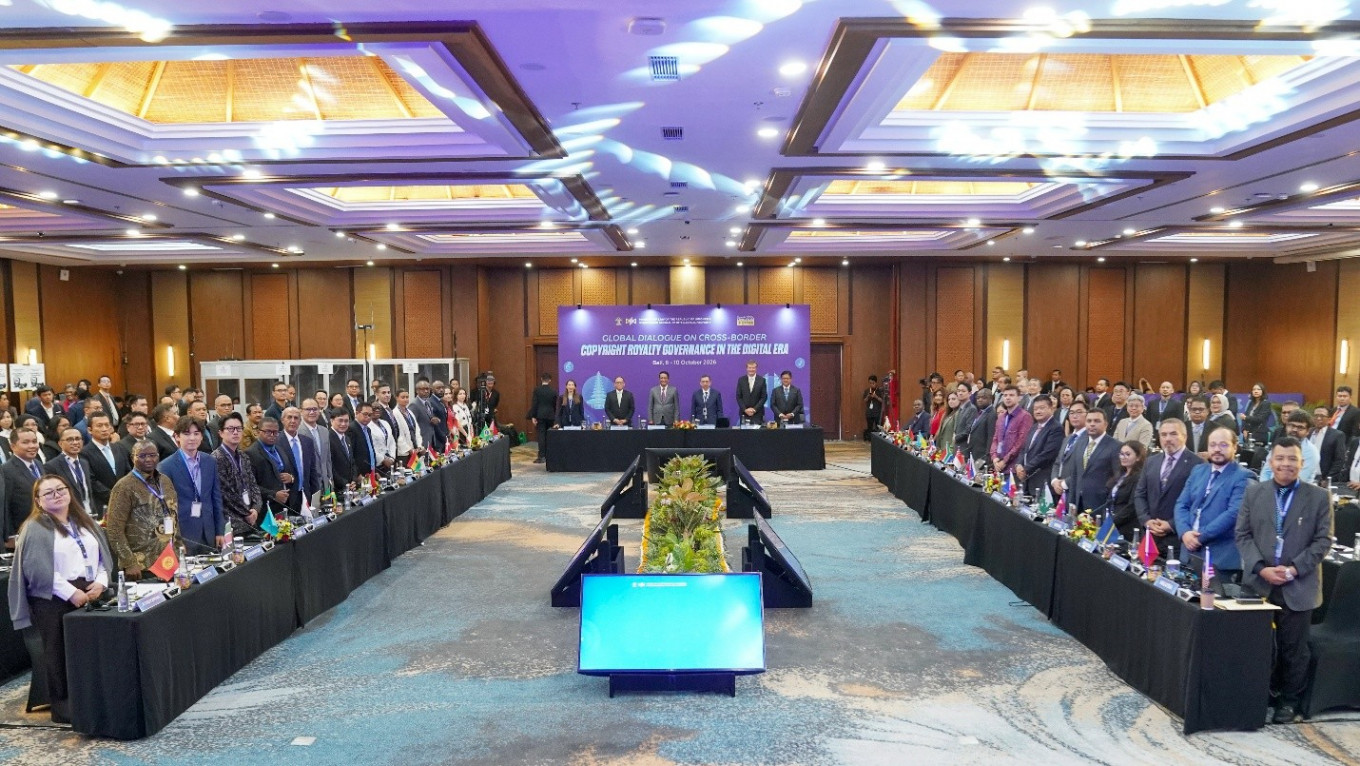 Delegates from 35 participating countries as well as organizations and experts attend the Global Dialogue on Cross-Border Copyright Royalty Governance in the Digital Era, held from Oct. 7 to 9 in Badung, Bali. (Image courtesy of the Law Ministry’s Directorate General of Intellectual Property)
O
n Oct. 7, the Indonesian government assembled delegations from 35 countries, international organizations, collective management institutions, creators, industry players and experts at the Global Dialogue on Cross-Border Copyright Royalty Governance in the Digital Era.
Taking place until Oct. 9 Bali, the forum seeks to discuss three key issues: transparency, accountability and system interoperability.
“Through this global dialogue, we aim to push forward rules and systems together so that copyright royalties can quickly flow between borders, while also being able to note, count and share relevant information transparently, fairly, alongside accountability,” said Minister of Law Supratman Andi Agtas.
The forum brings together member nations of the World Intellectual Property Organization (WIPO), two intergovernmental organizations, six collective management organizations and organizations as well as experts, creators and key stakeholders.
“When intellectual property can be enjoyed in a multitude of countries through digital platforms, royalty governance must also be able to keep up with these developments. Transparency, accountability and an interconnected system are certainly needed to protect creators' economic rights,” Supratman added.
He further explained that cross-border royalty disputes were not simply a matter of copyright laws but also pertained to interagency coordination and information systems. As such, Indonesia was urging international dialogue that could connect the experience and applied practices of various countries without ignoring their respective legal frameworks.
“This forum is a space to build collective understanding and explore practical collaboration. The goal is to ensure that creators and rights holders receive fairer economic benefits from the use of works in the digital environment," the minister said.
Hermansyah Siregar, Director General of Intellectual Property at the Ministry of Law, noted that the issue of cross-border royalties was more related to information exchange than to copyright law.
“Friction in cross-border royalties is rarely a dispute over copyright law. The main challenge is in the exchange of information,” he said.
According to Hermansyah, these problems can arise from the recordkeeping stage and usage reporting to the metadata matching process that links back to rights holders. When these work identifiers are not available, the process of calculating, distributing and reconciling royalties become increasingly complex.
Moreover, data from the International Confederation of Composers and Authors Association show that royalty revenues from copyright organizations worldwide reached 13.97 billion euros (around Rp 278 trillion) in 2024.
Of this, 5.14 billion euros (Rp 103.16 trillion), or 37 percent, came from digital use.
Though these revenues are still concentrated in Europe and North America, the data highlight a critical need to discuss proper governance in this digital realm.
On the international scale, WIPO has driven this mission of proper governance in collective management through publications and technical assistance, which includes practical guidance devices created for management institutions. Additionally, it created the TAG of Excellence initiative, which measures transparency, accountability and governance.
All this has done in the hope of being developed alongside key stakeholders, so that it can be further applied with professional rules and regulation standards applicable to WIPO member states.
In Indonesia, the copyright framework was established through Law No. 28/2014 concerning Copyright, which also includes a national framework for collective management. Furthermore, Government Regulation No. 56/2021 covers the Management of Song and/or Music Copyright Royalties, which regulates the framework for collecting and distributing royalties.
This regulation in particular manages the song and music database managed by the Directorate General of Intellectual Property and the Song and/or Music Information System (SILM), supporting the recording of works and usage data as well as the distribution of royalties.
Indonesia is also developing the Song and Music Data Center (PDLM) and an information system that can connect with the global royalty system.
"Interoperability simply requires systems that can communicate reliably. Currently, many developing markets lack the IT infrastructure to process large amounts of digital data," Hermansyah said.
Indonesia previously submitted a proposal on royalty governance, known as the Indonesian Proposal, to the WIPO Standing Committee on Copyright and Related Rights (SCCR).
The discussion will continue at the SCCR, while the global dialogue in Bali provides a space to exchange experiences and identify practical solutions that can be developed voluntarily.
"Technology has democratized the distribution of musical works. Our task now is to ensure our governance structure democratizes remuneration for these works," emphasized Hermansyah.