The Jakarta Post
Please Update your browser
Your browser is out of date, and may not be compatible with our website. A list of the most popular web browsers can be found below.
Just click on the icons to get to the download page.


Popular Reads
Top Results
No results found. Please check your search term and try again
Can't find what you're looking for?
View all search results
Popular Reads
Top Results
No results found. Please check your search term and try again
Can't find what you're looking for?
View all search resultsM4CR holds Livelihood Field School, encourage crab farmers to protect water quality
Change text size
Gift Premium Articles
to Anyone
Share the best of The Jakarta Post with friends, family, or colleagues. As a subscriber, you can gift 3 to 5 articles each month that anyone can read—no subscription needed!
 Set as preferred source
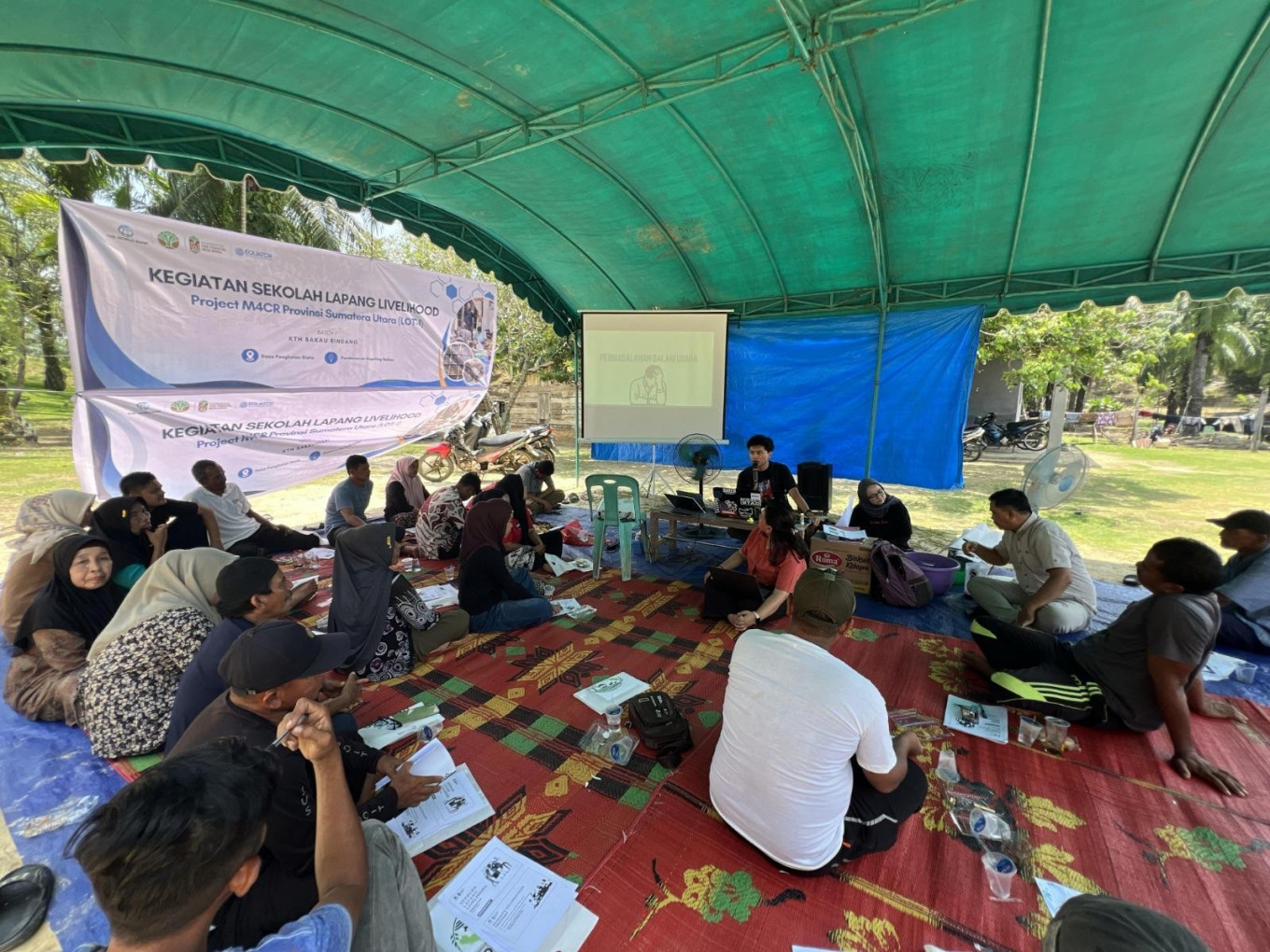 M4CR Livelihood Field School Training in Pangkalan Siata Village, North Sumatra. (Image Courtesy of The M4CR Project) (..)
T
he Ministry of Forestry’s Mangroves for Coastal Resilience (M4CR) organized a Livelihood Field School that encourages dialogue between farmers and facilitators in order to improve local livelihoods by addressing needs identified in the field. The program was attended by 32 members of Forest Farmers Groups (KTH) Bakau Rindang and Bakau Bahari in Pangkalan Siata, North Sumatra.
The program is a response to concerns set forth by KTH farmers that have faced challenges in crab farming in silvofishery ponds, where crab mortality rates are higher than in ponds without mangroves. The situation has raised concerns about the sustainability of their farming businesses.
The M4CR program aims to strengthen mangrove restoration while taking into account local communities’ social and economic needs. One of its approaches is silvofishery, a system that combines aquaculture with mangrove planting or conservation within the same pond area.
During the session, participants learned how to measure the pH and salinity of pond water. The results showed that water quality in the groups’ pond did not meet the optimal conditions for crab farming. The program’s findings indicated that high crab mortality was linked not to the presence of mangroves but to imbalanced water chemistry that could not be detected through visual observation alone. The session aimed to encourage participants to pay closer attention to pond water quality.
Aditya Wahyu Putra, PPIU Manager for M4CR in North Sumatra, emphasized that mangrove restoration must go hand in hand with improving local communities’ livelihoods.
“Mangrove restoration cannot stop at simply planting trees. The community must also reap the economic benefits. Therefore, through this Livelihood Field School, we are engaging farmers in dialogue and helping them learn directly from the challenges they face in their ponds. By understanding water quality, we hope that crab farming in silvofishery ponds can be sustainable and go hand in hand with mangrove conservation,” he said.
Beyond technical training, participants also took part in business analysis sessions using SWOT analysis and the Business Model Canvas (BMC). These sessions introduced strategies for marketing crab harvests and strengthening farmer groups. At the end of the program, participants developed six-month action plans to improve pond management and farming practices.
Through this follow-up plan, the group is expected to ensure the conservation of mangroves while also boosting the economy and food security of coastal communities. This marks the first step toward self-reliance for the community of Pangkalan Siata, where mangrove conservation and farmer’s well-being can go hand in hand.
The Mangroves for Coastal Resilience (M4CR) Program is a national strategic initiative aimed at addressing the degradation of mangrove ecosystems in Indonesia through large-scale rehabilitation that focuses on community-based approaches and environmental sustainability. The program is managed by the Ministry of Forestry through the Directorate General (Ditjen) of Watershed Management and Forest Rehabilitation (PDASRH), with support from relevant ministries and institutions. M4CR aims to rehabilitate 32,634 hectares of mangroves in four priority provinces: Riau, North Sumatra, East Kalimantan and North Kalimantan by 2027. The program promotes the “Mangroves for the Future” campaign.